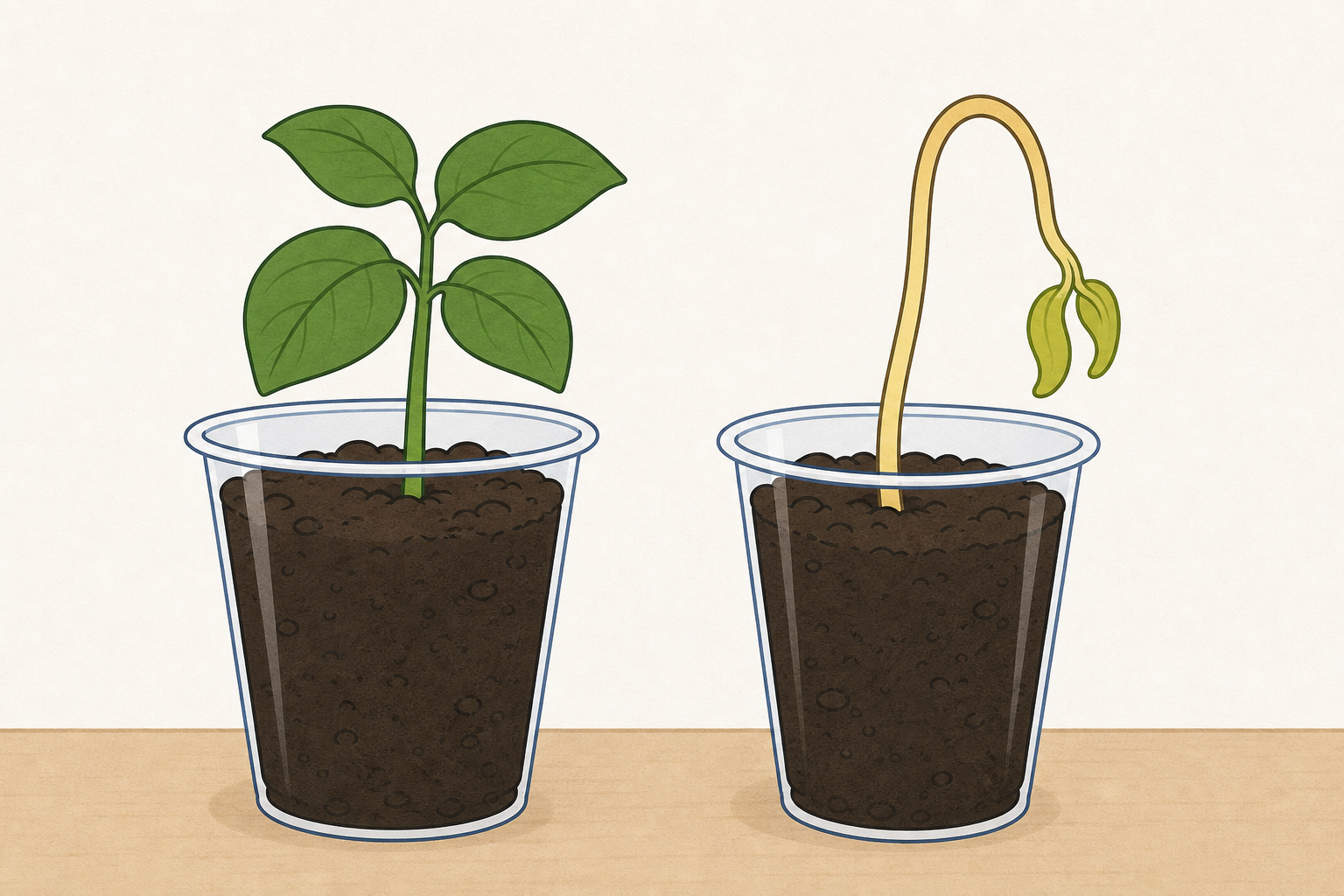
Look at the plants you set up earlier in this project. Which ones look healthy and which ones look weak or unwell? What do you notice before we measure anything?
Bring the class plants and watching logs to the front or leave them at group tables so every child can see both conditions side by side. Keep the hook light: curiosity first, measuring later.
Key questions: Which plant looks greener? Which looks fuller or stronger? Does anything look wilted, pale or leggy?
STEM eyes: link briefly to the school garden or windowsill plants: light and water shape how plants grow around us every day.
Have rulers ready but do not hand them out yet.
Note on height: a healthier plant is greener and fuller, not always taller. Dark-grown seedlings can grow long and spindly while still looking weak, so do not treat "taller" as the only sign of growing well.
Today's focus word is evidence: what we saw or measured that helps us answer our question.
What did we ask earlier in this project, and what did you predict would happen?
Revisit the class question from Part 1 without calling it a fair test. Typical questions: what happens to a plant without light, or without water. Invite a few children to read their earlier prediction from the watching log.
Keep the board light: only the word evidence with a short child-facing meaning. Weave condition orally while pointing at the two real plant set-ups ("one condition was light on the windowsill; the other was the dark press"). Do not pre-teach "what plants need" as a vocabulary block; that is the conclusion the class will build from today's evidence.
| Concept | Why it matters | Example |
|---|---|---|
| Evidence — what we carefully saw, measured or recorded that helps us answer our question | Scientists trust what the plants show us more than a lucky guess | The windowsill plant is greener and fuller than the one kept in the dark |
| Condition — one of the two ways we grew our plants so we could compare them | Comparing two conditions helps us notice what made the difference | With light on the windowsill, or without light in the dark press |
Misconception to head off: children may say the weaker plant is "bad" or "dead". Frame it as useful evidence: the difference tells us what the plant needed.
Predictions are never wrong; they are the start of the science. Unexpected results still count as evidence.
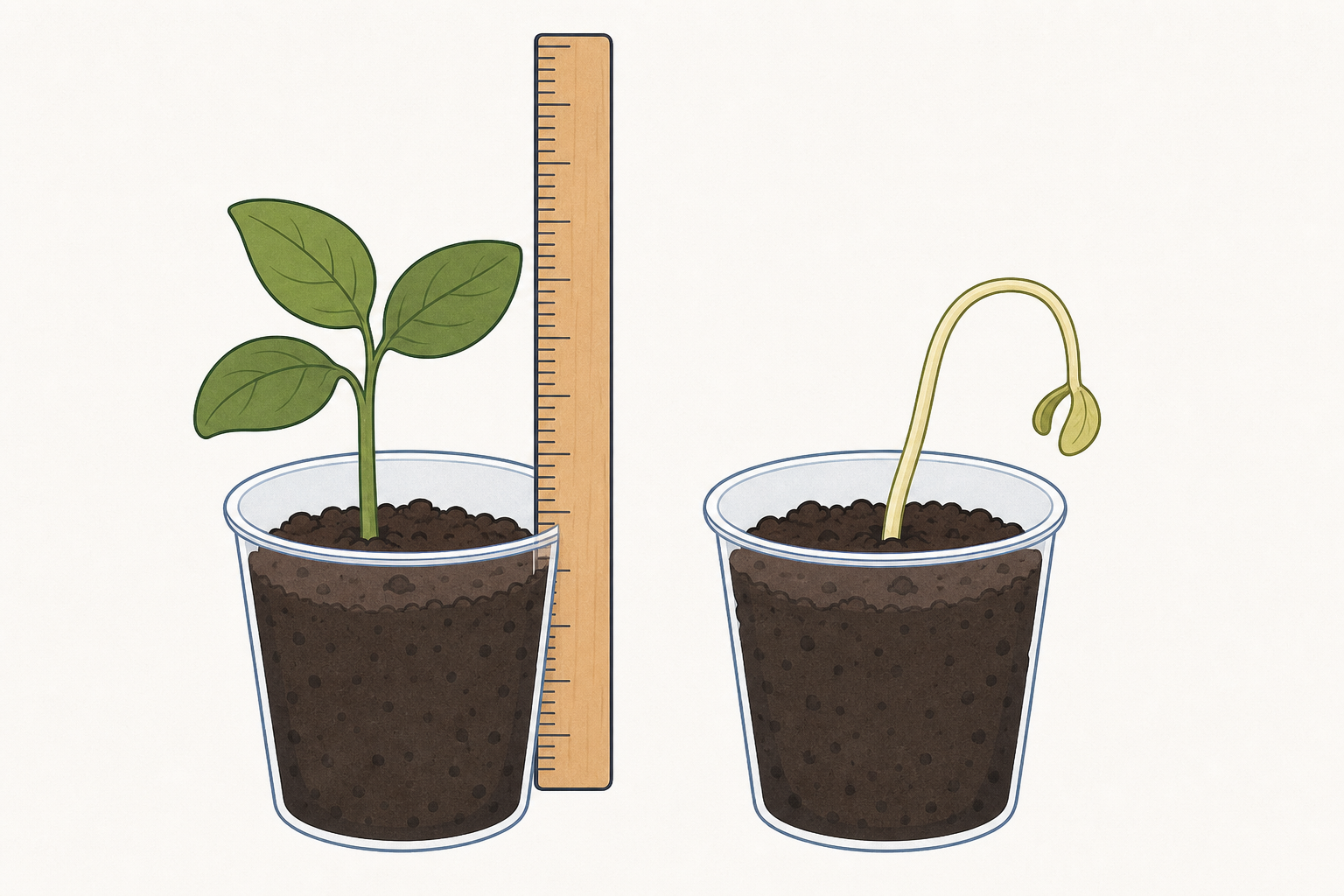
With your group, look carefully at both plant cups: the one that grew in one condition (for example on the windowsill) and the one that grew in the other condition (for example in the dark press). Use a ruler to measure how tall each plant is in centimetres. Write both heights on your watching log straight away so you do not forget them. Notice colour, leaves and stems as well as height. Talk about what is the same and what is different.
Place both conditions at each group table with the group's watching log. One ruler per group. Children measure from the compost or cotton wool surface to the tip of the tallest shoot.
Model one careful measurement at the front first: stand the ruler straight, read the number in centimetres, say it aloud. Then groups work together. Before they leave the tables, every group must write both condition names and both heights on the watching log (or one shared group strip if logs are scarce). Circulate and ask: which condition looks healthier, and what else do you notice besides height?
If you only have one shared class set (the low-cost substitute on the front table): keep both cups at the front. Call groups up in short turns to measure while the rest of the class watches. Fold watchers in with teacher questions ("What do you notice about the colour? Do you think this one will be taller or shorter?"). A runner from each group writes that group's two heights on a strip or watching log before the next group measures, so step 4 call-outs are still read from paper, not from memory.
What to expect: plants with light (or with water) are usually greener and fuller, with stronger-looking stems and clearer leaves. Plants without light are often pale and leggy; they may be shorter or longer than the light-grown plant, but they look weaker. Plants without water may be wilted, dry or barely grown. Use colour, stem thickness and leaf development as well as height. If the dark plant is taller, that is still useful evidence of missing light, not proof that dark is better. If both look similar, talk honestly about that: maybe both got some light, or the time was short. Evidence still matters.
Look-fors:
Differentiation: less confident groups can match picture words (green/pale, full/thin) before measuring. Confident groups can note leaf count or stem colour as well as height.
Safety: wash hands after handling plants and compost; do not taste seeds or soil. Support the cup when measuring; do not pull leaves or poke fragile shoots. Sight only is enough if a group is unsure.
Each group will call out both conditions and how many centimetres tall each plant is. We will put the heights on the board together.
Then we will look at the chart. Which bars are tallest or shortest?
Which plants grew better, and how can we tell from the bars and from looking? Remember: we also use colour and how full the plant looks, not only which bar is tallest.
Drive the data-recorder interactive on the IWB. Two columns appear: Condition and Height (cm). Keep entry brisk: one runner per group reads both heights from the watching log while you type. Every group reports both conditions, so two rows per group. Use clear condition names such as windowsill light, dark press, watered or no water, matching whatever the class chose earlier in this project.
After the rows are in, show the bar chart. Ask the whole class: which bars are tallest? Which are shortest? Does the height pattern match what we saw with our eyes about colour and fullness? Remind them that greener and fuller still matter even if a pale plant is long and spindly.
If a plant did not grow: record 0 cm and treat it as real evidence, not a failure.
Fold everyone in: when one group is calling numbers, ask the others whether those heights fit the pattern so far.
On your Investigation Journal page, do two jobs. First, draw or label the two plants, write how tall each one is, and note one other difference such as colour or leaves. Then write one short sentence about what plants seem to need to grow well, using what you noticed.
Pupils complete the Investigation Journal page during this beat. Keep the load in two clear jobs: (1) draw or label both plants with heights plus one non-height difference (colour or leaves), (2) one short conclusion sentence about what plants need. Do not demand a full written essay.
Sentence starters to say aloud (not to invent as printed boxes): I observed… The plant with… looked… I think plants need… because…
Check that conclusions link to evidence from the watching log and today's measurements and observations, not only to a remembered fact from a book.
Differentiation: some children draw and label with a single colour word; others add a fuller sentence. Scribe a key word for anyone who needs it.
You're previewing this lesson. Get full access to this lesson and hundreds more — each one ready to teach, with interactive activities, printable resources and pupil progress tracking built in.