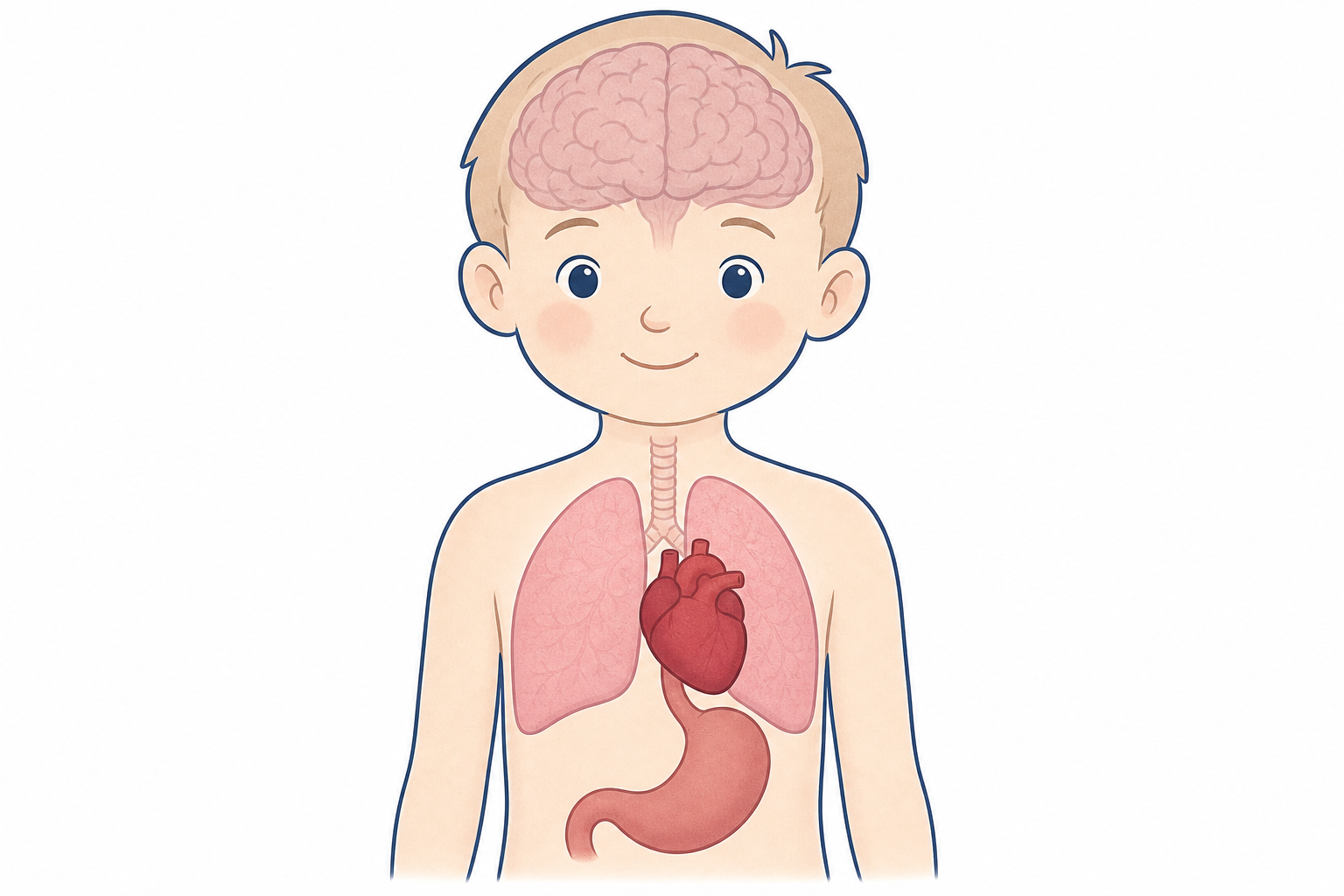
Right now, sitting still, your body is still busy. What jobs do you think it is doing this second?
Hands up one job you can name. We will find out how those jobs are run by teams inside you.
Keep this light: a curiosity beat only. Do not hand out cards or name the five systems yet.
Collect three or four pupil ideas (breathing, heart beating, digesting lunch, thinking, moving). Affirm every sensible job.
Nature of STEM: say that this is what biologists and doctors do. They investigate how the body works so they can keep people healthy. This year we will practise thinking like them: noticing, sorting, and explaining.
Key question: If your body has so many jobs, how does it organise them?
Today's words: organ — a body part with one clear job. body system — a team of organs that share one big job.
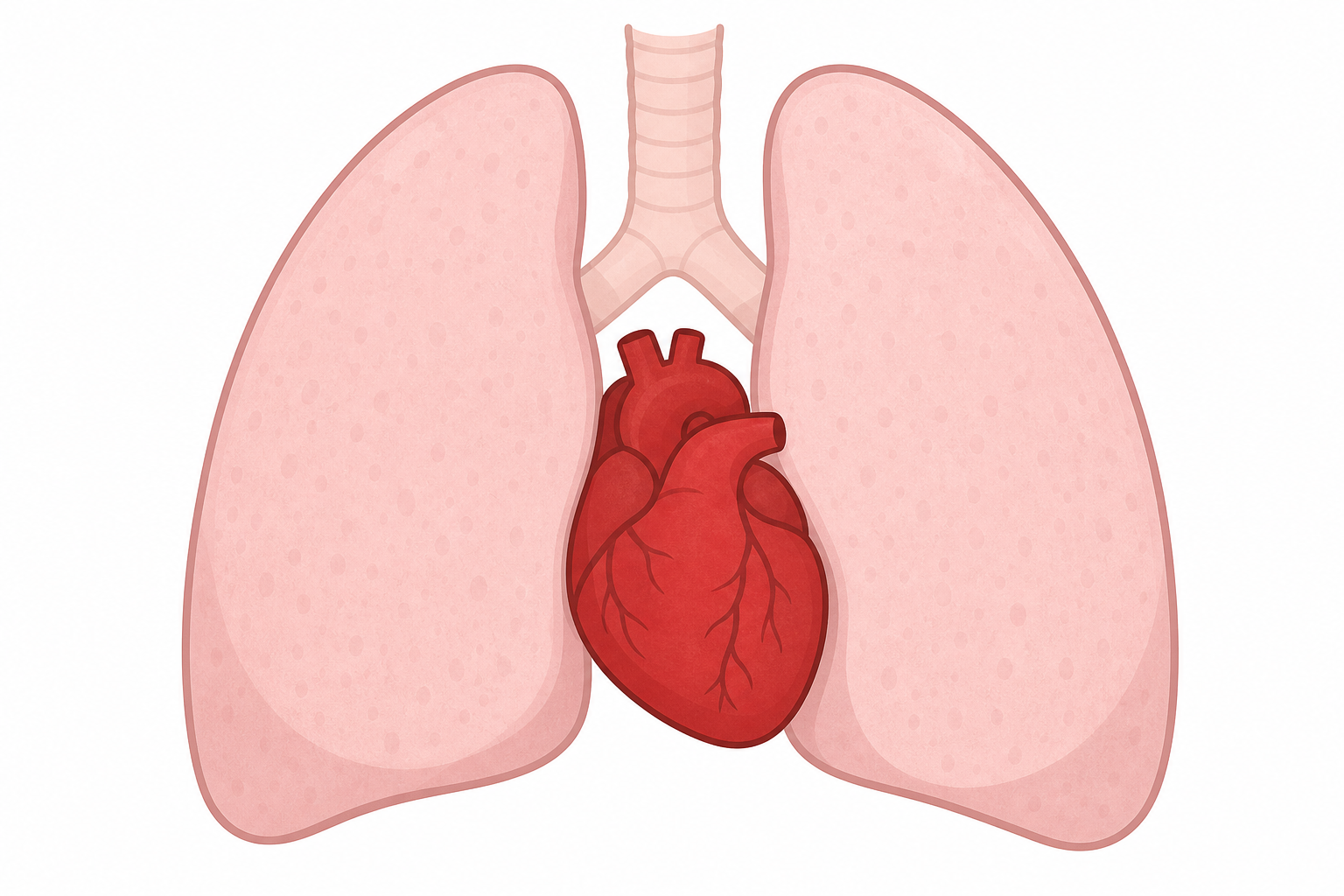
Watch this example with the heart card. The heart's job is to pump blood around the body. Even though it sits in the chest near the lungs, we sort it by that pumping job, not by where it sits.
When we sort organs, we sort by the job the team does, not by where the organ sits in the body.
Project only the short board text: the two definitions, the heart worked example (job, not place), and the job-not-place rule. Do not list the five team names yet and do not place any card on a mat; the mats and team names appear together in the next step.
| Concept | Why it matters | Example |
|---|---|---|
| Organ — a part of the body with one clear job | Naming the organ and its job is the first step to understanding how the body works | The heart's job is to pump blood; the stomach's job is to churn food |
| Body system — a team of organs that work together on one big job | Doctors and biologists group organs by the job they share, which helps them understand health and illness | Lungs and windpipe belong to the Breathing team because both help bring oxygen in |
| Working together — systems hand work to each other so the whole body stays healthy | No system works alone; if one slows down, others feel it | Breathing takes in oxygen, Circulation carries oxygen and nutrients from food, and Movement uses both when you run |
Misconception to head off: pupils often sort by body position (chest things together, tummy things together). The rule is the job, not the place. Say it aloud before the sort.
Worked model (say this; do not place a card on a mat yet): Hold up the heart card only. I wonder how we will decide which team this belongs to. Think aloud: The heart's job is to pump blood around the body. We will not put it with the lungs just because they are neighbours in the chest. We sort by the job. Put the heart card back with the set. In the next step, when the five team mats are out, model placing the heart on Circulation as the first move.
Here are our five teams: Breathing (brings oxygen in), Circulation (moves blood around), Digestion (breaks down food), Movement (bones and muscles that move us), and Control (brain and nerves that send messages and control what the body does).
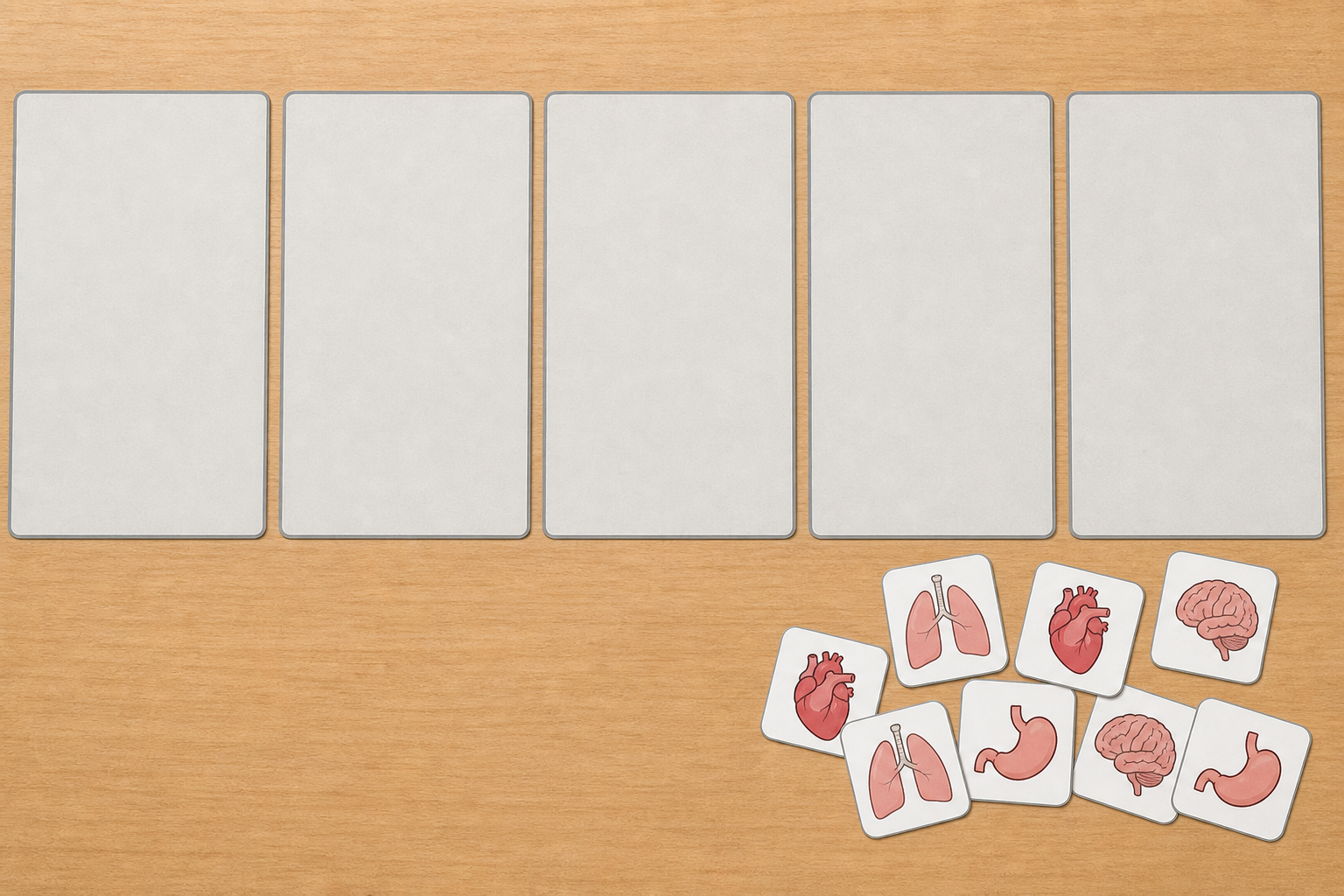
In your group, sort every organ card onto one of the five team mats. Read the job on each card. Put the card with the team that does that job. If you disagree, say why before you place it.
Print the provided organ cut-out sheet (one set per group) and the five team-mat header cards (one set per group). Cut the organ cards apart in advance, or have an adult cut while you open the lesson. Do not use a body silhouette: that teaches position, not team job.
As you hand out the mats, name the five teams on the board (or point to the header cards) so the job-not-place rule from the last step sits next to the action. Model the first placement aloud: hold the heart card, restate its job (pumps blood), and place it on the Circulation mat. That is the pattern groups will use.
Circulate. If a group puts the heart with Breathing because it is in the chest, ask: What job does the heart actually do? Guide them back to the job sentence on the card.
Differentiation: less confident groups may start with four cards only (lungs, heart, stomach, brain). Confident groups can write one extra organ they know on a blank slip and place it, ready to justify.
Extra-organ steer (teacher only): Liver → Digestion (makes bile to help break down food) is the justification to accept at this level. Skin is not one of today's five teams — praise the thinking and park it for later.
Look at the interactive on the board. Ten organ cards appear: lungs, windpipe, heart, blood vessels, stomach, intestines, bones, muscles, brain, nerves.
Call out which team each belongs to: Breathing, Circulation, Digestion, Movement or Control. We will place them together and check our table sorts.
Drive the sorting-tree interactive in explore mode on the IWB. The ten items and five group zones match the physical cards. Pupils do not need devices.
Work through disputed cards first (heart is the classic one). After each placement, ask a different pair: Do you agree? What job sentence proves it?
If a group's table mat disagrees with the board, they may move one card and say what changed their mind. That is good science talk, not a fail.
What good looks like: pupils justify with the job ("pumps blood, so Circulation"), not with body maps ("it's near the lungs").
On your Investigation Journal page, make a quick record of the sort we agreed.
Fully label three teams: write the team name, the big job it does, and the organs that belong in it. For the other two teams, write the team name and at least one organ each. Use your sorted cards to help you.
When your group has three full teams down, hand your mats to the front so we can use them next.
This is the paper journal beat. Pupils draw and label; they do not type into the platform. Frame it as locking in the agreed sort from the mats, not redrawing the whole activity from scratch.
Default product (on the board): three fully labelled teams plus the other two named with at least one organ each. That is the expected finish, not only a time-short fallback, so a complete-enough page is realistic if steps 3–4 ran long.
Look for: three full teams with a short job line and matching organs (lungs and windpipe under Breathing; heart and blood vessels under Circulation; stomach and intestines under Digestion; bones and muscles under Movement; brain and nerves under Control), plus the remaining two teams named with at least one organ.
Encourage simple diagrams or labelled boxes rather than a full body outline. A body outline pulls them back toward position instead of team job.
Mats for step 6: as soon as a group has three full teams recorded, collect their five team-mat headers (organ cards can stay bagged at the table). Do not wait for slow finishers before reclaiming mats; early groups' mats can form the front row for the next beat.
Early finishers: add one arrow between two teams and write how one hands work to the other (preview of the next step).
You're previewing this lesson. Get full access to this lesson and hundreds more — each one ready to teach, with interactive activities, printable resources and pupil progress tracking built in.