Think about the last thing you ate. Where does that food go after you swallow? Does it just sit in one place, or does it travel?
Today we follow food on a one-way journey through the body, and we find out what squeezes it along.
Keep this light: one curiosity question only. Do not lay out the rope or name every organ yet. Hands up for quick ideas, then move on. If someone says the stomach does everything, smile and say we will test that idea with a real model.
Before the lesson: print the provided organ cards (one set per group); clear floor lanes for the gut model (see Build the gut rope step); have the soft fabric tubes and soft balls ready but out of sight until the model beat.
Today's big idea: the digestive system is the team of body parts that break food into useful bits and send waste on its way. Food takes a one-way journey: it travels in order and does not jump backwards.
Food goes in at the mouth, and what is left over leaves at the far end. What do you think it travels through in between, and in what order?
The main stops are mouth, oesophagus (say it ee-SOF-uh-gus), stomach, small intestine, and large intestine.
Project only the short board lines above (digestive system, one-way journey, the five stop names, and the oesophagus say-it cue). Hold the word peristalsis until groups have squeezed the fabric tube in the next step. Use the full table yourself.
| Concept | Why it matters | Example |
|---|---|---|
| Digestive system — the team of body parts that break food into tiny useful bits the body can use, and send leftover waste on its way | Knowing the team helps you understand why each organ has a different job after lunch | Your mouth chews a sandwich; then the rest of the system squeezes it along and useful bits pass into the blood while waste continues |
| One-way journey — food travels in one direction only, through each part in order | If the order is wrong, the model cannot show how the body really works | Mouth, then oesophagus, then stomach — never stomach first |
| Peristalsis — a wave of muscle squeezes that pushes food along the tubes (introduce after the fabric-tube feel) | Food does not fall by gravity alone; the tubes actively move it | A soft ball pushed through a fabric tube moves because of squeezes, not because it slides by itself |
| Oesophagus — the food tube from mouth to stomach (ee-SOF-uh-gus) | It is the bridge between swallowing and the stomach's mixing work | When you swallow water, the oesophagus carries it down even if you are leaning back |
Worked prediction (do this aloud before groups work): I wonder which stop comes after the mouth. I predict the oesophagus, because food has to travel down a tube. I test by placing the mouth card, then the oesophagus card, on the rope. I observed that the stomach card only makes sense after the tube. I think the journey is a fixed order, so every group should match that sequence.
Misconception to head off: children often think the stomach is the whole story, or that food falls down. Save the active-squeezing idea for the fabric-tube model, then name it peristalsis.
If someone mentions being sick: acknowledge calmly that when we are unwell the body can push food back up the wrong way. The everyday journey we are modelling today is still one-way, from mouth to large intestine. Do not open a long discussion; return to the model.
Keep language gentle: break down, useful bits, waste on its way — no surgery or injury framing.
In your group, stretch the rope into one long gut on the floor. Place the organ cards in the order food travels. Read each card aloud as you set it down.
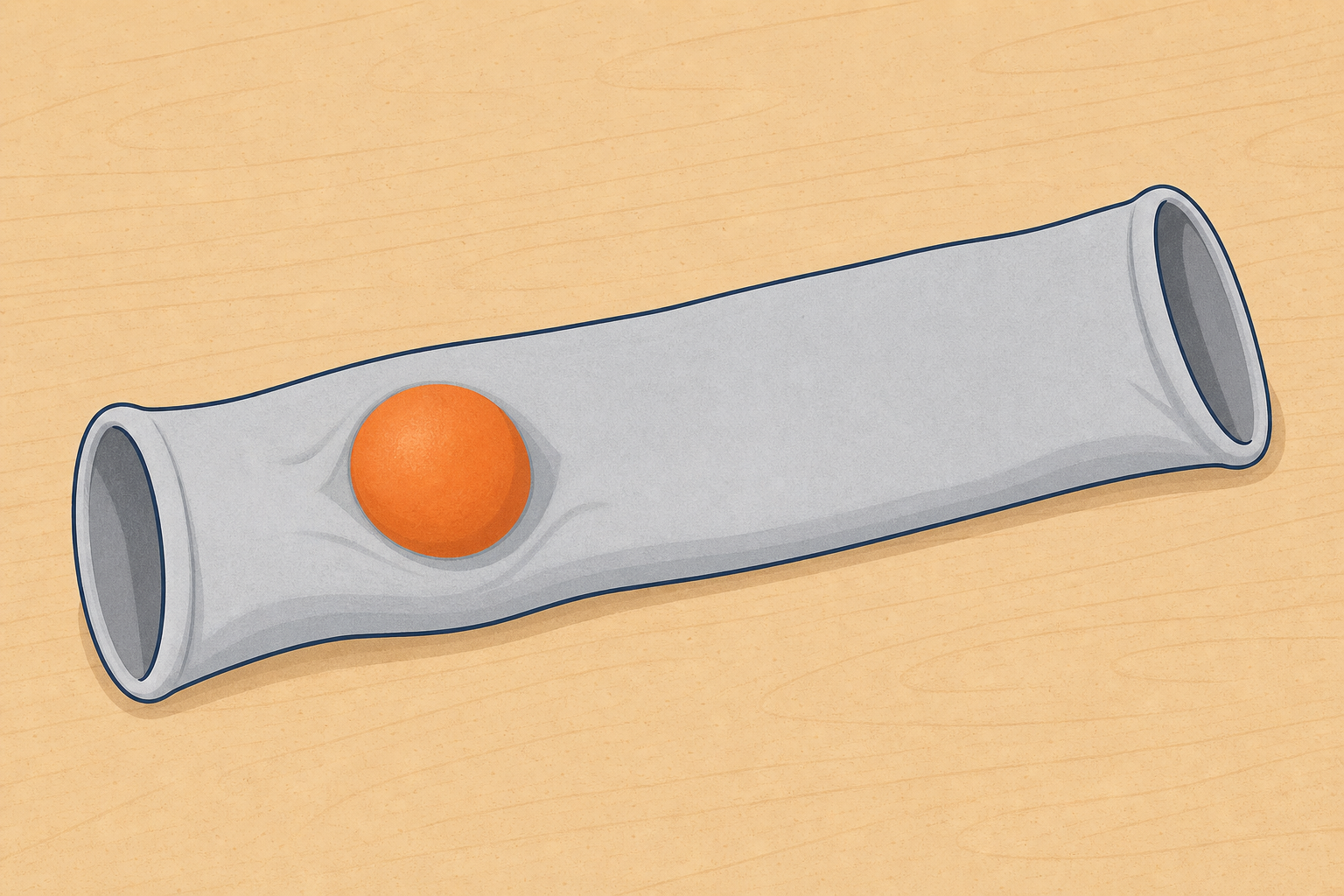
Then take turns gently pushing the soft ball through the fabric tube. Feel how squeezes, not gravity alone, move the ball. That wave of squeezes is called peristalsis.
A full set of long gut ropes will crowd a typical classroom. Stage the room first:
One rope, tape line, or long string per group; one set of five organ cards; one soft fabric tube (long sock or fabric sleeve is the classroom default); one small soft ball.
Card A — Mouth: Food is chewed and mixed with spit. Teeth break big pieces into smaller ones so the journey can begin.
Card B — Oesophagus: A soft tube that carries each swallow from the mouth down to the stomach.
Card C — Stomach: A stretchy bag that squeezes food and mixes it with juices so it becomes a soft mash.
Card D — Small intestine: A long, coiled tube where most of the useful bits of food (like energy from your sandwich) pass into the blood for the body to use.
Card E — Large intestine: Water is taken back into the body here. What is left becomes waste ready to leave.
Mouth → oesophagus → stomach → small intestine → large intestine. Walk the line and ask watchers: Are they right? What would come next?
Hold the fabric tube almost level. A pupil squeezes behind the ball so it moves forward in waves. Ask: What is doing the work — sliding, or squeezing? Only now name the word peristalsis and link it to the feeling in their hands.
Differentiation: if a group finishes early, challenge them to point to where useful bits enter the blood and where water is taken back. If a group is stuck, give only the first and last cards and ask them to fill the middle.
Look-fors: cards in correct order; children saying squeeze or push when describing the tube; someone correcting a jumper card using the one-way idea.
End of this step: leave ropes and cards in place for the short whole-class job check that follows. Do not coil yet.
Stay by your rope. We are checking two important jobs, not rebuilding the order yet.
Small intestine: useful bits (like energy from your sandwich) mainly pass into the blood here.
Large intestine: water is taken back into the body here.
Point on your rope to the blood-entry stop. Point to the water take-back stop. Do both match the order mouth → oesophagus → stomach → small intestine → large intestine?
This is a standing whole-class check with ropes still down. There is no board interactive on this beat: pupils answer by pointing at their own floor model while you project or say the two job lines above.
Call out each cue clearly so groups that rushed the card read-aloud still have the job language on screen:
Ask one or two groups to justify why those stops cannot swap places. Keep it brisk (about four minutes).
After the check, clear the floor before the board rebuild: coil ropes, stack organ cards, put tubes and balls on the side table. Pupils return to seats so walkways are clear and attention is on the IWB only. Do not leave apparatus out during the next beats.
Look carefully: the journey on the board starts with one stop in the wrong place on purpose. Call out which card has jumped, and say why that order cannot happen in a real body. Help put the five cards right: mouth, oesophagus, stomach, small intestine, large intestine.
When the order is fixed, talk about peristalsis: remember the fabric-tube squeeze — that wave pushes food along the whole chain, not at one stop only.
Open the same flow-builder in explore mode. Before pupils drag anything, place one card deliberately wrong (for example stomach before oesophagus, or large intestine before small intestine) so the visible job is catch-and-justify, not another plain rebuild of a correct chain.
Invite pairs to the board while the class checks: Are they right? What comes next? Why can that card not sit there? Press for one-way journey reasons, not silent swaps.
The interactive only handles card order. Do not ask pupils to "show peristalsis" on the board. After the sequence is correct, lead a short talk that links the arrows back to the fabric-tube model: the squeeze runs along the whole path between stops.
End by restating: the board shows order; the tube showed the muscle wave that moves food forward.
You're previewing this lesson. Get full access to this lesson and hundreds more — each one ready to teach, with interactive activities, printable resources and pupil progress tracking built in.