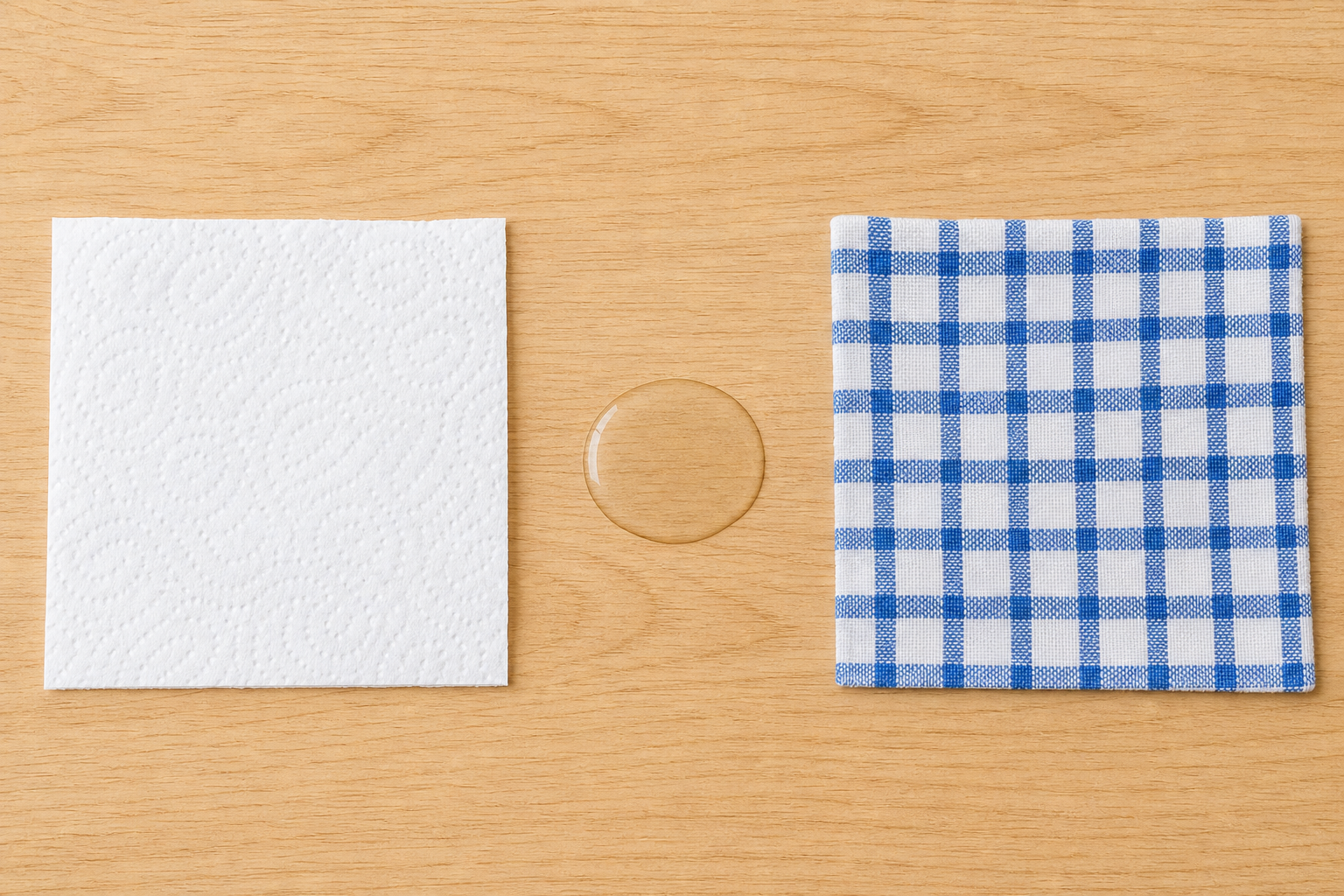
Watch carefully. A little water lands on the bench. Which cloth will soak up more: the paper towel or the tea towel?
How could we find that out fairly, so the comparison is honest?
Have a small jug of water, one piece of paper towel and one tea towel (or similar cloth) ready to show. Dab a small spill with each cloth in turn. Do not set out the full fair-test kit yet.
Take two or three quick ideas from the class about fairness (same size, same amount of water, same time). Do not correct every answer; this beat is curiosity only.
Nature of STEM: scientists compare materials with a fair method so their evidence can be trusted, not just a quick dab that favours one cloth.
Our question: Which material soaks up the most water?
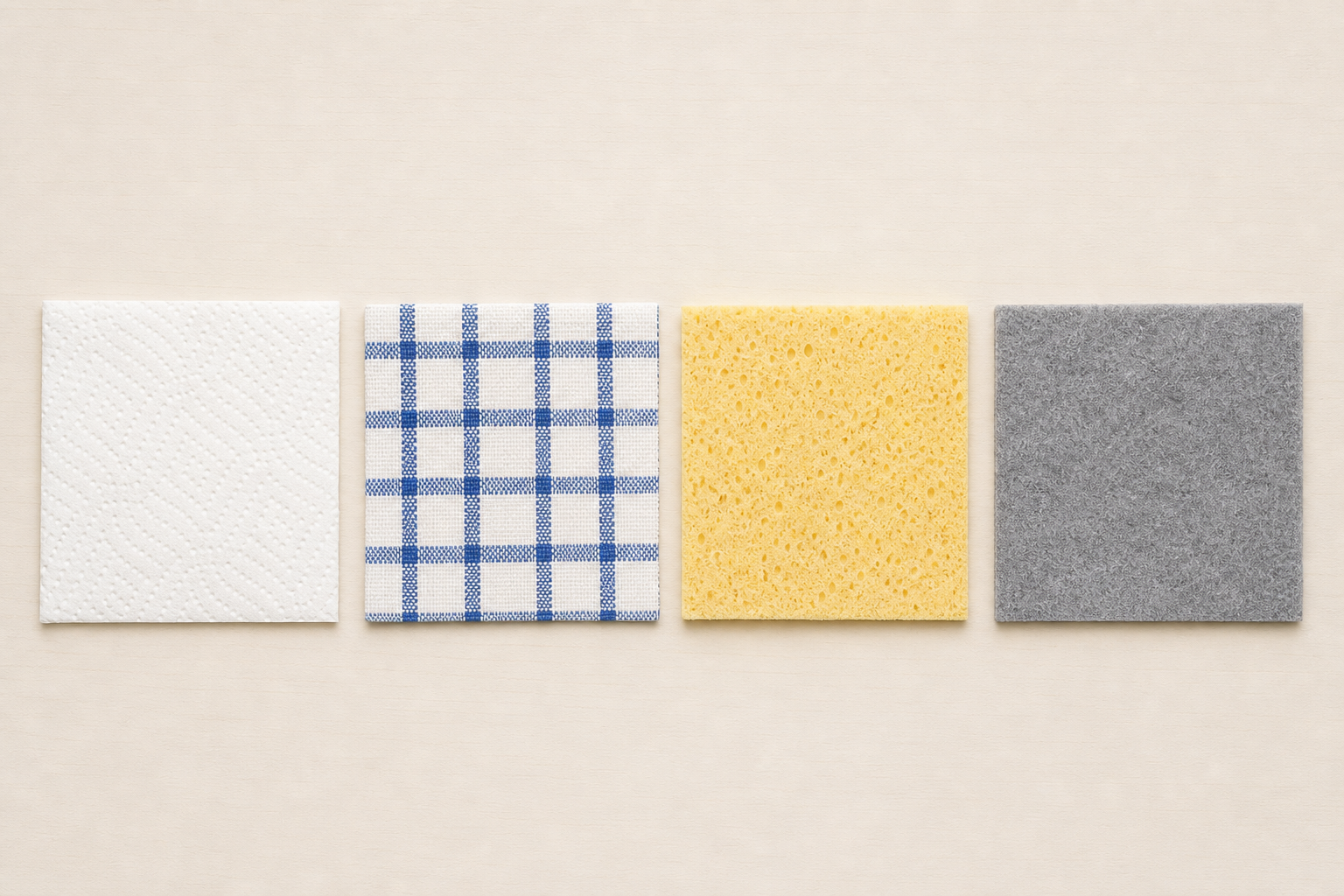
Look at the materials we will test. Whisper to your partner which one you think will hold the most water, and say why. Predictions are the start of the science, not a guess to get right.
Show the four materials the class will test: paper towel, cotton, felt and nylon (or your chosen set), all cut to the same size. Keep them dry for now.
Key questions:
Invite a range of predictions. Note one or two reasons on the board in the pupils' words. Do not reveal which material is expected to win.
Differentiation: less confident pupils can point and give one word reason ("thicker"); others can link feel or everyday use ("kitchen roll is made for spills").
We'll sort five cards on the board together: the material, how much water it holds, amount of water offered, size of each piece, time it sits. Call out whether each one is Change, Measure, or Keep the same.
As we place them: a fair test changes only one thing and measures one result; absorbency is how much liquid a material soaks up; an average is a sensible figure from more than one reading.
Then complete your Investigation Journal page for our question: which material soaks up the most water?
Drive the fair-test-planner interactive on the IWB. Lead with the sort, not a definition block. The five cards are exactly: the material, how much water it holds, amount of water offered, size of each piece, time it sits.
Target placement:
Fold the three terms in against the placements as cards land: fair test (change one, measure one, keep the rest the same), absorbency (how much liquid the material soaks up), average (one figure from repeats). Model why each keep-the-same matters. If the pieces are different sizes, a bigger piece can hold more water even if the material is less absorbent. If one piece gets more water or more time, the test is unfair.
| Concept | Why it matters | Example |
|---|---|---|
| Fair test — a comparison where you change only one thing, measure one result, and keep everything else the same | If two things change at once, you cannot tell which one caused the result | We only swap the material; every piece is the same size, gets the same water and waits the same time |
| Absorbency — how much liquid a material can soak up and hold | Absorbency helps us choose the right material for a job, like mopping a spill or making a raincoat | Kitchen paper is chosen for spills because it holds a lot of water for its size |
| Average — one sensible figure from two or more readings of the same thing | One reading can mislead; an average from repeats is more trustworthy | Readings of 8 ml and 10 ml give an average of 9 ml for that material |
Misconception to head off: children may think a fair test means "everyone gets a turn" or "we all agree". Fairness here means the scientific method is controlled, not that the test feels nice.
Pupils then fill their Investigation Journal page from the agreed plan. Circulate and check Change / Measure / Keep the same match the board.
Watch how we measure ml held. Do not write on your journal yet — that starts when your group tests.
Our class method (everyone will use this):
We will do each material twice with a fresh dry piece each time, then find the average.
This is a watch-and-listen beat. Leave method numbers on the board. Pupils do not copy demo readings onto their Investigation Journal page; journal recording begins only in the group Run step.
Think aloud with one material only (for example cotton) so every group sees the pattern before they begin:
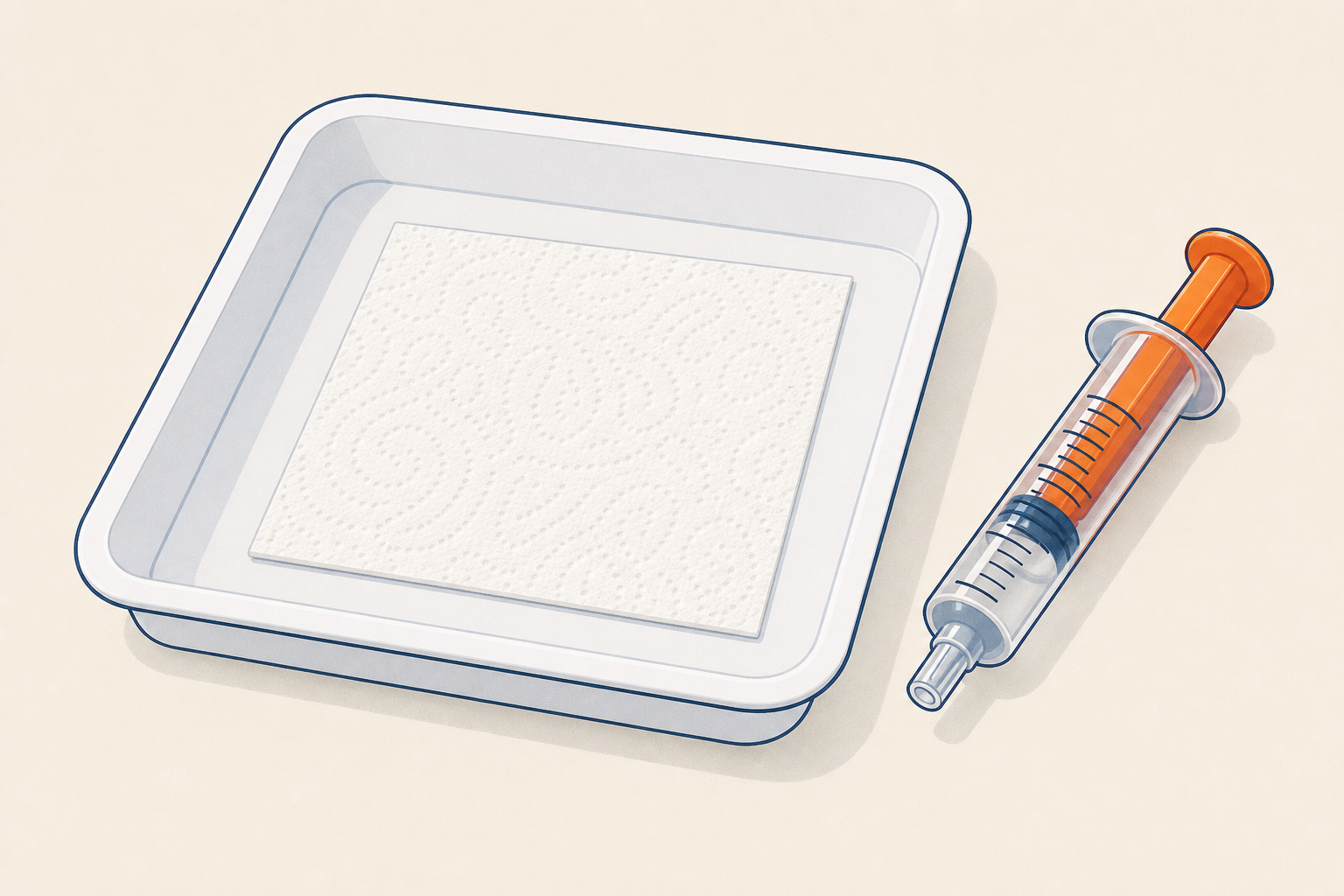
Agree one class method and stick to it for every group. Preferred: syringe leftover method in ml (10 ml offered, free water drawn back into the syringe, ml held = 10 − ml free). Optional mass-gain route only if the whole class uses scales the same way and still records ml held. Leave the agreed numbers and the tip-and-draw recovery technique on the board for the practical.
Teaspoon substitute (only if no group has a syringe): the whole class must use teaspoons, not a mix. Record teaspoons held everywhere (journal, board, chart axis), or convert with one agreed spoon volume before pooling. Never mix ml and teaspoons in the class table.
Ceiling check: if two materials both hold the full 10 ml, increase the offered volume slightly for a fair re-run of those materials (keep size, time and method identical) so averages can still separate them. Mass gain with free water left on the tray also avoids a false tie.
Honest measure: we compare how much each piece holds in 30 seconds — same time for everyone. Optional aside: some materials might hold more if left longer; keeping time the same is what makes the test fair.
In your group, test the materials one at a time using the class method on the board. Write each reading on your Investigation Journal page as soon as you measure it — only your group's own trials.
Method every time: same-size dry piece → offer 10 ml → wait 30 seconds → tip the tray so free water gathers, draw it into the syringe, read ml free → ml held = 10 − ml free.
Do each material twice with a fresh dry piece each time, then work out the average. We compare how much each piece holds in 30 seconds, same time for everyone.
If time is tight, finish two materials fully (two dry trials and averages each) and we will pool class data, or cut the set to three materials. Keep the method identical so only the material changes.
Groups now run the practical. The board still shows: 10 ml, 30 seconds, tip-and-draw free water into the syringe, ml held = 10 − ml free, two dry pieces per material, record live on the group's own Investigation Journal page.
Keep the same every trial: piece size (e.g. 10 cm square), 10 ml water, 30 second wait, same tray and measuring tool, same free-water recovery (tip corner, draw into syringe), same person reading where possible.
Repeats: two readings per material on separate dry pieces; average = (reading 1 + reading 2) ÷ 2. If the two readings differ a lot, check the method and run a third with a spare dry piece.
What to expect: paper towel and cotton often hold more than nylon; felt varies with thickness. Exact numbers matter less than a fair comparison and a clear ranking.
If the test misbehaves: pieces different sizes mid-lesson: stop and recut; water pooling off the tray: use a shallow dish; two materials both take all 10 ml: offer a little more water on a fair re-run of those only (same size and time).
Timing contingency (also on the board): if the clock is tight, every group completes two materials thoroughly (two dry trials each, averages written) and class data is pooled so each material still has repeats across groups. Do not rush eight sloppy trials. Alternatively cut the set to three materials for this lesson.
Group size: flexible groups of three to five. Roles can rotate: water measurer, timer, recorder, piece handler.
Safety: wipe spills as they happen; walk, do not run, with water; keep water away from devices and electrical sockets.
Live recording: check early that numbers are going onto the Investigation Journal page trial by trial, not held in heads until the end.
You're previewing this lesson. Get full access to this lesson and hundreds more — each one ready to teach, with interactive activities, printable resources and pupil progress tracking built in.