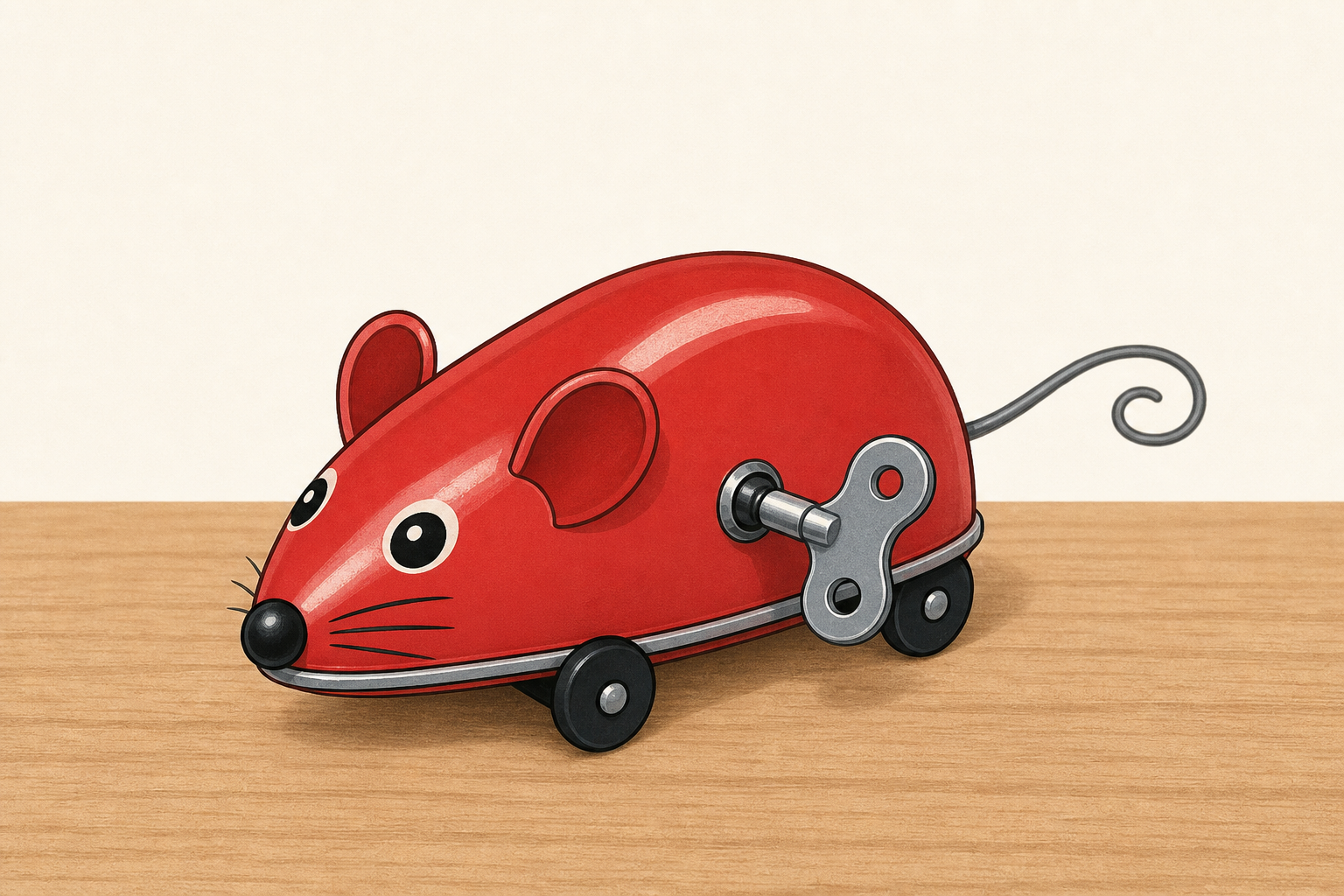
Look at this wind-up toy. Nothing is pushing it right now, yet when I wind it and let go, it races across the desk. Where was the energy hiding while it waited?
Today we will store energy in simple ways, watch it change into movement, and tell the story of that change as an energy chain.
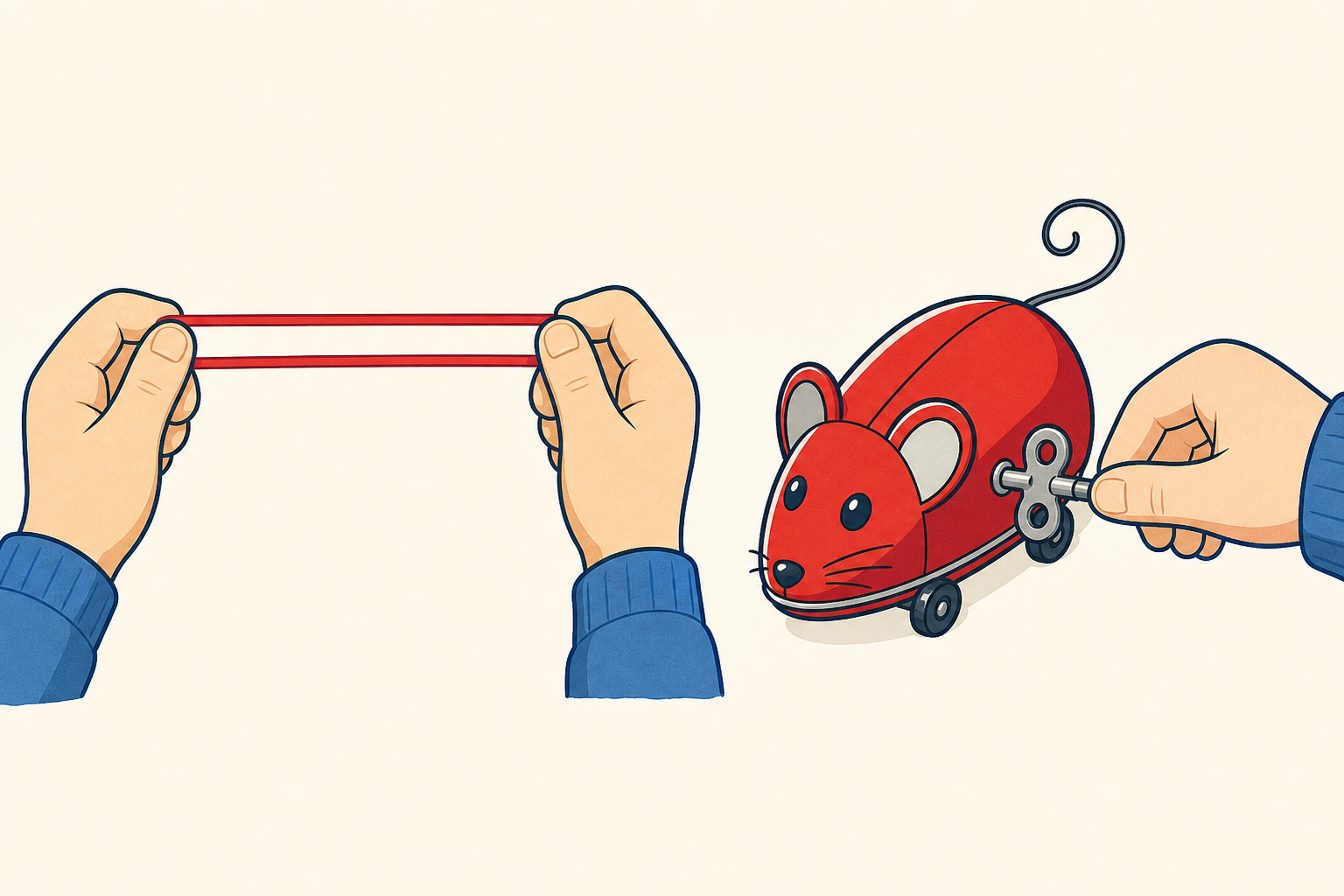
Hold up a wind-up toy (or a rubber-band car already prepared). Wind it slowly so the class can see, then set it free. Do not name the science yet — let the surprise land.
Key question: Where was the energy while the toy was still?
Keep the hook light: one object, one question. Stations come out in the investigate step, not now.
Today's first word: stored energy — energy kept ready to use, like in a stretch or a wind-up.
A stretched band and a wound spring can both store energy ready for a big move. Which one are you most curious to try?
Project only the short board text. Use the table below yourself. Hold back movement energy and energy chain until after the demo and stations — name them when pupils have something concrete to hang them on (after the demo for movement; in the chain step for the chain).
| Concept | Why it matters | Example |
|---|---|---|
| Stored energy — energy kept ready to use, such as in a stretch or a wind-up | Lots of everyday things work because energy was stored first — toys, catapults, a door-stop spring | A stretched elastic band on a spool car holds stored energy until you let go |
| Movement energy — energy something has when it is moving | We can see and feel movement, so it is the clearest way to notice that stored energy has changed | When the car rolls across the table, the stored energy in the stretch has changed into movement energy |
| Energy chain — a short story of how energy goes from being stored to making something move | Tracing the chain helps us explain what happened, not just watch it | Stretched band → band snaps back → car rolls |
Nature of STEM: People used moving water and wind long before batteries — water wheels and windmills changed that push into useful work. Clock springs were a true store: wind them up, and the energy waited until the clock needed it. Ireland's wind farms still catch moving air and change it into electricity.
Misconception to head off: children often say the energy "runs out" or "disappears". Energy changes form; it does not vanish. Keep saying changed into.
Raised weight (teacher only for now): a weight held up high is another real store, but it is optional extension today. Do not put it on the board as a core store the class must rank or visit.
Take a quick curiosity vote on stretch vs wind-up, then move to the demonstration. Do not ask which store holds "the most" energy — that needs a fair amount of stretch, wind or height to compare.
Watch carefully. First the energy is stored — then we let it go. Where is the energy at the start? What does it become?
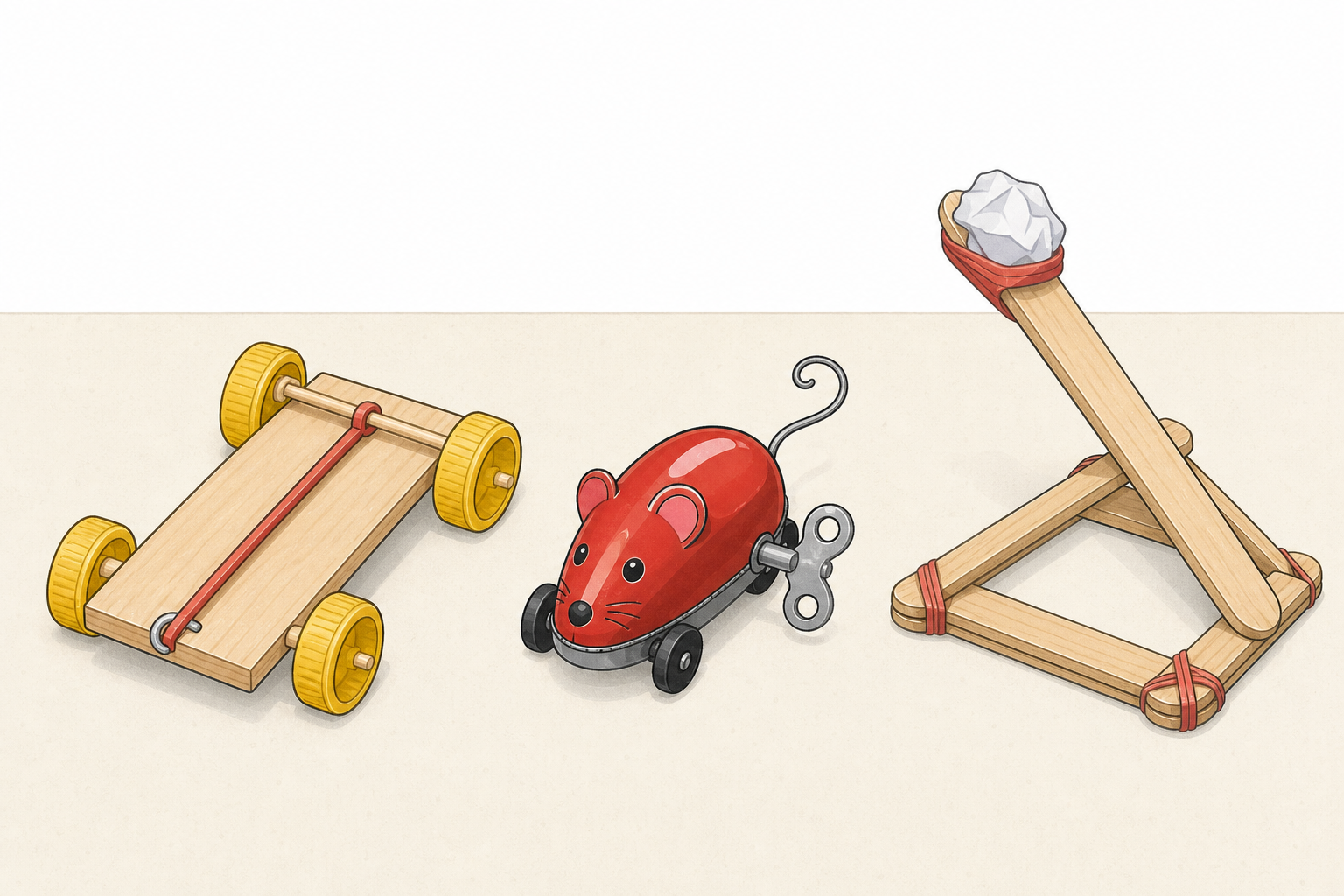
Use one clear example only: a rubber-band car (or a spool with an elastic band through it and a small stick or matchstick as the wind-up). Stretch or wind it in full view, pause, then release.
What to expect: the second run should clearly outrun the first if the floor is clear and the start line is the same. If both runs look the same, the stretches were too similar — exaggerate the difference.
Fold the watchers in: Was my prediction right? Where was the energy while the car was still? Name movement energy only after they have seen the car roll.
Your group will work at one station. Store energy, then let it go.
Before you let go, say what you think will happen. After you let go, talk about: how was the energy stored, and what did it become?
Station A: rubber-band car. Station B: wind-up toy. Station C: stretched catapult (launch a soft ball of paper along the floor, never at anyone).
Take turns so everyone gets a go. If you have time, try a smaller stretch or fewer winds, then a bigger stretch or more winds, and compare.
Three simple stations around the room. Default plan: assign each group to one station for about 10–11 minutes so they can store, predict aloud, release, try a bigger vs smaller stretch or wind, and talk. Use the last 5–6 minutes for a quick whole-class share so every group hears how the other stations stored energy and what it became. Full three-way rotation only if your class is small, transitions are slick, and an adult can keep eyes on the catapult.
In-group roles (so waiting pupils stay active): before the first release, name four quick jobs and rotate after each turn: storer (stretches, winds or loads), releaser (lets go on the count), marker (marks how far it went with a finger or scrap of paper), speaker (says the group prediction before release, then one sentence about what they saw). Everyone watches every run. Call a soft rotate every couple of minutes so more than one or two children act on the store-and-release cycle.
Optional extension if you have it and spare adult help: a small weight on a string, lifted then gently released onto a soft pad, to show a raised-weight store — keep drops tiny and supervised. Do not present this as a required station.
At each table, before the first release: Say what you think will happen when you let go. Groups may jot that prediction straight onto the Investigation Journal page at the station if they have it with them; otherwise they hold the spoken prediction and write it first in the record step before describing the result.
Prompt at each table: How did you store the energy? What did you predict? What did you see when you let go? Did a bigger stretch or more winds make a bigger move?
Safety: stretch bands and catapults aimed away from faces; no launching at people; clear floor runs; mind fingers in wind-up keys.
Deep recording happens in the next step on the Investigation Journal page. During stations, the spoken prediction and a quick note or memory of what moved is enough.
One voice per station type: how was energy stored, and what did it change into? This is how groups who stayed at one station still meet stretch and wind-up stories.
On your Investigation Journal page, choose the station your group worked at. Write or draw: how you stored the energy, what you predicted before you let go, what you observed, and what the stored energy changed into.
This is the in-class paper recording beat — keep it inside the lesson, not as homework. Pupils use the Investigation Journal page. They record the one station their group worked at so the page stays focused.
Order on the page: start with the prediction box first while the spoken "before we let go" idea is still fresh, then observation, then what it changed into. If a child jumps straight to the result, pause them: What did you think would happen before you let go?
Circulate and listen for the language stored and changed into movement. If a child writes that the energy "disappeared", ask them to point at what was moving at the end.
Look-fors:
You're previewing this lesson. Get full access to this lesson and hundreds more — each one ready to teach, with interactive activities, printable resources and pupil progress tracking built in.