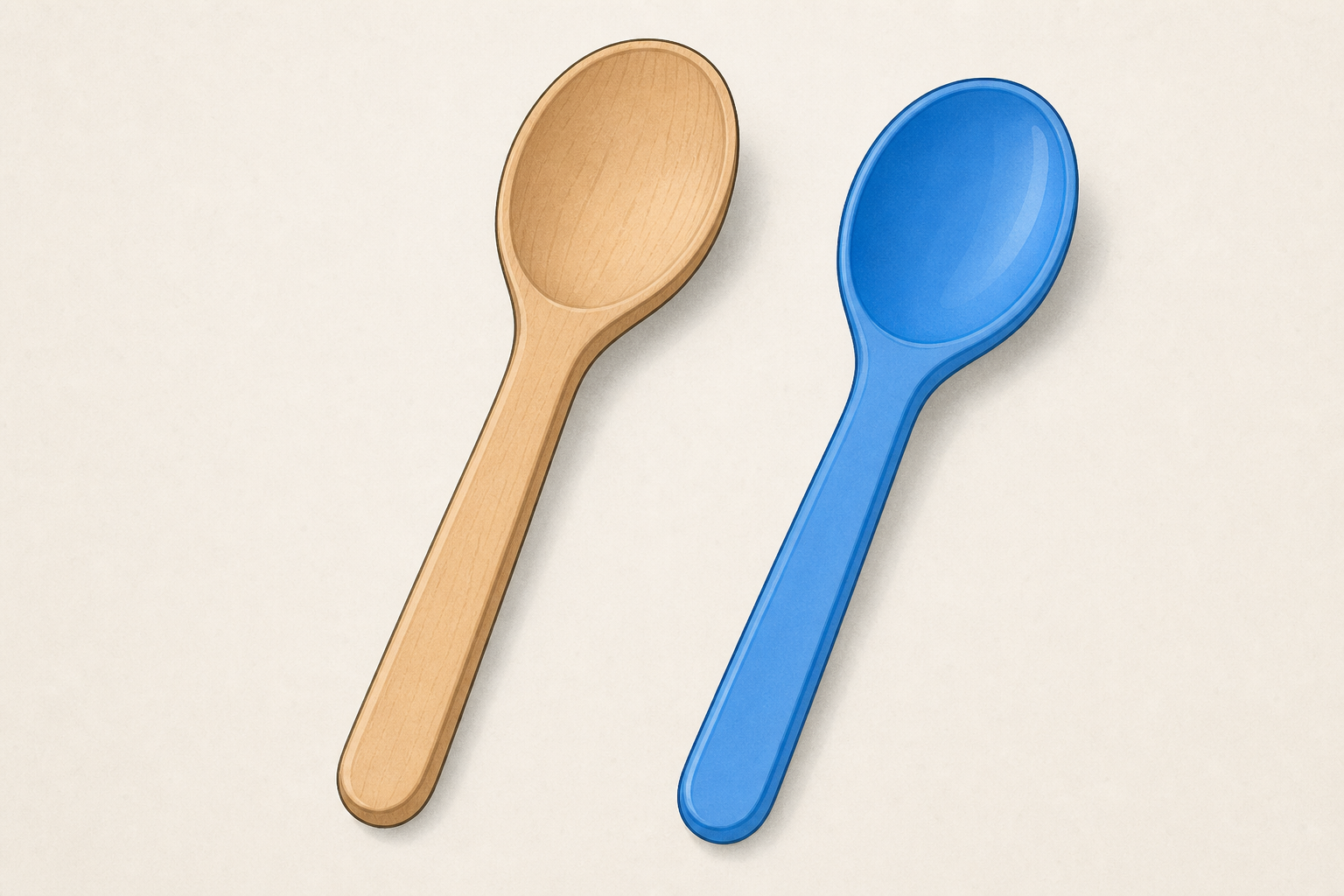
Look at this wooden spoon and this plastic spoon. They both do the same job. Why might someone choose wood for one and plastic for the other?
Hold up a wooden spoon and a plastic spoon (or any two everyday objects made of different materials). Keep the hook light: one question only. Do not name the full property list yet.
Key questions: Which feels harder? Which would you use in hot soup? Why?
Capture two or three pupil ideas on the board. Link briefly to Irish homes: people once built roofs from thatch; later they used slate and tile because those materials suit wet weather better.
If discussion stalls, add this one pupil line: People in Ireland once used thatch on roofs; later many chose slate because it suits wet weather better — that is matching a material to a job.
Two words help us talk about what things are made of.
Material means what something is made of, like wood or plastic.
Property means how a material feels or behaves.
As we handle things today we will notice pairs such as hard or soft, bendy or stiff, see-through or not, and waterproof or not.
Which property would you want for a raincoat?
Keep the board light: only the two anchor words plus the short property pairs and the raincoat question. Do not read a long glossary. Name each property fully against the real objects in the next step.
Use the table below for your own reference while you teach.
| Concept | Why it matters | Example |
|---|---|---|
| Material — what an object is made of (wood, plastic, fabric, metal, glass) | Choosing the right material helps an object do its job well and last longer | A window is glass so light can come in; a coat is fabric so it can bend with you |
| Property — how a material feels or behaves (hard, soft, bendy, stiff, see-through, waterproof) | Properties help us sort materials and match them to jobs | Foil is bendy so it wraps food; a wooden block is hard so it holds its shape |
| Hard / soft — hard feels firm; soft squashes or feels gentle | Hard materials make strong tools and furniture; soft ones make clothes and cushions | A desk is hard wood or plastic; a jumper is soft fabric |
| Bendy / stiff — bendy can fold or curve without snapping; stiff stays straight | Bendy materials suit wrapping, hinges and clothes; stiff ones hold a shape | Aluminium foil bends around a sandwich; a wooden ruler stays stiff |
| See-through — light passes through so you can look past it | See-through materials let light in or let us check what is inside | A clear plastic bottle or a glass jar |
| Waterproof — water does not soak through | Waterproof materials keep things dry in Irish rain | A plastic lunchbox or a wellington boot |
Misconception to head off: pupils often say the object name instead of the material ("spoon" rather than "wood" or "plastic"). Gently revoice: Yes, it is a spoon — and the material is wood.
Nature of STEM: people have always matched materials to jobs. Irish roofs moved from thatch to slate and tile because those materials cope better with wet weather.
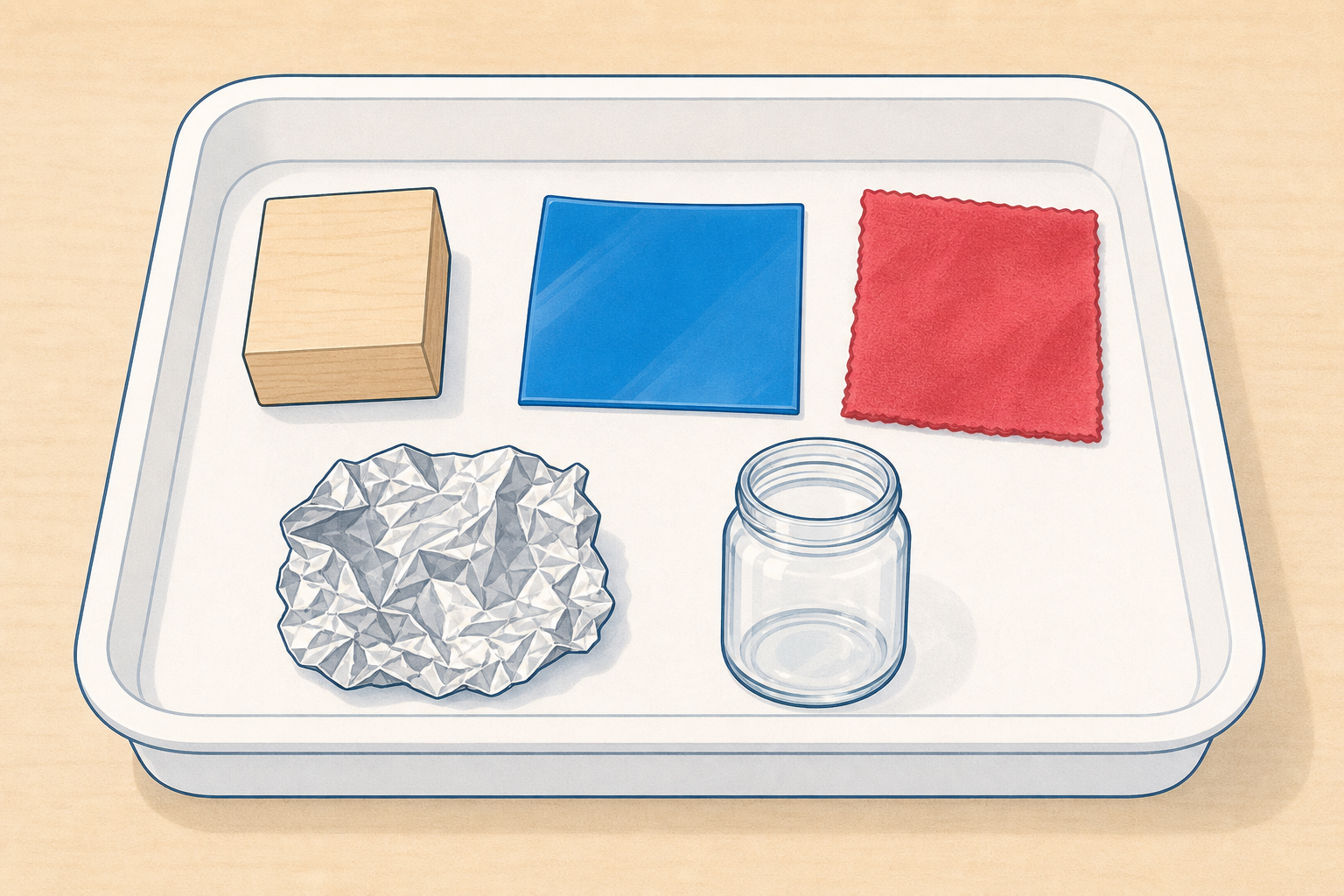
Your group has a tray of materials. Take turns to hold each one. How does it feel? Does it bend or stay stiff? Can you see through it? What happens if you drip a little water on it?
Talk about what you notice before you sort anything.
Give each group a tray with: a small wooden block or ruler, a clear plastic bottle or cup, a fabric scrap (cotton or felt), a piece of aluminium foil, and a small glass jar (or a clear glass bead bottle if jars feel risky). Place one shallow water tray per group for a careful drip test only — not dunking.
Model first (worked observation cycle): Hold the foil. I wonder what this material is like. Bend it gently. I predict it will bend easily. Bend it and drip a drop of water. I observed it bent and the water sat on top. I think foil is bendy and waterproof, so it could wrap food.
Then send groups to explore. Name each property as groups meet it on the tray: hard or soft, bendy or stiff, see-through or not, waterproof or not. Circulate and ask those same pairs out loud so the vocabulary sticks to the feel of the object.
Waterproof check on wood: if water sits on wood at first, wait a few seconds or blot with a fingertip — many woods slowly darken as water soaks in. Contrast with plastic or foil where the drop stays on top. That stops pupils calling wood waterproof.
Remind groups they will record these observations on the Investigation Journal page after sorting, so they should notice carefully now.
Safety: glass stays on the tray; wipe spills at once; no tasting.
As a group, choose one property pair to sort by first: hard or soft, bendy or stiff, see-through or not, waterproof or not.
Put each material into the matching group. Then choose a different property pair and sort again. Be ready to say why one piece went where it did.
Provide two sorting hoops, trays or labelled paper mats per group. Groups choose the first criterion themselves (bounded choice). After about 6 minutes, ask them to re-sort by a second property so they see that the same object can sit in different groups depending on the question.
Look-fors: pupils name the property, not just "I like this one"; they can justify a placement; they notice foil is bendy and often waterproof, fabric is soft but not waterproof, glass is hard and see-through.
Differentiation: offer the printed property word cards (hard, soft, bendy, stiff, see-through, waterproof) for groups who need vocabulary support. Confident groups can invent a third sort (e.g. natural or made by people) if time allows.
Keep glass on the tray during moves. Wipe any water from the drip test. Tell groups they will write one of their sorts on the Investigation Journal page in the next recording step.
Now we will sort some of the same materials on the interactive activity. Four cards appear: wood, plastic, fabric and glass.
We answer yes or no to send each card down the tree: Is it hard? then Is it see-through? Call out where each card should go and why.
Drive sorting-tree in explore mode on the IWB. Name the four cards and the two questions exactly as they appear so pupils can follow. Foil stays on the group trays for this board sort so hardness and bendiness do not get collapsed into one rule. Fold the whole class in: Do you agree with that group? What property are we using now?
Suggested placements to guide discussion:
As fabric is placed, say: Soft and bendy are not the same. Fabric is not hard because it feels soft when you press it. Bendy is a different property — we tested that with foil on the trays.
As clear plastic and glass land together, say: Under these two questions they share a bin. Both are hard and see-through.
After the sort, one clean line: Hard is about how firm it feels when you press it. Bendy is about whether it curves. They are two different properties.
Prompt: Which question split the materials best? Could we add a waterproof question next time?
You're previewing this lesson. Get full access to this lesson and hundreds more — each one ready to teach, with interactive activities, printable resources and pupil progress tracking built in.