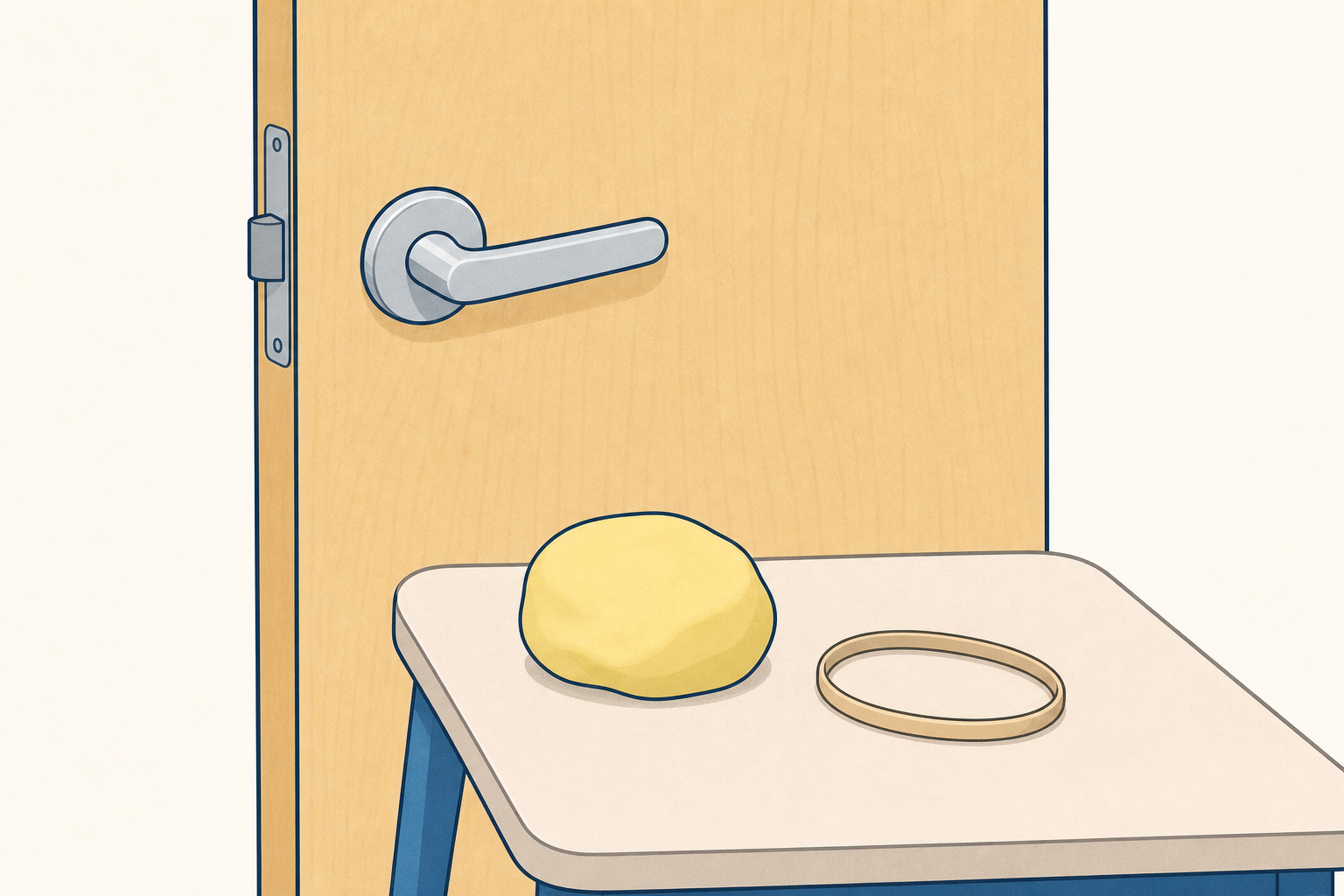
What makes a door open? What makes soft dough go flat? What makes an elastic band get longer?
Hands up: do you think those are all the same kind of thing, or three different kinds of thing?
Keep this light. Hold up or point to one everyday object if it helps (the classroom door, a ball of modelling dough, an elastic band) but do not set out the full hunt yet. Take three or four quick guesses. Do not name the word force until the next step unless a pupil offers it.
Key question: Are opening a door, flattening dough and stretching a band somehow the same idea?
When you open a door, squash soft dough flat or stretch a band, you are using a force: a push or a pull.
A push moves something away from you. A pull brings something towards you. Forces can make things start, stop or change shape.
Which of those do you think you use most often in school?
| Concept | Why it matters | Example |
|---|---|---|
| Force — a push or a pull that can make something start, stop, speed up, slow down or change shape | Forces are happening all around us every day, even when we do not notice them | Pushing open the classroom door, pulling a chair in, or squashing modelling dough all use a force |
| Push — a force that moves something away from you or presses it inwards | Pushes start many everyday movements and can squash soft materials | Pushing a swing, pressing a lid onto a tub, or kicking a football in the yard |
| Pull — a force that draws something towards you | Pulls open drawers and doors, and can stretch materials such as elastic when the pull changes shape | Pulling a schoolbag towards you, or opening a drawer |
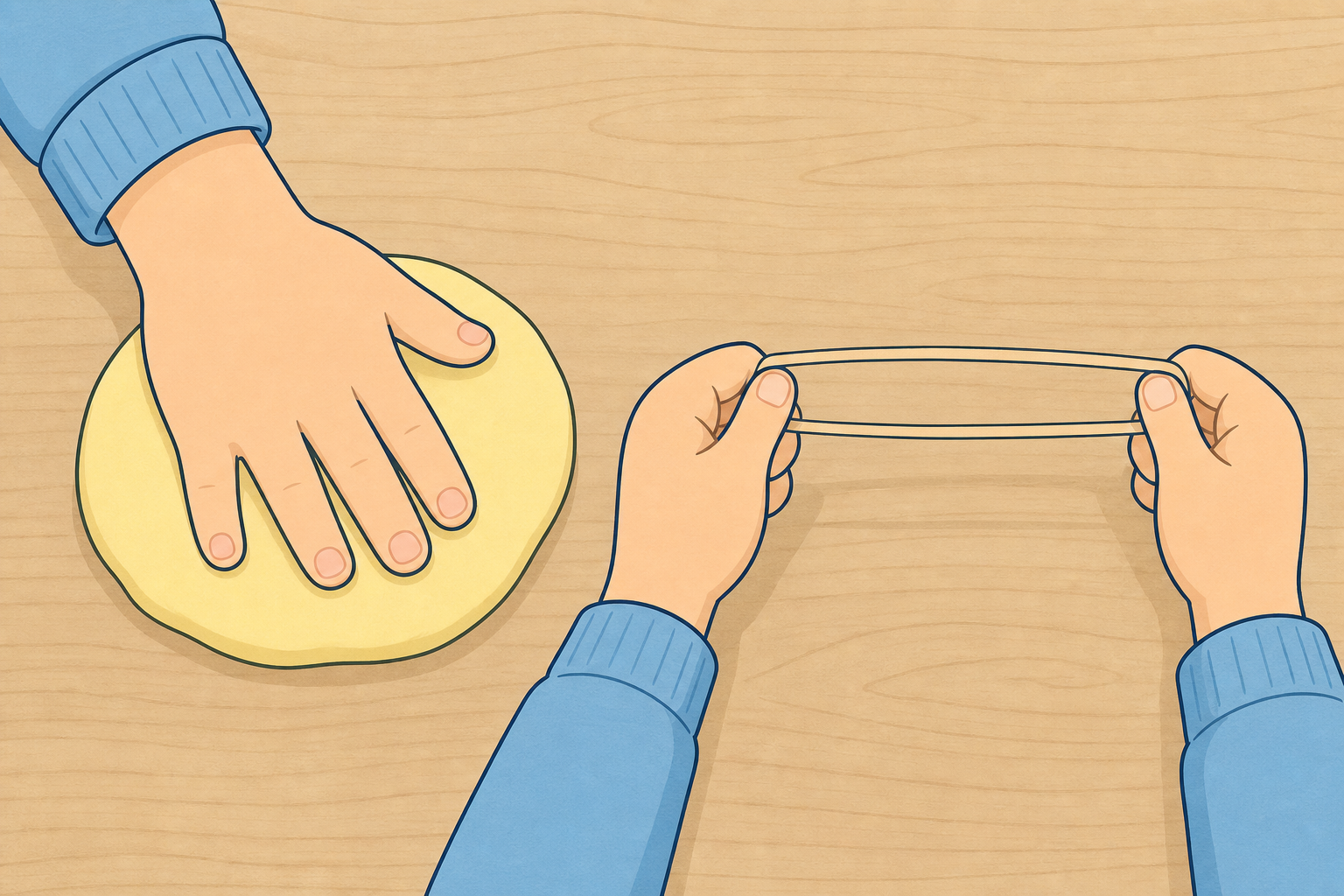
Every force we name today is first a push or a pull. Squash and stretch are not separate force types; they name a shape-change result. A squash is a push that makes something shorter or flatter. A stretch is a pull that makes something longer. When a pupil flattens modelling dough, the correct force word is push, and what happened is that the shape changed (it was squashed). Do not mark squash or stretch as if they replace push or pull.
Do these as short think-alouds, not three full inquiry cycles. Have the door, a book and a small ball of dough ready before you start.
Then ask the class question on the board: which force do you use most often in school?
Misconception to head off: children often think a force is only a big shove, or that something must be moving for a force to count. A gentle push, a stretch that holds still, and a squash that changes shape are all forces. Also, gravity is a pull, but keep today's hunt to forces the children can feel themselves applying with their hands or body. If pupils argue whether dough is "push or squash", revoice: Push is the force; squash is what happened to the shape.
Pronunciation: force is everyday speech; no special cue needed.
We are going on a force hunt around our room and, if we can, the yard.
Before we go: name one place you think you will find a push, and one place for a pull. Tell your partner why. Might any of those also change a shape (squash or stretch)?
Predictions stay oral. Take a few pairs aloud so the class hears a range. Capture two or three ideas on the board under Push / Pull — not as a full materials list, just as curiosity markers. If a pair also names a shape change, jot it beside the push or pull it belongs to, not as a third column of force types.
Remind them: predictions are the start of the science, not a test to get right. A force they did not expect is a good find. On the hunt they will always decide push or pull first, then what happened (started, stopped, or changed shape).
Before you leave the carpet: quickly name the safe rules you will use on the hunt (see safety). Point out the two shared dough and elastic-band stations you have ready, and the everyday objects already in the room (door, drawer, chair, book).
Time to hunt for forces. At each stop, try the action yourself, then decide two things:
1. Was it a push or a pull?
2. What happened — did something start, stop, or change shape (squash or stretch)?
Visit the stations your teacher shows you. Stay with your group and keep hands and feet safe.
Run the hunt as a rotation around shared stops (or walk the whole class stop to stop if space is tight). Stock the room once for the class, not a full kit per group:
Rotate groups through the stops, or walk the whole class from stop to stop if space is tight. At each stop, ask the two-step questions aloud: Push or pull? What happened — start, stop, or change shape? Fold watchers in with the same questions rather than giving them a separate desk task.
Memory anchors (do these so step 5 is not a blank-page test):
Look-fors: pupils naming push or pull first; then saying whether something started, stopped or changed shape; noticing squash as a push that changes shape and stretch as a pull that changes shape. If a group only says "I moved it", prompt: Did you push it away or pull it towards you? If they only say "squash", prompt: Was that a push or a pull that squashed it?
Differentiation: less confident pupils can point and use the words push or pull with a partner's help. Confident groups can hunt for a force that both starts movement and changes shape, or find two different pulls, or find one clear stop.
Safety while moving: push chairs and doors gently; pull elastic bands low and away from faces; keep the run clear of feet; outdoors stay inside the agreed boundary.
Back at your seat, open your Investigation Journal page.
Record at least three forces you found. For each one, write or draw: where it was, whether it was a push or a pull, and what happened (started, stopped, or changed shape — squashed or stretched).
This is the paper recording beat on the Investigation Journal page. Do not invent extra columns or a separate homemade sheet. Tell pupils what to record (place, push or pull, what happened); the page layout is generated for them. Point back to the three class finds on the board if anyone blanks.
Circulate and prompt: Push or pull first — which word fits? What happened — did it start moving, stop, or change shape? Accept drawings with labels for pupils who write slowly; the science is in naming the force and the result. If a pupil writes only "squash", ask them to add that it was a push that squashed the dough.
Success look-fors: at least three different examples; each named as push or pull; a clear "what happened" note for each (start, stop, or shape change). Squash and stretch count as shape-change results, not as replacements for push or pull. If someone only lists objects, ask them to add the force word and the result.
You're previewing this lesson. Get full access to this lesson and hundreds more — each one ready to teach, with interactive activities, printable resources and pupil progress tracking built in.