Someone in our school has a job that feels awkward. How could we help them without guessing what they need?
Today we will ask, watch, and plan a helper. We will make it next time.
Keep this light. Do not hand out materials or start drafting yet. The hook is the idea that guessing is not enough: real makers find out from the person first.
Have the large reading book (or another simple awkward everyday job prop) ready to name aloud if the class is quiet, for example holding a big book open while writing, or keeping paintbrushes from rolling off the table.
Before the lesson (required prep): decide your user setup. Default path (typical classroom): put pupils in pairs. One child is the user and shows one awkward classroom job; the other asks and watches. After about four minutes they swap roles briefly if you wish, but each pair then agrees one shared user and one awkward job to design for (pick the clearer need). Print the Investigation Journal Design Brief page (one per pupil). Put one large reading book (or similar demo prop) beside the board for the live model in the next step.
Other options if you prefer: (1) invite an SNA, caretaker or another teacher for a short five-minute visit and rotate groups; or (2) you act as the shared user for one class problem and groups design different helpers for you. Later steps in this lesson assume the default pair path unless you note otherwise.
One maker word and one maker habit for today:
Watch the board while I ask, watch, and sketch two quick ideas for a helper.
Project only the two short board lines above. Keep adult words light: say empathy aloud as your own label for ask-and-watch, but do not put four glossary terms on the board. Draft and labelled plan are quick recaps of skills pupils already practised earlier in this project; bring them back into focus in the design step with the live model, not as new board definitions now.
| Concept | Why it matters | Example |
|---|---|---|
| Empathy (ask and watch) — finding out how someone really feels about a job by asking them and watching them do it, not guessing | If we guess, we might build the wrong helper and waste our making time | Watching a classmate try to keep a reading book open, then asking what feels awkward about it |
| User — the real person we are designing the helper for | Every good helper is made for someone, not just for the fun of making | A younger pupil, a classmate, the class teacher, or the school caretaker |
Worked example (protect about five minutes of this eight-minute step; this is the main scaffold): Use the large reading book from the materials list. Invite a volunteer user (a pupil). Think aloud: I wonder what feels awkward when you hold that book open… Ask one question, watch them try the job for a few seconds, then say what you noticed. On the board, sketch two very rough ideas for a helper (for example a folded card prop and a lolly-stick stand). Talk through one good point and one tricky point of each out loud, choose one, and add two labels plus one material name. Only then ask: Why do makers draw more than one idea before they choose? Say: That is ask and watch, then two quick ideas, then choose, then label. Your pair will do the same.
If time is slipping, still finish choose-and-label on the board so pairs see the full sequence they must copy; do not skip the second idea sketch.
Misconception to head off: children often invent a clever gadget without checking the user. Keep returning to what did your user say or show?
Your teacher has put you with a partner. One of you is the user. Meet at your table.
Ask what job feels awkward. Watch them try that job for a short time. Notice what is hard.
Then write three things on your Investigation Journal page: who the user is, what the awkward job is, and one thing you saw. No drawing of helpers yet.
Be ready to tell the class those three things.
Run the default path: pairs at tables. One child is the user and shows one awkward classroom job; the other asks and watches. A short swap is fine if time allows, but before you move on each pair must settle on one named user and one awkward job (the clearer need). If you arranged a visiting adult or yourself as shared user, keep the same capture rule: every group leaves this step with one user and one job written down.
Investigation Journal page is in hand now. Pupils fill the user section straight after watching so they do not forget. Do not delay writing until the draft step. There is no prediction beat in this step: the lesson message is ask and watch, not guess.
Sentence stems to coach: What job feels awkward for you? Can you show me how you do it? What would make that easier?
Look-fors: pupils watch before they suggest fixes; they can name the user and the awkward job in plain words; they notice a real difficulty (slips, tips, needs two hands, rolls away).
Keep it kind and short. No filming. No making the user feel silly. If a pair invents a problem the user did not show, send them back to ask again.
After watching and writing, take two quick whole-class shares (about one minute total) so everyone hears strong examples of real user needs. Do not aim for every pair to speak.
Look at the sample plan on the board: two quick ideas, then one clearer drawing with two labels and a short materials list.
Your teacher will show one step at a time. Follow only that step on your Investigation Journal page.
When it is time to talk about good points and tricky points, whisper with your partner. You do not write those down.
We make the helper next time, so your plan must be clear enough to build from.
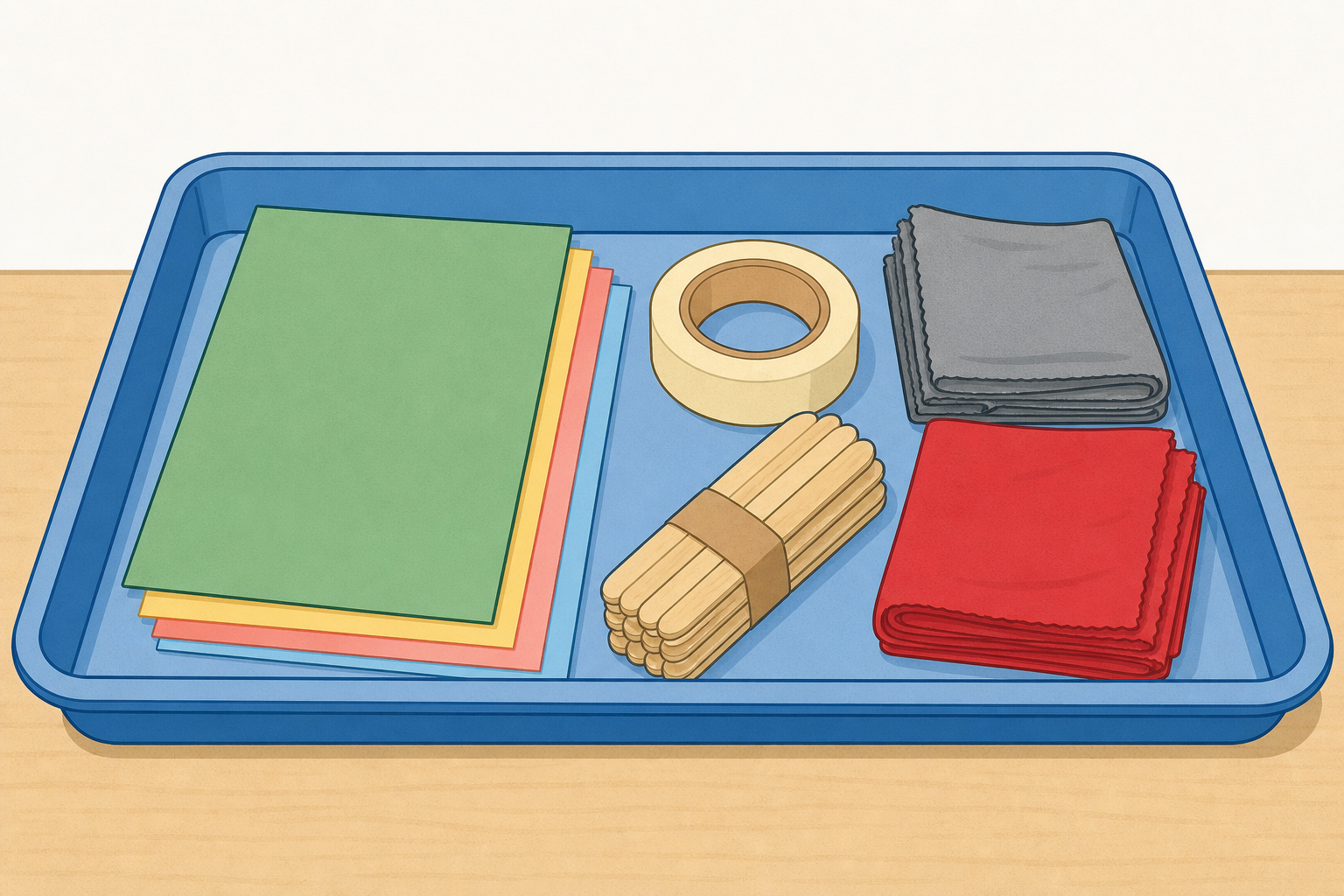
This is the heart of Part 1. Put a sample materials tray on each group table so pupils can handle real card, tape, sticks and fabric while they choose materials — they do not build today.
Sample plan to show first (draw this yourself in under two minutes; no special resource needed): On the board or a large sheet, rough box 1: a folded card book prop. Rough box 2: a lolly-stick V stand. Clearer box 3: a simple L-shaped stand with two labels written as base and back rest, plus materials listed underneath: card, masking tape, lolly sticks. Point to this sample, then wipe or cover the numbered beats so only the current beat is large while pairs work.
Reveal one beat at a time on the board (do not leave all five up together):
Use the plain phrase two quick ideas on the board. Keep the word draft as spoken teacher language only.
Mandatory finish line for this sitting (keep it realistic for 7–8s): user and problem already written, two quick ideas, one chosen clearer plan with at least two labels and a short materials list. Good/tricky talk is a 30-second partner whisper only. A third idea is optional for early finishers only. If the class is short of time, protect steps 2, 4 and 5 of the reveal list above.
Helper ideas that suit junk-modelling next time: a stand to hold a reading book open; a desk tray divider; a simple brush or pencil pot; a door wedge; a bag hook from a chair; a phone or tablet prop for watching a clip; a scoop for sand or compost. Steer pairs toward one moving or holding job their user really showed, not a huge invention.
Constraints to keep saying: must help the real user; must be makeable from the sample tray materials next time; must be safe for classroom use; keep it simple enough to finish in one making lesson.
Differentiation: less confident pupils can trace a simple L-shape or folded stand and add two labels; confident pairs can add a second view or note one part that might move. Early finishers improve labels or list a backup material, not start building.
Nature of STEM weave: makers plan and choose materials before they build — that is why the clearer drawing and materials list matter today.
Join another pair. You have about two minutes to show your plan while they listen, then swap.
Say who your user is, what feels awkward, and which materials you chose. Give one kind comment that starts with I like… or I wonder…
Display-only share. No scoring. Pair pairs so each plan is seen once. Use a visible timer: about two minutes for the first pair, then swap for about two minutes, with a short settle at each end. Keep comments kind and useful: I like how simple the base is; I wonder if the book will slip.
If the class is large or time is tight, run one timed round only and invite two pairs to hold their plan up for a 20-second class glance rather than forcing every group through a long turn.
Listen in for pairs that still cannot name the user or the awkward job — send them back to the Investigation Journal user box rather than polishing the drawing.
Collect or store the Investigation Journal pages and any materials lists safely; pupils will need them in the next lesson of this project when they make, share and reflect.
You're previewing this lesson. Get full access to this lesson and hundreds more — each one ready to teach, with interactive activities, printable resources and pupil progress tracking built in.