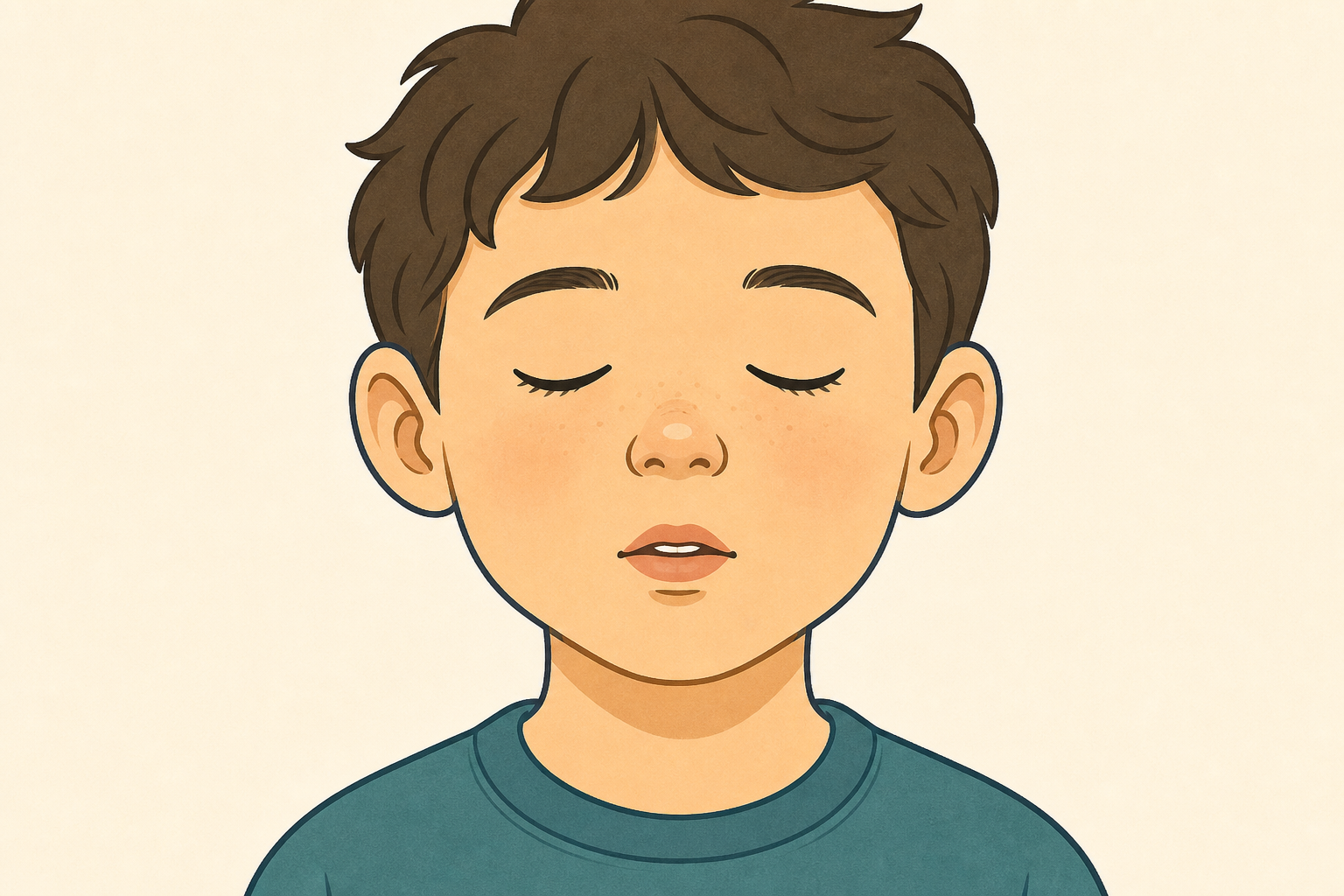
Close your eyes for a moment. What can you still notice? A sound in the room? The feel of the chair? A smell from lunch?
Scientists use their senses carefully to find things out. Today we investigate like scientists.
Keep this light. No station set-up talk yet. Ask two quick hands-up questions: What did you still notice with your eyes closed? and Which sense do you use most in the classroom?
Link noticing to everyday school life: a school bell, wet coats after rain, the smell of pencil shavings.
Before the lesson: print the Investigation Journal page (one per pupil). Print the provided station instruction cards (one set of three cards). Set up three stations (see Station round step) and place a set of science word cards at each station. Check smell-pot allergies with the usual class allergy list. Have one sealed feely bag ready for the modelled observation later. Have one leaf or fabric scrap ready for a short whole-class sight look before stations.
Today's big word is senses: the ways our body notices the world.
On the board is a child figure. Labels: eyes, ears, nose, hands. Help us put each label on the part we use for that sense. Which part helps us hear? Which helps us feel if something is rough?
Now look carefully at this leaf or scrap of fabric. What do your eyes notice when you slow down?
A careful observation uses clear science words, like cool, smooth and round.
Drive the diagram-labeller on the IWB in explore mode. Pupils call out where each label belongs; you drag. The four labels on screen are exactly: eyes, ears, nose, hands.
Lead with senses and the labelling first. Only after labels are placed, hold up a leaf or fabric scrap for a 30-second whole-class sight moment. Keep the on-screen observation line short (one model phrase). Say the fuller idea aloud yourself: careful noticing of what is really there, said so someone else could check it, not just "weird" or "nice".
| Concept | Why it matters | Example |
|---|---|---|
| Senses — the ways our body notices the world (seeing, touching, hearing, smelling) | Scientists use their senses on purpose, not by accident, so they notice real clues | You hear a robin outside, feel a pine cone is prickly, and smell orange peel in a pot |
| Observation — careful noticing of what is really there, said in clear science words | A careful observation can be checked by someone else; a vague guess cannot | "Cool, smooth and round" is more useful than "nice" or "weird" |
Link each sense to a body part: eyes for sight, ears for hearing, nose for smell, hands (and skin) for touch. We are not tasting today. Sight gets this short whole-class look; the stations then deepen touch, hearing and smell.
Misconception to head off: children may think only eyes count as "real" science. Stress that touch, hearing and smell give real evidence too.
Ask: Which part would you use first to investigate a bag you must not open?
Three stations are ready. Take your Investigation Journal page with you.
Your group will visit each station. When you hear the clap or timer, move to the next one.
At every station, write or draw one careful observation before you move on.
The board (or the card on your table) shows only the station you are at now. Follow those short instructions and the science words.
Set up three stations around the room. Print the Investigation Journal page, the science word cards, and the three station instruction cards (one card per station, or advance the matching short block on the IWB). Place one set of word cards and the matching station card at every station. The station contents are real objects you gather.
Four opaque bags or clean socks, each sealed with one object inside:
Label bags A1 to A4 on the outside only. Pupils must not open them.
On-screen / card text for Touch only: Feel inside a closed bag. Do not peek. Write or draw one careful observation. Use words like smooth, rough, soft, hard, warm, cool, round.
Four opaque pots or yoghurt pots with lids, filled and sealed:
Keep a teacher answer key off the pupil tables: Jar 1 rice, Jar 2 paper clips, Jar 3 cotton wool, Jar 4 buttons/coins.
On-screen / card text for Sound only: Shake each jar gently. Guess what might be inside. Write or draw one careful observation. Use words like loud, quiet, rattly, muffled.
Four small pots with a little cotton wool and a lid with holes, or a cloth cover:
Allergy check first. Skip or swap any scent that clashes with a known class allergy. No tasting. Teach the hand-wave technique live: wave a hand from pot toward nose (do not say only "waft" without showing it).
On-screen / card text for Smell only: Wave your hand from the pot toward your nose. Do not put your nose in the pot. Write or draw one careful observation. Use words like strong smell, gentle smell.
Form about six groups of four to five. Two groups share each station at a time and take turns with the four bags, jars or pots. Signal rotates with a timer or clap about every four minutes so every group visits all three stations. Show only the active station on the IWB (or rely on the printed station card on the table). Never leave all three dense blocks on screen at once.
Hold one sealed feely bag. Keep the model short and focused on one clear observation cycle:
Show a quick model journal line on the board: sense = touch; observation = cool, smooth and round. Then send groups to rotate. About four minutes per station after the model. Pupils write or draw one observation (or circle a science word) on the Investigation Journal page at each stop before rotating. You stay mobile: coach science words, stop peeking, and keep volumes gentle at the sound station.
End of rotate: before pupils sit for recording, write the class word bank on the board from the cards (smooth, rough, soft, hard, cool, warm, round, loud, quiet, rattly, muffled, strong smell, gentle smell), or collect one set of cards to the front. Station cards can stay at tables; the board bank must be visible from desks for the next step.
Differentiation: less confident pupils point to the word cards already on the station table if speaking full sentences is hard. Confident groups can add one extra sight observation with a magnifier on a leaf or fabric scrap at the side of Station A after the bag work.
Safety: no tasting; wave smells toward the nose; wash hands after the round; shake jars away from faces.
Look back at the notes and drawings on your Investigation Journal page from the stations.
For each one you still have, name the sense you used and finish my careful observation in science words. Use the word bank on the board if you need help.
Aim for one touch, one sound and one smell observation you really noticed. If one box is empty, make the words you already wrote clearer instead of making something up.
This is the paper Investigation Journal beat. Pupils already captured a quick note at each station; these minutes are for upgrading vague words and finishing the page, not reconstructing forgotten stations from scratch. Pupils record on paper only.
Before they start, check the class word bank is visible on the board (written at the end of the station round) or bring a set of word cards to the front. Do not leave support stranded at empty stations.
Show a filled model row on the board first, for example: sense = touch; my careful observation = cool, smooth and round. Point to the board word bank.
Circulate and push vague words toward clearer ones: swap "nice" for "soft and fluffy"; swap "smelly" for "strong orange smell" or "gentle mint smell".
Look-fors:
If a pupil is stuck, offer stems said aloud: With my hands I noticed… With my ears I noticed… With my nose I noticed… Allow pointing to the board bank or cards.
Do not ask them to type anything on screen. Do not set this page as homework; recording stays in this lesson sitting.
Let's share like scientists.
What careful observation did your group make at the touch station? At the sound station? At the smell station?
Which science words helped most? Did anyone's observation surprise the group?
Whole-class, display-only talk. No typing. Take two or three offerings per station. Revoice pupil language into clear science words and keep the shared bank visible on the board: smooth, rough, soft, hard, cool, warm, round, loud, quiet, rattly, muffled, strong smell, gentle smell.
Reveal gently after sharing: you may show what was in one bag, one jar and one pot so pupils can link observation to evidence. Keep one mystery unopened if time is short; the skill is the careful description, not winning a guess.
Key point to draw out: scientists trust careful observations. Two groups can notice the same bag and use similar science words even if they guessed different object names at first.
Everyday link: Where else today could careful senses help us notice something real in our school? (wet footprints in the hall, the lunch trolley, wind at the door).
You're previewing this lesson. Get full access to this lesson and hundreds more — each one ready to teach, with interactive activities, printable resources and pupil progress tracking built in.