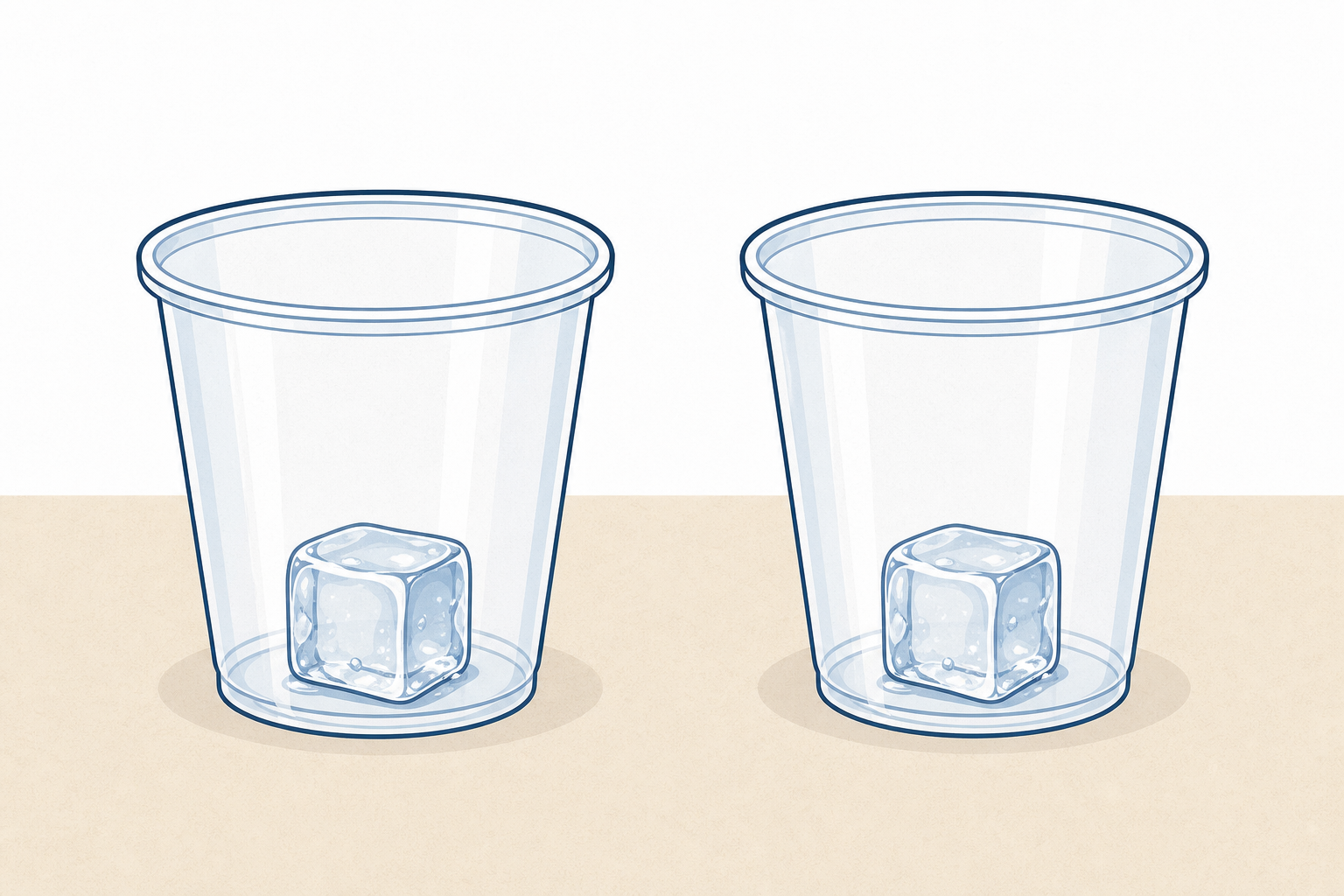
Look at these two ice cubes. If I leave one on the windowsill and one in a shaded corner, will they melt at the same speed?
How could we find out fairly?
Hold up two same-size ice cubes (or identical cups ready for them). Keep the hook light: one curiosity question only. Do not name variables or stage the full apparatus yet.
Science-talk: take three or four quick ideas. Common answers: the sunny one melts first; both melt the same; we need a clock. Accept all ideas without correcting yet.
Nature of STEM: people have always needed fair ways to compare (cooks timing a melt, farmers watching frost). Today the class meets that idea as a proper science rule.
Our question: Which place melts an ice cube fastest?
Our three places today: windowsill, shaded corner, and near the heater.
Predict which place will be fastest and say why. Predictions are the start of the science, not a guess to get right.
Agree the testable question together exactly as on the board. Confirm the three places on the board match the room you will use (windowsill, shaded corner, near a radiator or heater that is warm but safe to stand cups beside). Keep the three names visible for the rest of the lesson. Use location names only on the board; save warmth talk for after the results.
Each pupil says or whispers a prediction and a reason. Capture a few on the board as place names only (not full sentences).
Misconception to head off: some children think a prediction must be correct. Say clearly that a surprising result is still good data.
Predictions go on the Investigation Journal page later, when you fill the plan. Keep this beat oral.
A fair test means we change one thing, measure one thing, and keep the rest the same.
On the board are three bins: Change, Measure, and Keep the same. Five cards will appear: the place, how long the cube takes to melt, size of each ice cube, the cup, and when we start.
Help us sort each card into the right bin. Watch and talk first; keep your journal closed until we finish the board.
When every card is in place, copy the finished plan onto your Investigation Journal page so it matches the board.
Lead with the one fair-test idea first, then use Change / Measure / Keep the same only as the three sort labels on the board. Do not ask pupils to memorise four separate definitions before the cards move.
Sequence (do not run both at once): (1) drive the full card sort on the IWB with a short meaning as each card lands; (2) only then give a quiet minute or two for pupils to copy the agreed plan onto the Investigation Journal page. Watching first, writing second.
| Concept | Why it matters | Example |
|---|---|---|
| Fair test — a comparison where we change only one thing, measure one thing, and keep everything else the same | If two things change at once, we cannot tell which one caused the result | Same-size ice cubes in identical cups, started together, only the place different |
| Change — the one thing we deliberately make different | This is what we are testing | The place: windowsill, shaded corner, or near the heater |
| Measure — the result we time or count | Numbers let us compare trials fairly | How many minutes until the cube has melted fully (or rank / ice left if we stop early) |
| Keep the same — everything else we hold steady so only one thing differs | Same starting conditions make the comparison trustworthy | Cube size, cup type, and start time all match |
Drive the interactive on the IWB. Five cards appear: the place, how long the cube takes to melt, size of each ice cube, the cup, and when we start. Drag the place to Change, how long the cube takes to melt to Measure, and the other three to Keep the same. As each card lands, say one short meaning (for example: If one cube is bigger, it will take longer even in a warm place, so size must match.).
This is the class's first fair test: agree the structure together; do not hand design over to groups yet. Pupil demand is the one rule, the card sort, then copying the finished plan. The full inquiry cycle below is teacher modelling only; pupils do not need to track all five beats in this step.
Worked example to model aloud (teacher only) before the run:
Watch the class stopwatch on the board. We open it now, before any cube is set down. We start it together when every cube is in place, and we note the time when a place finishes melting.
Open the fair-test-timer on the IWB now, before cups or cubes leave the tables. Keep it visible for the whole melt. Start it on the shared class signal once every cup is in place in the next step. Use the mark control when a group's place finishes so the class shares one clock. If groups have optional table stopwatches, still align start with the board timer.
If melting overruns, freeze the comparison at one agreed clock time and rank remaining ice — same rule for every place.
We share three class places: windowsill, shaded corner, and near the heater.
We may not see every cube vanish. If time is up first, we stop together and rank the places by how much solid ice is left at that same clock moment. That is still a fair test.
Reassurance first: we may not see every cube vanish. If time is up we stop together and rank by ice left. That is still a fair test.
Class logistics (shared places): mark three shared stations only (windowsill tray or strip, shaded-corner tray, heater-side tray — heater warm but safe, cups not touching hot surfaces). Each group lines one cup at each station so several cups sit side by side at the same place. On one class signal, every group's last cube is in place and the board stopwatch starts (already open from the Class stopwatch step). Groups own their own three cups and read their own finish times or ranks. If space is very tight, run one shared class set of three cubes and every group records the same board times.
Hand out identical cups and same-size ice cubes (from one tray, or frozen overnight in identical bottle caps). Confirm the class stopwatch is already live on the IWB before cubes are placed. Start it the moment every cup is in place.
What to expect: the warmest place finishes first or has least ice left; the shaded corner often last. Times vary with the room. A radiator spot is often warmer than a dull windowsill — trust what your room shows. Let warmth emerge from the results; do not pre-label places as warm or cool on the board.
Optional reversible-change aside (not the main learning): near the end of the slot or after recording, you may pour one melt into a bottle cap and put it in the freezer (or a cool bag with ice packs) to show later that melting can reverse. Keep this brief so fair-test language stays the star.
Safety: ice only — no hot water, no flame. Cups near a heater must not touch hot surfaces. Wipe melt water as it appears so floors stay safe.
You're previewing this lesson. Get full access to this lesson and hundreds more — each one ready to teach, with interactive activities, printable resources and pupil progress tracking built in.