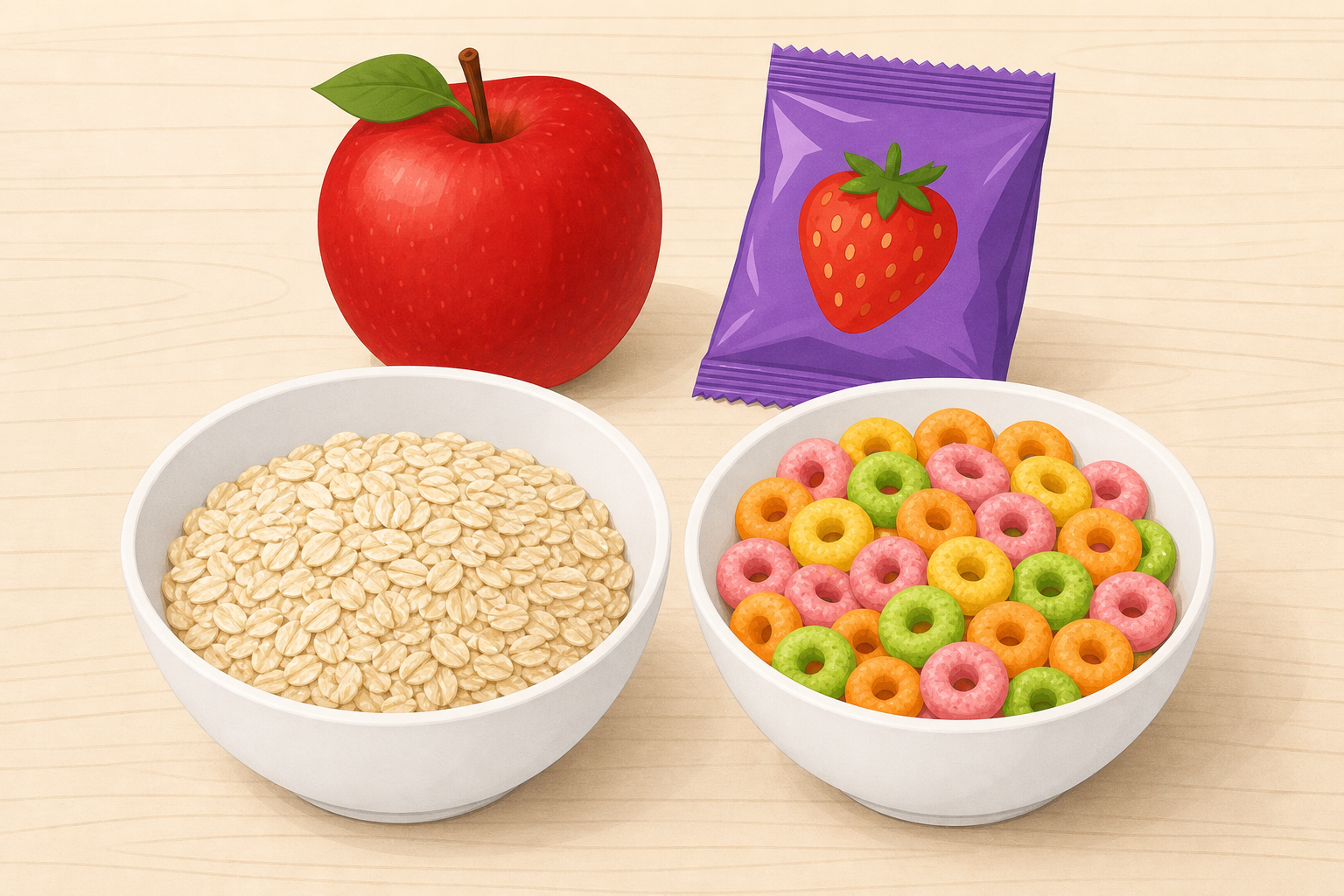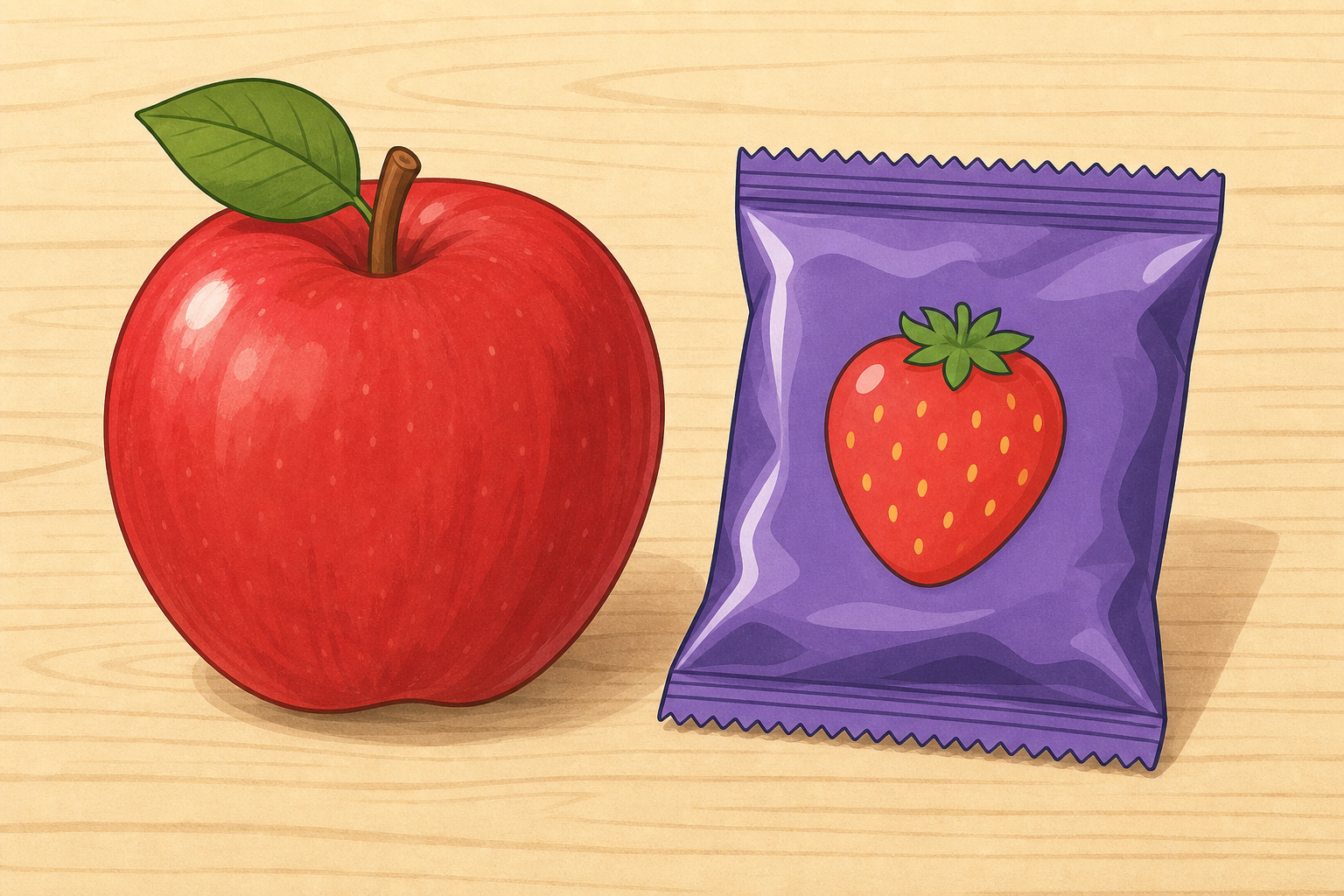
Look at these two foods. One is a fresh apple. The other is a fruit-flavoured snack from a packet. Both say something about fruit. Which one do you think has been changed more from a real fruit, and what clue on the packet could help us decide?
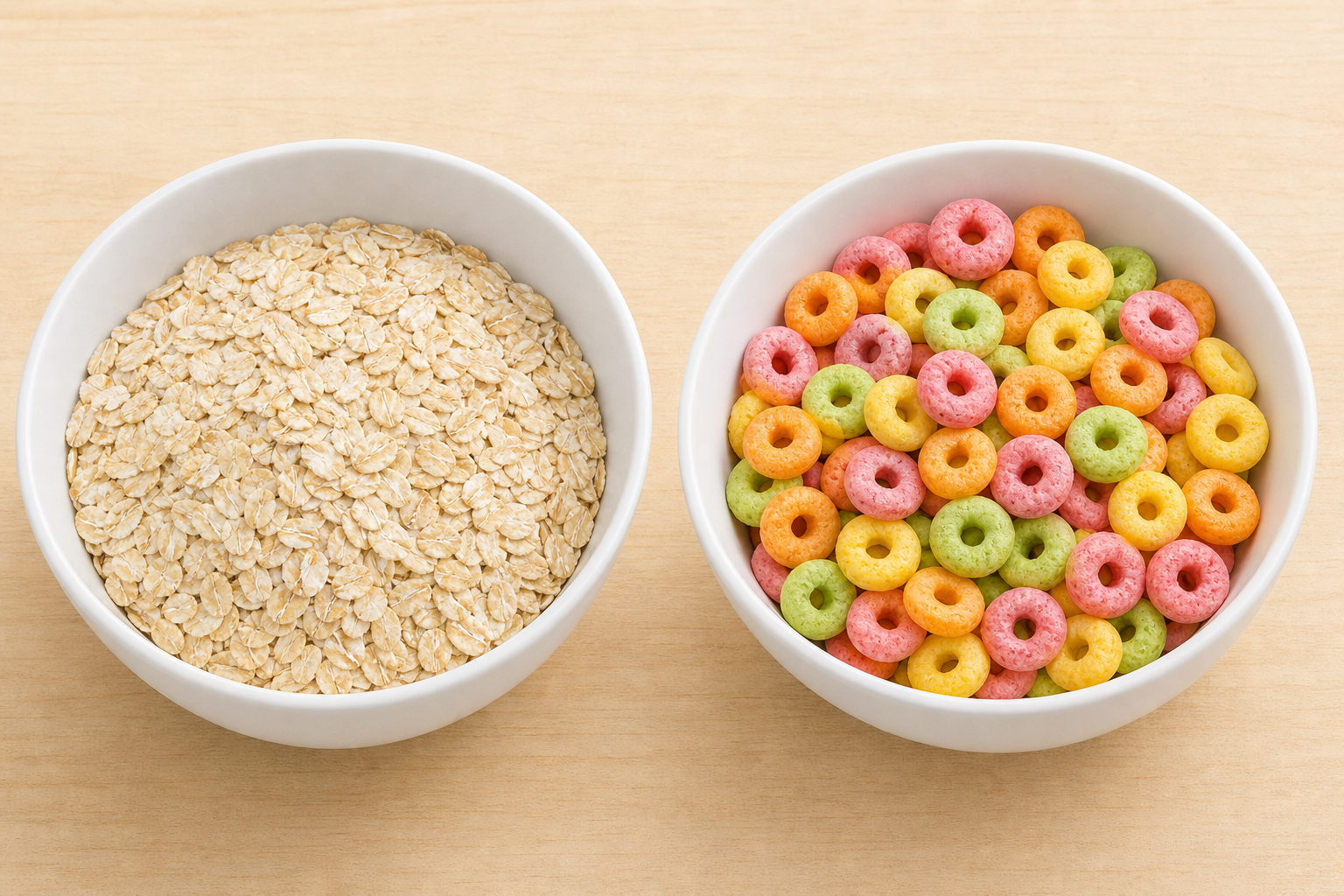
Materials decision (choose before you teach):
Canonical ingredients card set (print one set per group or shared between two):
For the pair investigation (Step 4), groups mainly need the four tray cards: apple, porridge oats, sugary cereal, fruit-flavoured snack. Keep the other four for the class consolidation and any borderline debate.
Hold up a real apple beside a clean, empty fruit-flavoured snack packet (or the matching printed card). Keep the hook light: one curiosity question only. Do not hand out packaging yet and do not explain the spectrum.
Ask: What clue on a packet could tell us how much a food has been changed? Accept ideas such as pictures, claims on the front, or the ingredients list. Steer gently toward the ingredients list without giving the full lesson away.
Before the lesson: decide Option A or B. If A, gather clean empty packaging with readable ingredients lists. Bring one fresh apple (class reference only) and one small bag or pot of plain porridge oats if available. Wipe packaging; no food is tasted. If B, print the ingredients cards from the lists above and skip hunting for missing packs.
Allergy note: check the class allergy list before bringing any food packaging that once held nuts, milk, gluten or other allergens. Keep packaging sealed in clear bags if needed.
Food scientists do not guess from the cartoon on the box. They read the list on the back. We will practise that skill.
A whole food is still close to how it grew, with little or nothing added — like a fresh apple or plain porridge oats.
An ultra-processed food has been changed a great deal, often with a long list of factory-made ingredients you would not keep at home — like a sugary cereal with colours and flavourings.
Many everyday lunchbox foods sit in the middle. They are a bit processed: changed in a useful way (baked, fermented or mixed) but still mostly kitchen ingredients, such as plain yoghurt or brown bread.
The ingredients list names what is inside, with the largest amounts first. How can that list help us judge how much a food has been changed?
Teach the four ideas in short beats before any sorting. Project only the short board text (one or two terms at a time, then an oral example). Pause after whole and ultra-processed for a quick call-out example, then name the middle ground, then the ingredients list and the closing question.
| Concept | Why it matters | Example |
|---|---|---|
| Whole food — a food still close to how it grew or was produced, with little or nothing added | Whole foods are often easier to picture growing on a farm or in a garden, and their packets (if any) have very short lists | A fresh apple or plain porridge oats: the list may be just "apple" or "wholegrain oats" |
| A bit processed — changed in some useful way (baked, fermented, mixed) but still mostly recognisable kitchen ingredients | Many everyday Irish lunchbox foods sit here; processing is not automatically a problem | Plain yoghurt (milk and cultures) or brown bread (flour, water, yeast, salt) |
| Ultra-processed food — a food changed a great deal from its natural state, often with many ingredients you would not keep at home | Knowing how much a food has been changed helps us make informed choices; it is not about calling one food "bad" | A sugary breakfast cereal may list sugar near the top, plus colours, flavourings and other factory ingredients |
| Ingredients list — the ordered list on a packet naming what is in the food, largest amounts first | The list is evidence. Scientists and dietitians read it instead of guessing from the picture on the front | If sugar or salt sits near the front of the list, there is more of that ingredient than of the ones written after it |
Middle ground: name a bit processed aloud with the board example. Processing is not automatically a problem: freezing, tinning and salting help keep food safe and stop waste. Today's question is how much a food has been changed, not whether processing exists.
Natural sweetness vs added sugar (say once with the apple): fruit can still be naturally sweet. When we check for sugar on a list, we mean sugar written as an ingredient that was added, not the sweetness inside the fruit itself. Keep the three checks focused on the list as evidence of change, not a full nutrition lesson.
Modelled investigation cycle (you perform; do not print the answers on the board):
Misconception to head off: children may think "natural" on the front of a pack proves a food is whole. The evidence is the ingredients list, not the marketing claim. Also avoid fear talk: preservation methods keep food safe; the skill is reading how far a food has been changed.
Nature of STEM: biologists, doctors and food scientists use evidence on labels to understand nutrition. Ultra-processed foods are a current Irish and global health talking point, including public debate about sugar and children's diets. Frame agency: reading a list is a skill pupils can use when choosing a lunch or snack.
Our question: which of two similar foods has been changed more from its natural state, and what does the ingredients list show?
Talk with your partner. For porridge oats versus a sugary cereal, and for an apple versus a fruit-flavoured snack, which do you predict will have the longer list and more words you cannot picture? Say why.
Agree the testable question in child-friendly language: Which food in each pair has been changed more, and what evidence does the ingredients list give us?
Pupils predict aloud in pairs, then two or three pairs share. Predictions are never wrong; they start the science. Listen for reasons linked to sugar, length of list, or "chemical-sounding" words. Do not confirm answers yet.
Prompts: Where do you expect sugar to sit on the cereal list? What might be the only word on the oats list? Remember the apple may have no packet at all — what would its "list" be?
In your group, study the two food pairs: porridge oats and a sugary cereal, then an apple and a fruit-flavoured snack.
The apple is our whole-food reference. It has no packet list: treat it as one ingredient — apple. Fruit can still be naturally sweet; when we look for sugar on a list we mean sugar written as an added ingredient, not the sweetness inside the fruit. On the apple, added sugar and salt are not listed.
For each food, use the three checks on the board (or the matching boxes on your Investigation Journal page): how many ingredients; how many you recognise from a farm, garden or home kitchen; and where added sugar or salt sits on the list. Jot each check while the packs are still on your tray.
Your group's decision: which of the three checks will you weight most when you say which food was changed more? Be ready to give that reason with list evidence.
Give each group a clear tray or bag with clean empty packaging or the printed ingredients cards (matching your materials decision from Step 1). Typical set per group or shared between two groups:
Apple: one fresh apple for the whole class (or a clear photo on the IWB). Hold it up or place it at a central station. Groups do not each need an apple. On the board write:
Three-check scaffold (project or write on the board so groups do not invent a table under pressure):
If anyone prefers, they can jot straight onto the matching fields on the Investigation Journal page instead of scrap paper. Point to those fields before trays go out.
If a group cannot read small print, one pupil holds a magnifying glass or you project a clear photo of that list on the IWB for that group only.
For each of the four foods they complete the three checks now on the scaffold or journal (do not wait until later).
One real group decision (Stage 4 agency): after the checks, each group chooses which of the three checks they will weight most in their "changed more" justification (list length, recognisable ingredients, or sugar/salt position). They still gather all three checks; they choose which clue leads their spoken reason. Different groups may weight differently — that is good science-talk if they cite the list.
Expected pattern (typical packs; real brands vary): oats and apple have one short entry; cereal and fruit snack have longer lists with sugar higher up and factory words (glucose syrup, flavouring, colour). Use whatever is actually on your packs; the skill is reading evidence, not matching a memorised answer.
Circulate and ask: What is your evidence? Is the picture on the front enough, or do you need the list? Which check will your group weight most, and why? Have you written the three checks down before you put the pack away?
Safety: no tasting, no opening of dusty packs near faces, wipe tables after handling packaging, wash hands if anyone has handled sticky residue. Reassign anyone with a relevant allergy to a pack type that is safe for them, or to a printed list you provide.
On your Investigation Journal page, record the foods you compared using the notes you just made. For each food, note how many ingredients you counted, how many you recognised, and where added sugar or salt sat on the list. Then write which food in each pair had been changed more, and the evidence that convinced you — including which check your group weighted most.
Pupils use the Investigation Journal page. You do not design the page layout; tell them what to record. This write-up happens before the whole-class spectrum so the journal stays a record of their own pair test, not a copy of the class answer.
How the three checks map onto the journal (say this aloud so success criteria are checkable):
If the printed Investigation Journal page has fewer labelled boxes than the three checks, pupils still write all three checks in the observation space (or a short bullet list under each food name). The success criterion is that the three checks and a justified conclusion are on the page, not that every printed heading matches a brand template.
Support writers with oral rehearsal first: The cereal was more changed because… If anyone only held numbers in their head, let them re-check a pack or card quickly before writing. Circulate to check they separate observation (what the list showed) from opinion ("I like it").
You're previewing this lesson. Get full access to this lesson and hundreds more — each one ready to teach, with interactive activities, printable resources and pupil progress tracking built in.