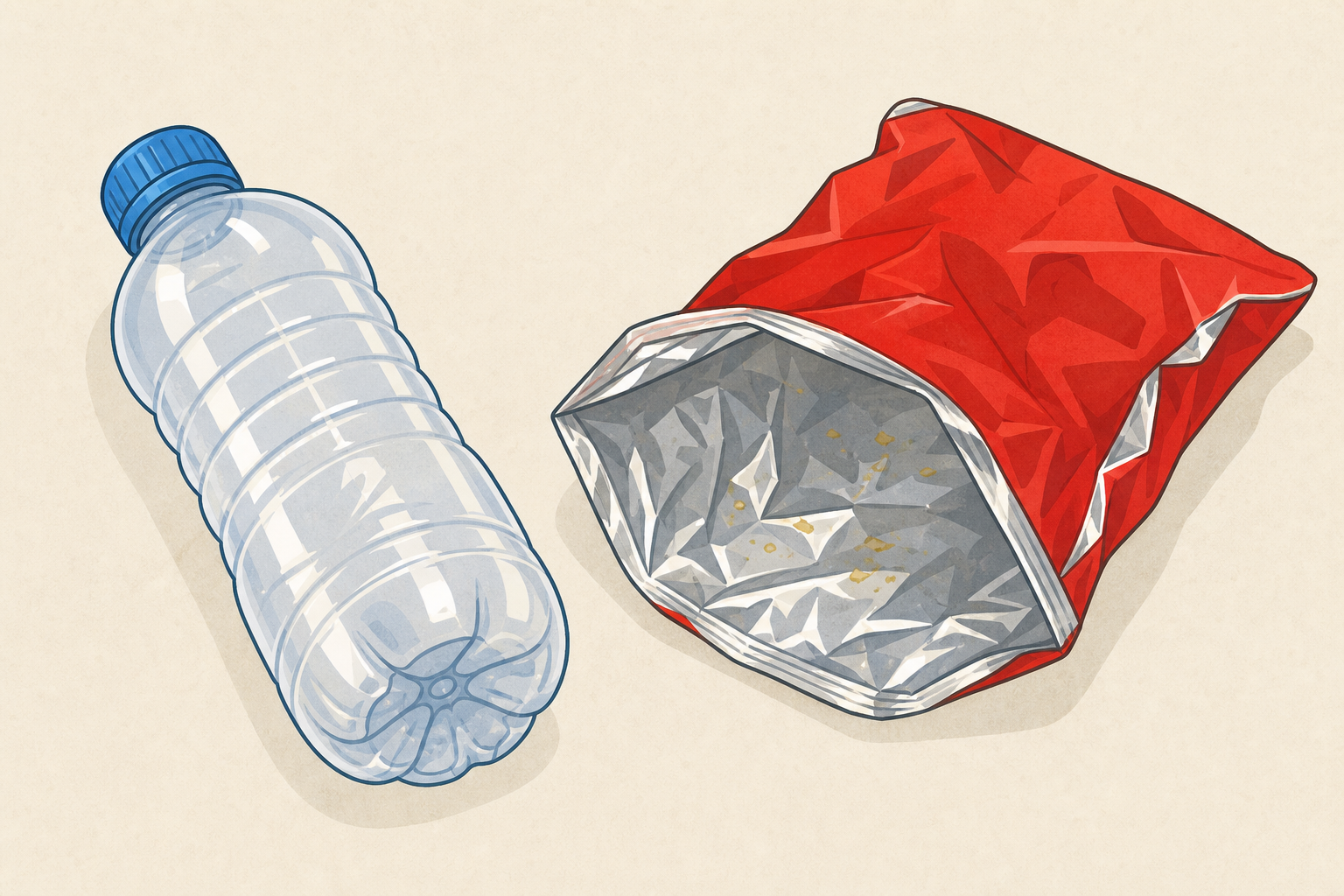
Look at these two clean empty items: a plastic bottle and a crisp packet. Which one do you think can usually go in the recycling bin, and which one cannot? Hands up your guess, and be ready to say why.
Hold up one clean empty plastic bottle and one clean empty crisp packet (or show them on the IWB). Do not reveal the full answer yet. Take three or four quick guesses and reasons only. The point is curiosity: children often think all plastic is the same.
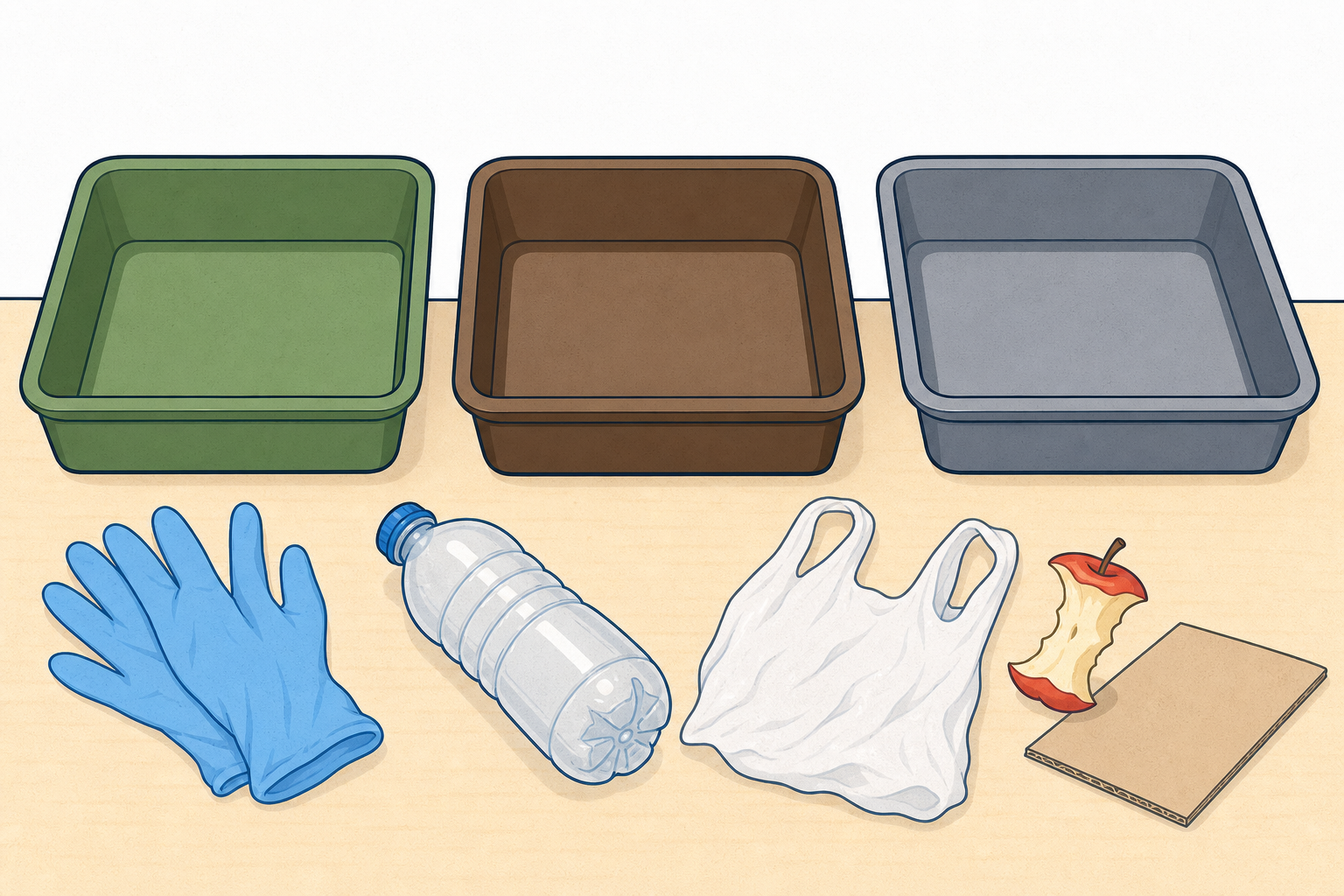
Before the lesson: gather a sealed bag of clean, dry, empty classroom waste samples for each group (minimum viable set below). Set out three trays or bins with the provided header labels. Print the Investigation Journal page. Have disposable or washable gloves ready (one pair per pupil, or shared pairs if supply is short).
Minimum sample set per group (8 items): clean plastic bottle or yoghurt pot, cardboard or newspaper, aluminium can or clean food tin, banana peel or apple core (sealed), crisp packet, dirty tissue, thin plastic bag, and one extra clean recyclable (e.g. glass jar picture or second pot). Add more from the full list if you have them.
Key question: How can we decide fairly which bin something belongs in?
Those two items both look like plastic, but they do not belong in the same bin. Today we use clear questions so we can sort fairly, not by guesswork.
We will sort into three bins: recycling (clean materials our scheme accepts, such as a rinsed bottle), compost (food and plant scraps such as fruit peel), and general waste (the rest, such as a greasy crisp packet or a thin plastic bag).
For every item we ask the same three questions: Is it food waste or plant material? Is it clean and dry paper, card, plastic, metal or glass? Is it a type our school recycling accepts (not thin plastic bags or greasy film)?
Teach only the three bin criteria now. Keep reduce and reuse for after the audit, as plain action language tied to what groups have just sorted. Keep the board short; use the table below as your reference.
| Concept | Why it matters | Example |
|---|---|---|
| Recyclable — a clean material our scheme accepts that can be turned into something new | Sorting correctly means useful materials are not lost in general waste | A rinsed plastic bottle, clean cardboard, paper, a washed food tin or a glass jar |
| Compost — food and plant scraps that can break down into a soil-like material | Food in the wrong bin smells, spoils recycling, and wastes a useful material | Banana peel, apple core, vegetable scraps (no packaging) |
| General waste — rubbish that cannot be recycled or composted here | Putting the wrong thing in recycling can spoil a whole load | A greasy crisp packet, a dirty tissue, or a thin plastic bag |
Decision path (same rule the interactive uses): food or plant material → compost bin; else if it is clean, dry paper, card, plastic, metal or glass and a type our recycling accepts → recycling bin; else → general waste.
Worked model (say aloud before the interactive): I wonder which bin this clean yoghurt pot belongs in. I predict recycling. Is it food waste? No. Is it clean and dry plastic? Yes. Is it a type our recycling accepts? Yes. So it goes in recycling. A thin plastic bag is different: it may look like clean plastic, but many school schemes do not accept thin bags, so the third answer is no and it goes to general waste. A greasy crisp packet also goes to general waste.
Misconception to head off: children often say “all plastic recycles” or “if it looks clean enough, it is fine when greasy.” Stress clean and dry plus accepted type, and that food waste and greasy packaging follow different rules.
Nature of STEM: materials scientists and waste engineers study what materials are made of and how they can be kept in use. In Ireland, people have already cut single-use plastic bags a great deal since the plastic bag levy was introduced; classrooms can still cut single-use packaging and sort more carefully.
Irish bin language: use the three groups the class will use today — recycling, compost (food and garden waste), and general waste. Match your school’s real bin colours if you know them, but keep the three criteria the same. If you usually say “residual waste,” treat it as the same as general waste so the tray labels stay consistent.
We will sort waste items on the interactive activity together. For each item, hands up yes or no for every question. Then check which bin it lands in: recycling, compost, or general waste. Call out if the bin makes sense.
Drive sorting-tree in explore mode on the IWB. The items on screen are: plastic bottle, cardboard box, newspaper, aluminium can, glass jar, banana peel, apple core, crisp packet, dirty tissue, plastic bag.
The three guide questions (same as the board and the group audit) are: Is it food waste or plant material? Is it clean and dry paper, card, plastic, metal or glass? Is it a type our school recycling accepts (not thin plastic bags or greasy film)?
The three groups are: recycling bin, compost bin, general waste.
Branching rule the interactive applies (narrate this so paths never diverge):
Work through four or five items with the class calling out yes/no. For each one, ask: Is it clean? Is it food? Does our recycling actually take this type? Could it spoil a recycling load?
Answer key for you:
If your local scheme differs for one item, say so honestly and stick to one rule for today’s sort so the test stays fair.
Differentiation: ask a quieter pupil to decide the next yes/no; ask a confident pupil to explain why a greasy item or a thin bag is not recycling even if it is “plastic.”
In groups, put on gloves and sort the clean sample waste on your table into three trays: recycling, compost, and general waste. Use the same three questions we used on the board. Keep a simple tally as you go: how many items land in each tray. Talk about any item your group is unsure about before you place it.
Remind pupils: only the prepared clean sample waste on the tables; no digging in real bins; gloves on; no tasting or smelling closely; wash hands after.
Groups of three to five. Each group gets one mixed bag or tray of clean sample waste, three labelled trays, gloves, and one scrap strip or sticky note for an in-step tally (three boxes: R / C / G).
Minimum viable sample set per group (8 items): 1 clean plastic bottle or yoghurt pot; 1 cardboard piece or newspaper; 1 aluminium can or clean food tin; 1 sealed fruit scrap (banana peel or apple core); 1 crisp packet; 1 dirty tissue; 1 thin plastic bag; 1 extra clean recyclable if available (second pot, glass jar, or tin). Full set can grow to 10–12 from the list below.
If real packaging is scarce (picture-card substitute): use the provided picture cards of the same items. Pupils still apply the three questions out loud. For “clean and dry,” the card caption or a tick/cross mark on the card tells them (e.g. “clean empty bottle” vs “greasy crisp packet” vs “dirty tissue”). Fruit-scrap cards count as food/plant. The criteria stay the same; only the sensory check is read from the card instead of felt.
The three tray headers say:
1. Groups tip out the sample and count how many items they have in total.
2. One item at a time, they ask the three sorting questions and place it.
3. As each item is placed, one pupil marks the group tally strip (R, C, or G). Disputed items stay in a “not sure” pile until a 30-second class check.
4. Flag disputed items for a quick class check: hold one up and revoice the criteria.
5. End of sort: groups should have three tray counts on the tally strip before they move to the journal.
Look-fors: groups using the questions, not guessing by colour of packaging alone; noticing “clean and dry” and “accepted type”; separating food from packaging; tally matching the trays.
If a group finishes early: ask them to pick one item that was hard and prepare one sentence for the class on why they chose that bin. Do not send anyone to a device.
Common sticky items: yoghurt pot (recycling if clean), crisp packet (general waste), apple core (compost), cardboard with heavy grease (general waste), clean newspaper (recycling), thin plastic bag (general waste unless your scheme clearly accepts it).
First job: on your Investigation Journal page, record only your audit. Write how many items went into recycling, compost, and general waste. Note one item that was tricky and which bin you chose, with a short why.
Second job (when the audit notes are done): think about making less rubbish in the first place. Reduce means use less so less waste is made. Reuse means use something again before binning it. Write one practical reduce or reuse idea our class or school could try.
This is the paper recording beat. Run it in two clear phases so pupils finish the audit record before new language appears.
Phase 1 (about 5 minutes) — audit only: pupils use the Investigation Journal page. Tell them what to capture (do not describe page layout):
Do not introduce reduce/reuse until most groups have those two audit notes down.
Phase 2 (about 5 minutes) — action language and design: in one short spoken beat, give the plain one-line meanings only (no full board table):
Then: write one practical reduce or reuse idea for the class or school. Keep this as action language tied to the waste they just sorted, not a second formal concept set.
Circulate and push for evidence language: We put the crisp packet in general waste because it was greasy plastic, not just rubbish.
Support: sentence starters on the board — We sorted __ items. Most went in __. One tricky item was __ because __. One reduce or reuse idea is __.
Challenge: ask a pair whether their sort would still work if an item was wet or food-soiled, and what that tells them about looking after recycling.
Journal match: the provided Investigation Journal page for this lesson should prompt exactly those three captures (bin counts, one tricky item with why, one reduce/reuse idea). If using plain paper, write the same three prompts on the board.
You're previewing this lesson. Get full access to this lesson and hundreds more — each one ready to teach, with interactive activities, printable resources and pupil progress tracking built in.