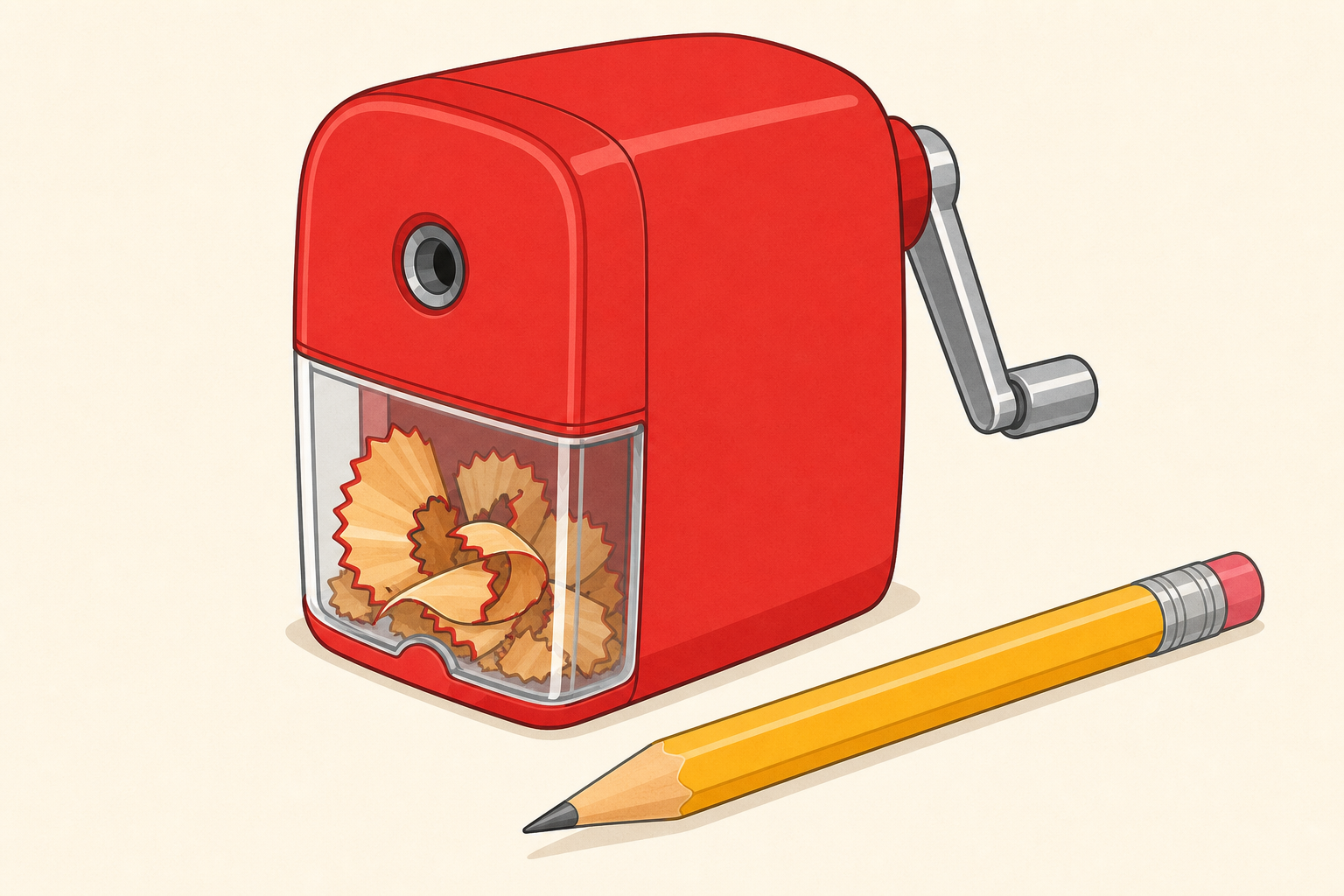
Think of something you do every day, like tying a shoe or washing your hands. Could a robot do that job if we only told it half the steps?
If we forgot to turn the sharpener handle, would the pencil ever get a point?
Today we will break everyday jobs into ordered steps, then play robot and spot what is missing.
Keep this light. Hold up one everyday object if you wish (a pencil sharpener or a classroom door) and ask what it does — do not lay out the step cards yet.
Key question: What would go wrong if we missed one step?
Pupils already know how to notice and sort. Frame this as a new way of looking: devices and jobs work because steps happen in order.
Today's big idea: jobs work in steps in order — small actions from first to last, like a recipe.
If one step is missing, the job fails.
Watch: can we put the pencil-sharpener cards in the right order?
Project only the short board text. Do not introduce the word algorithm yet — save that name for after groups have built an ordered list (step 5). Use the table below for yourself.
| Concept | Why it matters | Example |
|---|---|---|
| Steps in order — a job broken into small actions that must happen one after another | If the order is wrong, the job does not work, even if every action is a good one on its own | You must put the pencil in before you turn the handle, or nothing is sharpened |
| Missing step — a part of the job left out so it cannot finish correctly | Finding the gap is how we fix instructions — for people and for machines | Forgetting to turn the handle means the pencil stays blunt |
| Algorithm — a clear list of steps that tells how to finish a job (introduce later) | Everyday devices and apps follow algorithms, just as a recipe tells a cook what to do | After play-robot: the ordered step cards the group built are an algorithm |
Order the four sharpener cards with the class only. Do not run the full missing-step reveal here — that is the first beat of group play in step 3.
I wonder: How does a pencil sharpener actually do its job?
I predict: I think we put the pencil in, turn the handle, then take the pencil out.
I test (board only): Lay the four Set A cards face up (mixed). With the class, put them in order on the board ledge or floor. Read them aloud once left to right. Name the idea: these are steps in order — first to last, like a recipe.
Bridge to play (about 30 seconds, optional): Point at the line and say, In a moment one card will go missing. Watch what happens when your robot tries the job without it. Then send groups to their own sets. Prefer Set A for the board model — every card is a clear physical action.
Misconception to head off: Pupils may think any list of actions is fine. Stress that order matters and that one missing step breaks the whole job — they will prove this themselves next.
Prep rule (one place only): Print and cut one 4-card job set per group, mixing Sets A, B and C across the class so neighbouring groups have different jobs where you can. Also print one spare of each set for the board model and for early finishers to borrow. Do not give every group all three sets.
Author every card fully so nothing is left for the teacher to invent. Keep wording very short (a few plain words). Optional: a simple line drawing beside the words helps mixed readers. Cut into separate cards. Mix the order before handing out. Peer-read-aloud is the scaffold — one confident reader can say the card while the robot acts.
Before the lesson: print and cut one job set (A or B or C) per group; print one spare of each set for the board and swaps; keep Set A ready as the default model. Clear a small floor or carpet space for play-robot. No interactive is used in this lesson. Have plain paper or Investigation Journal pages and pencils ready.
In your group, you get one job: pencil sharpener, sending a message, or washing hands.
1. Mix the four step cards, then put them in the order that makes the job work.
2. One pupil is the robot. The others read each card aloud. The robot does only what that card says — nothing extra.
3. Now hide one card. Run the job again. What goes wrong? Which step is missing?
Setup: Groups of three or four. Give each group one 4-card job set (A, B or C) — not all three. Prefer Set A (sharpener) for any group that needs the clearest physical actions. Set B needs a shared pretend phone (or flat hand). Set C is washing hands — every card is one child-robot action. Clear floor space for the robot to move safely.
How to run (parallel group play for the full 16 minutes):
Class fold-in: Keep this step as simultaneous group play-robot. Whole-class share happens in step 5. Optional only: if one group finishes early and you have about one spare minute, they may show a single missing-step rerun at the front while you ask watchers What broke? — this is not required and does not need its own timing block.
Look-fors: cards left to right in a true sequence; robot not adding extra actions; group can name the missing step in plain words.
Differentiation: Support — start with Set A (sharpener) and keep all cards visible while ordering. Stretch — invent one extra ‘wrong’ card (e.g. ‘eat the pencil’) and explain why it does not belong; or borrow a second set from a neighbouring group / the spare pack and spot one missing step there.
STEM eyes: Link to recipes, PE warm-up sequences, and school routines — everyday jobs work when steps are complete and in order, just like devices.
On your paper, show your job in two parts.
1. Number or draw the four steps in order.
2. Draw or label only the missing step, and write or say what went wrong without it.
Full sentences are optional — a short label or a quick drawing is enough.
Pupils record on paper only. Default sheet: plain paper (or the Investigation Journal page if printed). Three things only: ordered steps, hidden step, what failed. Do not invent journal column names or describe a special layout — the prompts above are the whole task.
Pacing for slow writers (7–8): Number the four cards 1–4 in order, then draw only the missing step and say aloud what failed. A short label is enough — full sentences are not required and the pupil text already says so.
Circulate and ask: Could a robot finish with only the steps you wrote?
If a group finishes early, they may borrow a second job set from the spare pack or a neighbour and spot one missing step there — still on paper, not on a device.
Share one thing with the class: which step did your group hide, and what went wrong?
That ordered list of steps you built is called an algorithm — like a recipe that tells how to finish a job.
Now think of making toast, unlocking a door, or loading the dishwasher. What would go wrong if one step was skipped?
Spotting the missing step is how people who make apps and machines fix jobs.
Display-only science talk. No typing into the platform.
Introduce algorithm now (after hands-on ordering): point at a group’s finished card line and say, That clear list is an algorithm — a recipe for the job. Keep it light; one concrete example from their own cards is enough. Avoid stacking new adult roles; say people who make apps and machines rather than coders.
One share question at a time (start from the step they hid):
Draw out:
Anchor stems: If I skipped turning on the tap… / If I forgot to press send… / If I put bread in the toaster but never pressed down…
Revoice: Turn pupil ideas into the words algorithm and missing step without a lecture.
Optional homework (noting only): At home, watch one everyday job (making toast, unlocking a door, loading the dishwasher) and tell an adult the steps in order — no digital task.
You're previewing this lesson. Get full access to this lesson and hundreds more — each one ready to teach, with interactive activities, printable resources and pupil progress tracking built in.