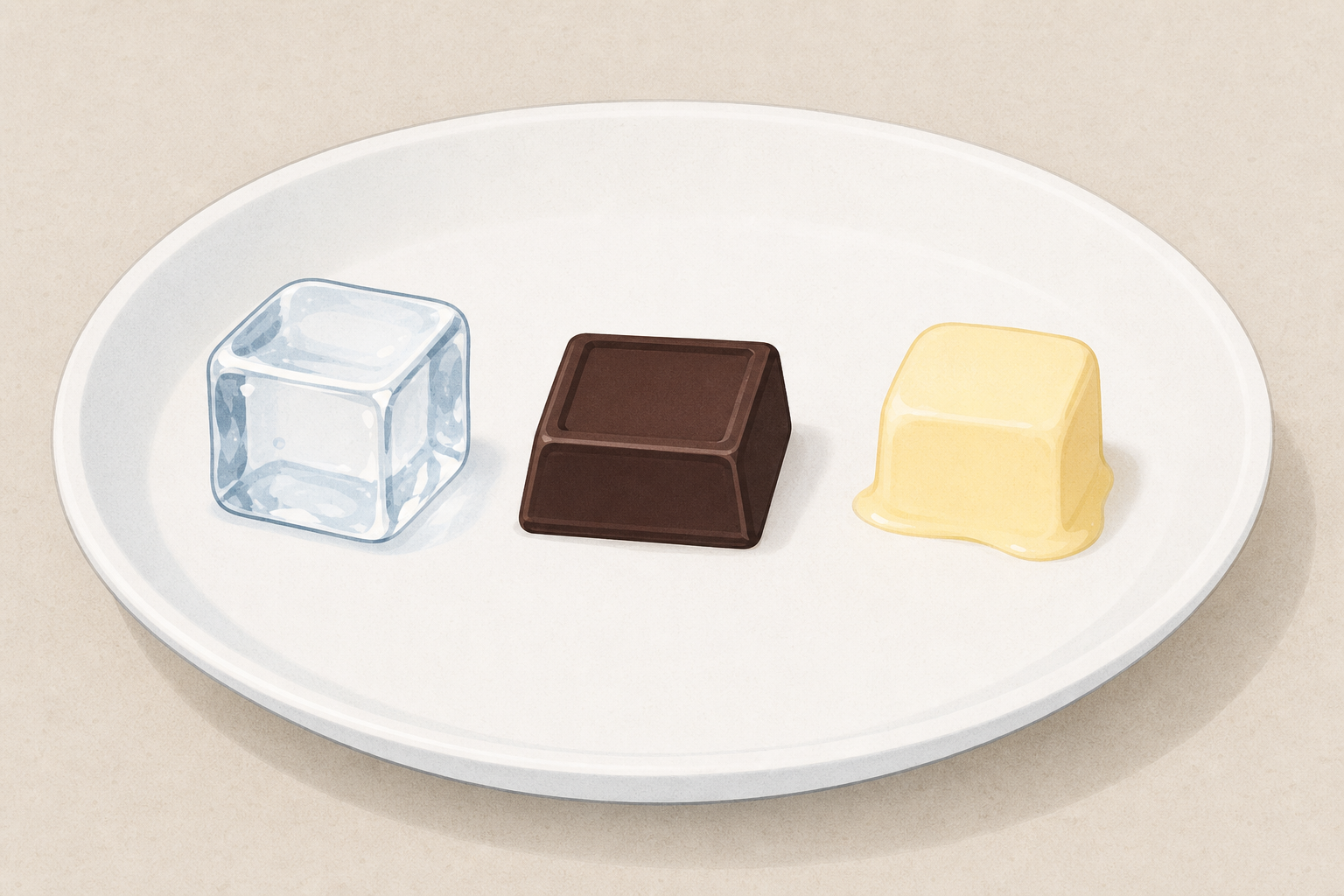
Look at these three things: an ice cube, a square of chocolate and a small lump of butter. If gentle warmth reaches them, which do you think will change first, and will any change only a little?
Show of hands as we go: ice first… chocolate… butter… We will watch carefully and find out.
Hold up one ice cube, one plain chocolate square and a small lump of butter so the whole class can see them. Keep the warm-water set-up out of sight for now so the hook stays a curiosity beat, not the full set-up.
Take three quick hand counts (ice, chocolate, butter) and leave the guesses on the board as tally marks. Do not correct anyone yet. Predictions are the start of the science.
Before the lesson: freeze same-size ice cubes; break plain chocolate into equal squares; cut small equal lumps of butter; set a jug of warm (hand-safe, not hot) water ready but keep it off the pupil tables. Print the Investigation Journal page.
You have already met ice that turns to water on a warm day. Today we name what is happening.
Two words for today: melt means a solid softens and turns liquid when it is warmed. Cool means something loses heat and gets colder.
Which of our three materials do you think will melt first on gentle warmth? After we watch, we will add one more word for changes that can go back.
Keep this board light: only melt and cool before the demo. Hold the full idea of reversible change until after the cooling watch (step 5), when pupils have seen something firm up or heard why water needs a freezer.
Use the table below as your own reference while you talk.
| Concept | Why it matters | Example |
|---|---|---|
| Melt — a solid softens and turns into a liquid because it is warmed | Cooking, weather and factories all rely on knowing which solids melt when warmed | Chocolate on a warm tray goes soft, then runny, just as ice turns to water |
| Cool — something loses heat and gets colder again | Cooling is how melted things can firm up or freeze back into solids | Melted butter left away from the warm water slowly firms up on the foil dish |
| Reversible change — a change that can go back the other way so the material can return to how it was | Knowing a change can reverse helps us reuse materials instead of wasting them | Ice melts to water; that water can freeze back into ice in the freezer |
Misconception to head off later (not yet): children may say melted chocolate has "gone" or been destroyed. It is still chocolate, only in liquid form. Also, "reversible" does not mean it always happens by itself in the classroom: ice water needs a freezer (or a very cold place) to become solid ice again.
Nature of STEM: cooks and chefs have always used gentle heating and cooling: melting butter for baking, setting chocolate, freezing water for ice. People worked these changes out by watching carefully long before science lessons named them.
Our question today: What happens to ice, chocolate and butter when we warm them gently, and what happens when we cool them again?
On your Investigation Journal page, write or draw what you think will happen to each one when it is warmed, and whether you think any of them can go back when cooled. Say why in a short phrase.
Agree the question together on the board. Predictions are never wrong; they are the start of the science.
Circulate while pupils record a quick prediction for each material. Sentence stems if needed: I think the ice will… because… / I think the chocolate will… / I think when we cool them…
Invite three volunteers to share one prediction aloud. Keep the class folded in: Do you agree? What would you add?
Differentiation: some pupils may draw symbols (solid block → puddle) instead of full sentences. That is fine if they can say their idea aloud.
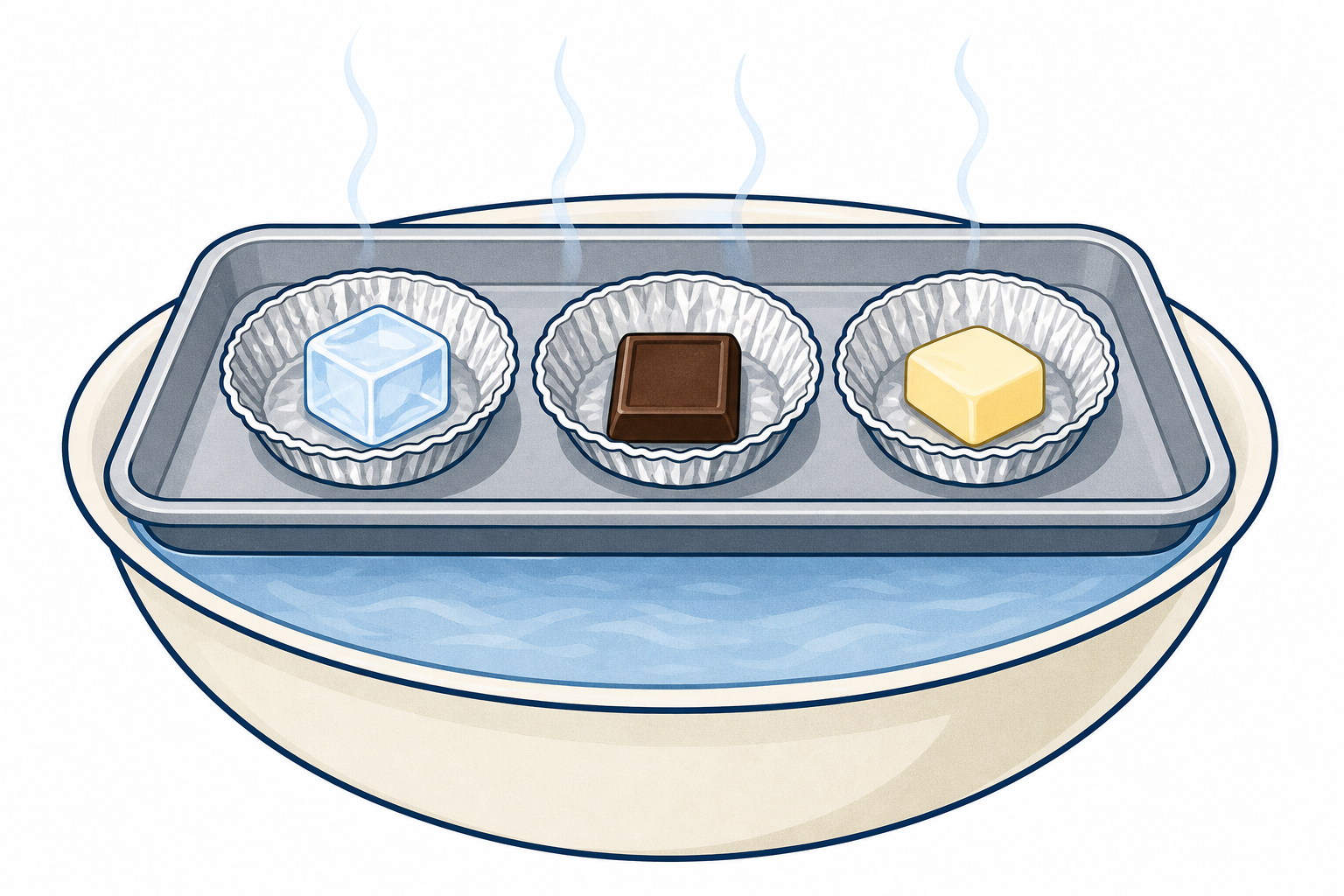
Watch the teacher's tray. Three foil dishes hold ice, chocolate and butter. Warm water sits under the tray. Keep your Investigation Journal open: check the prediction you already wrote, then jot or sketch as you watch (solid, soft edges, or puddle).
Look for soft edges, shiny pools and any dish that still holds its shape. We do not touch or taste anything on the tray.
Set up so the materials list alone is enough: pour warm, hand-safe water into the basin or large roasting tin. Place the three identical small foil dishes on the shallow tray or baking sheet. Rest that tray in the basin so the underside of the tray is in contact with the warm water, while the dishes stay dry inside the tray. Do not try to float the loaded tray. Put one same-size ice cube, one plain chocolate square and one small lump of butter each in its own dish. Pupils stand back in a viewing arc with pencils ready. No pupil pours water or handles the tray.
Tell the class: pencils ready during the watch, not only after. A 1–2 minute mid-demo jot is enough: tick or sketch solid / soft / puddle for each material as change appears. Full sentences come later in the record step.
I wonder: will gentle warmth melt all three, or only some?
I predict: (point back at the journal predictions) I think the ice will melt fairly quickly, the chocolate and butter will soften and may melt, and none of them will stay completely unchanged.
I test: I leave all three dishes on the same warm tray for the same time so the only difference is the material itself.
I observed (typical result): the ice usually melts first into clear water; chocolate softens then pools; butter softens and may melt to a yellow liquid. Times vary with how warm the water is, but ice almost always goes first.
I think: gentle heat can melt some solids into liquids. The material is still there; it has changed state.
Key questions while they watch: What is changing first? Is the chocolate still chocolate? Which edges went soft? Does this match what you predicted?
The dishes are away from the warm water now so they can cool. Watch again, and add a quick cool note or sketch on your Investigation Journal page.
Look for: edges that firm up, a thicker or dull top on the chocolate pool, butter that looks less runny, and which dish still looks most like a puddle.
Lift the shallow tray out of the warm water (or move the three dishes onto a cool plate) so cooling can begin. Keep pupils in the viewing arc with journals open for a quick cool jot (symbols fine). Keep the board to watch prompts only while they look; do not announce typical outcomes on the IWB yet.
Pace the wait with short whole-class look-fors so there is no dead air while change is slow:
After they have looked, land results and the word by talk (not on the board during the watch): Butter often begins to firm at the edges; chocolate may thicken or dull on top as it cools; the melted ice usually stays liquid water here. If a change can go back, we call it a reversible change. Butter setting again is one example. Water staying liquid here is still useful evidence: the reverse step for ice needs colder conditions.
What to expect: butter often begins to firm at the edges within several minutes; chocolate may thicken or dull on the surface as it cools; the melted ice stays liquid water in a normal classroom and will not refreeze without a freezer or very cold place. Only claim what the demo can show in this slot. Water staying liquid is the planned teaching point, not a failed reverse.
If you have freezer access later in the day, you may show one cup of the melt water frozen again as a follow-up, or simply tell the class that is how the reverse step is finished for water.
Misconception: some children think only ice is "allowed" to reverse. Butter and chocolate setting again on cooling are also everyday reversible changes (solid to liquid and back), even if the set solid looks a slightly different shape.
You're previewing this lesson. Get full access to this lesson and hundreds more — each one ready to teach, with interactive activities, printable resources and pupil progress tracking built in.