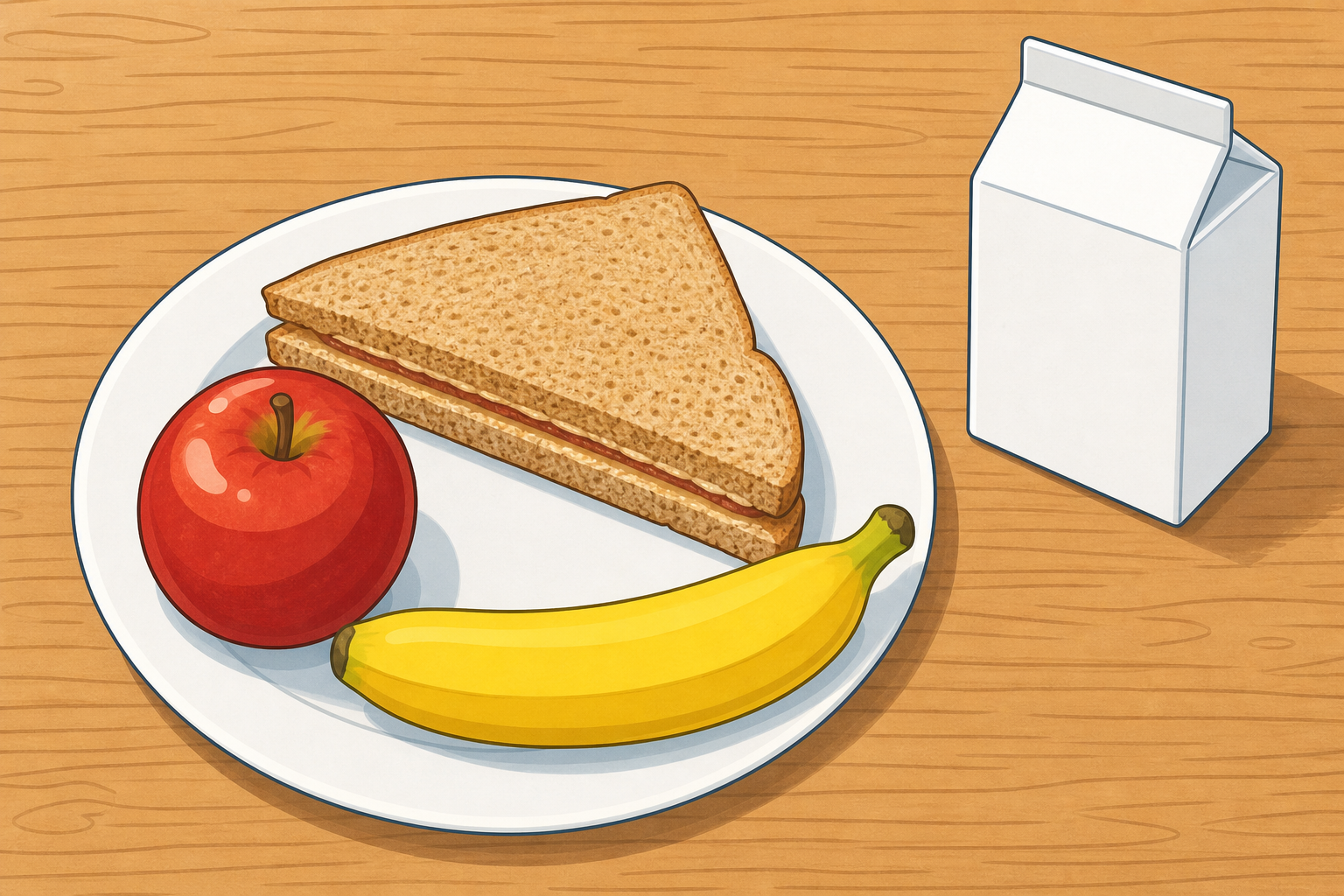
Think about your school day. You run, you listen, you play, you think hard. What keeps you going from morning until home time?
Hands up: what do you think gives your body the energy to do all of that?
Keep this light. Stand at the board and invite three or four quick ideas only. Accept food, sleep, water, rest, or play without correcting yet. The lesson will gather these into clear needs.
STEM eyes: link to the immediate school day the children just lived through, not an abstract body chart.
Have the activity cards and needs cards ready nearby, but do not hand them out yet.
Today's big word is energy: the go-power our body gets from food (our fuel) so we can grow, run and think.
Where do you think most of your energy for school comes from?
We also need more than food. Our second word is needs: the things our body must have to grow and stay well.
Our needs are food, water, air, sleep and care.
Project only one short line at a time on the IWB so pupils meet one idea before the next appears. Order: (1) energy meaning, (2) the question, (3) needs meaning, (4) the five needs. Do not show the full block at once. Use the table below yourself; do not project the full table.
| Concept | Why it matters | Example |
|---|---|---|
| Energy — the go-power our body gets from food (our fuel) so we can grow, play, run and think | Without enough energy from food, children feel tired and find it harder to learn and play | Breakfast before school helps you run in the yard and concentrate on your work |
| Needs — the things our body must have to grow and stay well: food, water, air, sleep and care | Meeting these needs helps every child grow and stay well through a full school day | Water at break, sleep at night, fresh air outside, and care from adults all help you stay well |
Worked model (say this out loud, do not project it as a script for children to copy):
Optional if time allows (cut these first if the board beat is tight):
Misconception to head off: children may say only sporty jobs need energy. Gently show that reading, listening and thinking use energy too. Do not talk about calories, numbers on labels, or ranking anyone's lunch. Keep saying food is like fuel; energy is the go-power food gives.
Ask: Does your brain need energy when you are sitting still and thinking?
Pick a card. Put it on the mat labelled Food gives me energy for this. Tell your group why food helps you do that job.
Do the same for each card. Quiet jobs such as reading or listening need food energy too. Be ready to share one card and your reason if we have time.
Print the provided activity cards (one set per group). Place one large mat or hoop label per group: Food gives me energy for this. There is only one mat on purpose. This is place-and-say-why talk, not a two-pile sort.
Card 1 — Running: Running fast in the yard at break.
Card 2 — Reading: Sitting quietly and reading a book.
Card 3 — Football: Playing a game of football with friends.
Card 4 — Thinking: Working hard on a tricky maths problem.
Card 5 — Climbing: Climbing on the climbing frame.
Card 6 — Drawing: Drawing a careful picture at your desk.
Card 7 — Skipping: Skipping with a rope in the yard.
Card 8 — Listening: Listening carefully to a story on the carpet.
Model one card first with the whole class. Hold up Card 4 (Thinking). Do a quick whole-class check: Does this job need food energy? Yes. Even though I am sitting still, food helps my brain think. Place it on the mat. Then name a quiet example out loud: Quiet jobs such as reading or listening count too.
Then groups pick cards one at a time, place each on the mat, and say why. Every card belongs on the food-energy mat. If a group sets a quiet job aside, ask: Does your body still need fuel when you are reading or listening?
Timing and what to drop: The main learning is group place-and-say-why while you circulate (aim for each group to justify at least three cards, including one quiet job). A short whole-class share (two or three pairs) is a bonus only if time remains at the end of the 10 minutes. If groups move slowly, drop the class share first. Next, let groups finish fewer cards with full reasons rather than rushing all eight in silence. Do not extend this step into the acting-out slot.
Look-fors: children name food as the fuel; they accept that thinking and listening count; pairs can justify one choice in a short sentence.
Differentiation: offer a sentence starter on the board: Food gives me energy to… Confident groups can also say whether a job needs a lot of energy or a little, still keeping food as the source.
We will act three ways we use the energy food gives us. First, freeze like a statue.
When I say go, show energy for running. Freeze again. Next, show energy for thinking. Freeze again. Then show energy for playing.
After each freeze, whisper to your partner: when did food help you feel ready for that today?
Clear a little floor space or stay standing by desks. Keep movements small and class-friendly: march on the spot for running, tap temples gently and look focused for thinking, clap a quiet rhythm for playing.
Sequence:
After each freeze, take two partner whispers. Keep the link general and time-based (breakfast before learning, lunch before afternoon play, water through the day, sleep at night). Revoice: food fuels the body and the brain. Do not invite ranking of foods or inventing special 'running snacks' versus 'thinking snacks'.
Observation focus: children notice that meals and rest keep them going from morning assembly to home time. No tasting and no comparing packed lunches.
Safety: stay in your own space; no racing across the room.
Our class will build a poster: What we need to grow and stay well (that is what thrive means).
The five needs cards are food, water, air, sleep and care. For each one, tell us one reason it helps a child grow and stay well.
Print the provided needs cards. Stick a large sheet of poster paper on the wall or board with the title What we need to grow and stay well (or use clear whiteboard/noticeboard space). Leave a little space under each card for a short teacher-written phrase.
Card A — Food: Food gives our body energy to grow, play and think.
Card B — Water: Water keeps our body working well through the day.
Card C — Air: We need clean air to breathe every minute.
Card D — Sleep: Sleep helps our body rest, repair and grow at night.
Card E — Care: Care from family and adults keeps us safe, calm and well.
Reveal one card at a time. Ask the focus question once, take one short answer per need, stick the card, and you write a brief phrase under it (or revoice orally if writing would slow you). Do not collect a sticky note from children under every card. That overhead will overrun the slot.
Spend a little more talk on food (energy link) and sleep if needed; keep water, air and care to one crisp reason each so all five stay visible and meaningful.
Prompts:
Points to draw out: all five needs work together; food is the main source of energy for activity and thinking; sleep and care are not extras. Keep language gentle and hopeful. Pair the word thrive with grow and stay well whenever it appears. Avoid weighing food talk, diet talk, or ranking home meals.
Differentiation: offer the stem This helps me grow because… for less confident speakers.
You're previewing this lesson. Get full access to this lesson and hundreds more — each one ready to teach, with interactive activities, printable resources and pupil progress tracking built in.