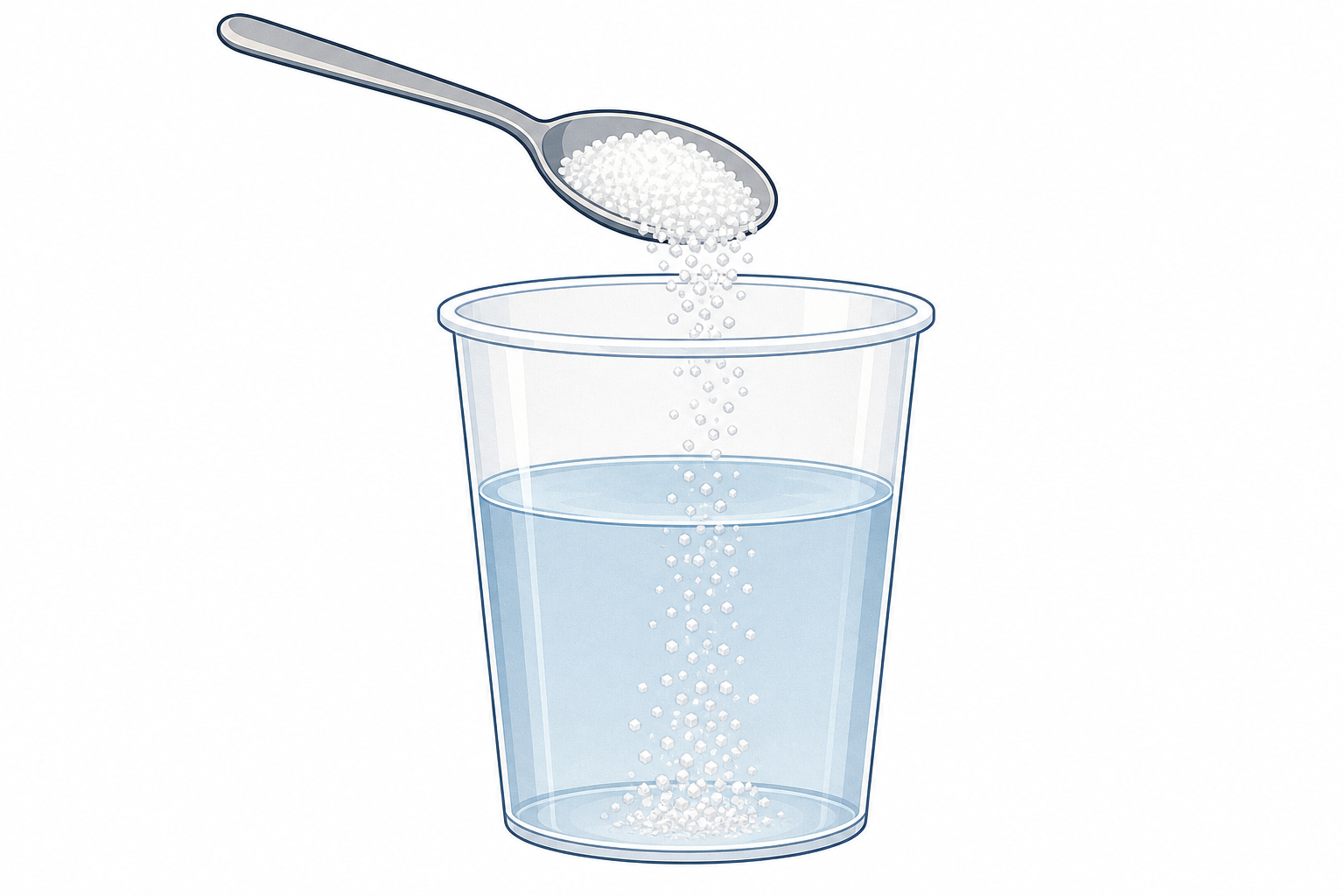
Watch this spoon of sugar go into warm water. Where does it go? Does every solid disappear from sight like that, or do some stay behind?
Today we will test four materials fairly and find out which ones dissolve in water.
Hold up a clear cup of warm water and stir in half a teaspoon of sugar so the class can watch it disappear from sight. Do not show sand or flour yet — keep the surprise for the investigation.
Key question: If the sugar is gone from sight, is it still there? Accept ideas; do not settle the science yet. You will close this loop in the evidence discussion.
Misconception to head off later: dissolving is not the same as melting. Melting is when a solid turns to liquid from heat alone; dissolving is when a solid mixes into a liquid so the pieces are no longer separate.
Grouping: plan groups of 4–5 so each group can share four cups, one measuring spoon, one stirring spoon and one timer.
Our question: Which materials dissolve in warm water, and how long do they take?
On the board are six cards: the material, time to dissolve, amount of water, water temperature, how we stir, and amount of each material. Call out which box each card belongs in: Change, Measure, or Keep the same.
Your group’s design choice: agree how you will judge that a material has dissolved (for example, no solid pieces left on the bottom, or the liquid looks clear with no cloudy bits). Write that rule on your Investigation Journal page.
Then each of you notes a quick prediction: which materials will dissolve, and which will be fastest.
Open the fair-test-planner interactive on the IWB in explore mode. The six cards must match the prose above exactly. Do not show a sample prediction on the board — pupils write their own on the journal first.
Drag cards as pupils call them. If someone puts water temperature under Change, ask: If one cup is hotter, how would we know it was the material that made the difference?
After the class plan is agreed, each group decides how they will judge “dissolved” when calling stop. Accept more than one sensible rule; the point is that the group owns the decision and sticks to it for every material. Flour will force a careful call — that is useful science talk.
| Concept | Why it matters | Example |
|---|---|---|
| Dissolve — a solid mixes into a liquid so you can no longer see separate pieces | Cooking, cleaning and many drinks rely on solids dissolving in water | Sugar vanishing in warm tea while sand would sit on the bottom |
| Soluble / insoluble — soluble means it can dissolve; insoluble means it cannot | Helps us sort materials by how they behave in water, not just how they look | Salt is soluble in water; sand and flour stay visible |
| Fair test — change one thing, measure one thing, keep the rest the same | Only a fair test lets us trust which material really dissolved faster | Same warm water, same spoonful, same stir for sugar, salt, sand and flour |
Board version only (already in description): keep the full table here, not on the IWB.
Predictions are never wrong — they start the science. Keep this beat short (about one minute) so groups still have time for the investigation.
Will salt behave like sugar, and what about sand and flour?
1. Watch first. We lock one timing method together. Watch the stopwatch on the board while we run one full sugar trial at the front. Start when the material goes in and stirring begins. Call stop using your group’s dissolve rule, or when two minutes are up.
2. Your group kit. In your group of about four you have four clear cups and four materials: sugar, salt, sand and flour. Agree roles: one times, one stirs, one watches for pieces, one records. Test one material at a time.
3. One trial. Pour warm water from your jug into one cup just before that material (do not fill all four cups at the start). Add one level teaspoon, start the timer, and stir the same way each time.
4. What to write. On your Investigation Journal page, write dissolves or does not dissolve, and the time in seconds if it dissolves. Leave the time blank if pieces are still there at two minutes.
Open the fair-test-timer (stopwatch, laps on) and keep it visible for the whole of this step so every group shares the same start and stop rules. Groups may also use table stopwatches, but model the method once on the IWB first.
Use sugar at the front while groups watch — cups stay untouched until this model is done. Think aloud:
Then groups run salt, sand and flour themselves (and may re-check sugar). Sand should remain visible (insoluble). Flour often clouds the water without fully dissolving — count it as does not dissolve if cloudy bits remain under the group’s agreed rule. Salt usually dissolves but may take longer than sugar.
Groups pour from the jug into one cup immediately before each material. Check they are not pre-filling all four cups at the start of group work — sequential trials from one warm jug will drift if cups sit waiting. Remind: water from the same jug, same volume mark (e.g. 100 ml).
Pupils record live on the Investigation Journal page during each trial (material, dissolves yes/no, time in seconds or blank). There is no second copy later — the next step is only a quick check that the table is complete.
Classroom cutoff: if solid pieces remain at two minutes, record does not dissolve for this test. Solubility is not defined by two minutes — the cutoff is only so every group finishes fairly.
Safety: warm water from a kettle mixed with cold just before testing — comfortably warm, never hot enough to scald. No tasting. Wipe spills at once.
Differentiation: less confident groups test two materials carefully; confident groups may repeat one material and compare the two times.
Look back at your Investigation Journal page. This is a quick check only — you should already have results from the trials.
Make sure every material has dissolves or does not dissolve, and a time in seconds or a blank. Fill any gaps from what your group saw. Save any “I think…” ideas for our discussion next.
This is a finish-and-check beat, not a second copy of the results. Pupils should already have rows for sugar, salt, sand and flour from the trials. Help anyone who only has rough notes to transfer them once onto the Investigation Journal page.
Columns to capture: material, dissolves yes/no, and time in seconds (blank or n/a if it did not dissolve).
Do not invent extra boxes or named zones on the journal page — say what to record, not where on the layout.
Keep this tight (about 5 minutes). If a group finished early, they may average two times for one material or note one thing that would have made the test unfair.
Let us share what your groups found. Which materials dissolved, and which ones did not? Of the materials that dissolved, which was fastest, and how do you know from your times?
Materials that dissolve are called soluble. Materials that do not dissolve are called insoluble. Use those words when you share.
Talk with the class about whether your prediction was close, and name one thing we kept the same so the test stayed fair. How did your group decide when to call stop?
Think back to the sugar at the start: if the pieces disappeared from sight, is the sugar still in the water?
Expected pattern: sugar dissolves (often fastest); salt dissolves (often slower); sand does not; flour clouds the water and is treated as not fully dissolving for this test.
Draw out: soluble versus insoluble by name, and that a fair test needs the same water, amount, temperature and stir. Invite groups to compare the dissolve rules they chose — did different rules change how flour was classified?
Close the hook loop: the sugar is still in the water — mixed so evenly we cannot see separate pieces. That is why the liquid would taste sweet if we tasted it (remind: we do not taste in class) and why the cup is not suddenly empty of sugar. Dissolving is not the sugar being destroyed or simply vanishing.
Nature of science: chemists sort materials by how they behave, not only by how they look — sugar and salt look similar as white grains but both dissolve; sand does not.
Misconception: if pupils say the sugar melted, revoice: melting turns a solid to liquid with heat alone; here the solid mixed into water — that is dissolving.
Display-only discussion — nothing typed into the platform.
You're previewing this lesson. Get full access to this lesson and hundreds more — each one ready to teach, with interactive activities, printable resources and pupil progress tracking built in.