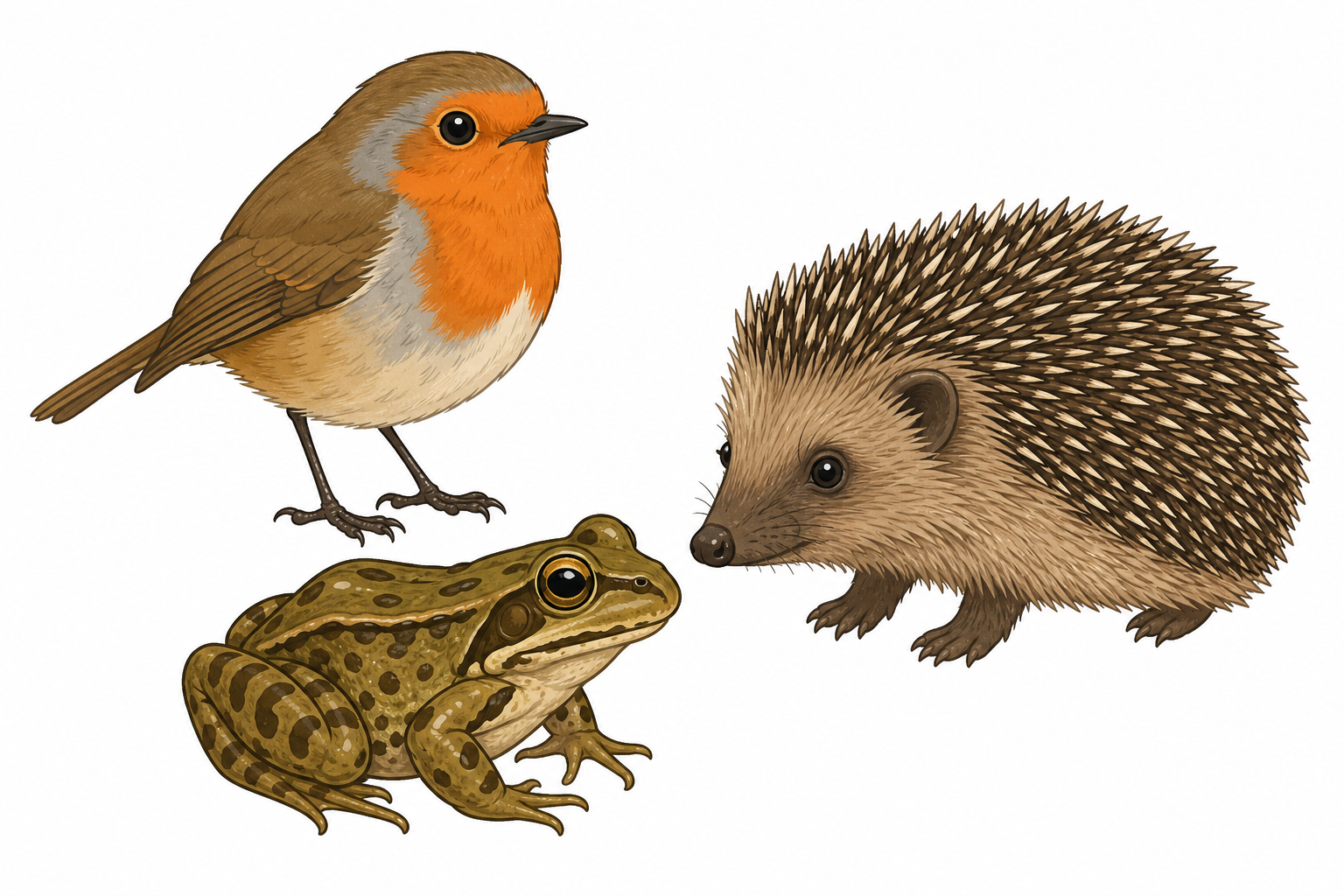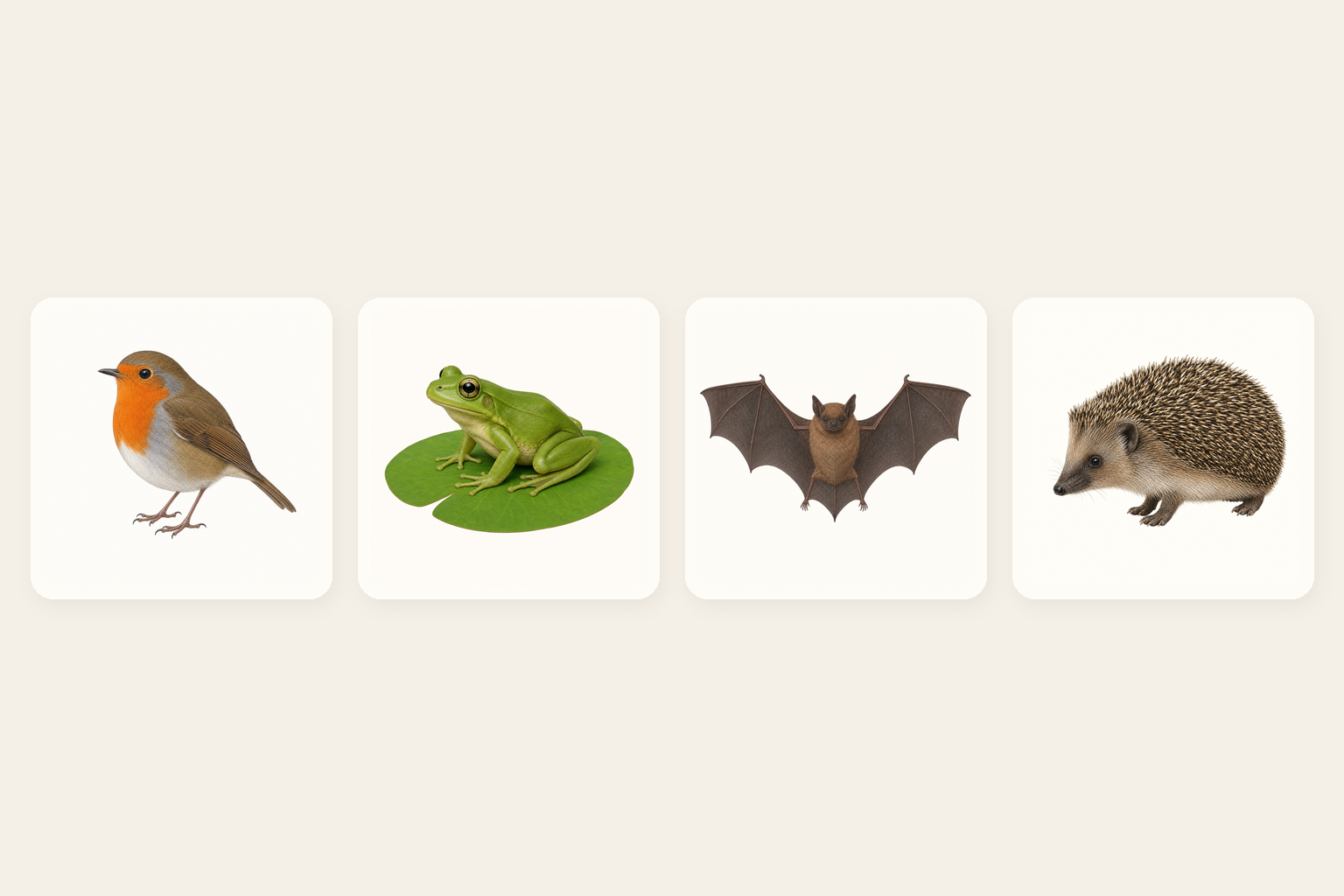
Look at these Irish wildlife cards: a robin, a frog, an oak, a hedgehog. How would you sort them into groups so someone else could find each one again?
Hold up four photo cards so the class can see them clearly: robin, frog, oak, hedgehog. Ask for quick ideas only. Do not hand out the full card set yet and do not introduce the branching-key vocabulary here. The aim is curiosity: can we sort living things by what we notice about them?
Look-fors: pupils may sort by animal vs plant, size, colour, or habitat. All are useful starting points.
Watch this split with four cards: robin, frog, oak, hedgehog.
First question: Is it a plant? Oak goes Yes. Robin, frog and hedgehog go No.
Next question for the animals: Does it have feathers? Robin goes Yes. Frog and hedgehog go No.
That line of yes-or-no questions is a branching key. Each question is about a feature you can see. Using features to sort living things into groups is called classify.
Which feature question would you ask next to split frog from hedgehog?
| Concept | Why it matters | Example |
|---|---|---|
| Feature — something you can see or notice about a living thing that helps you tell it apart from others | Good features are clear and the same every time you look, so two people can agree on the answer | Spines on a hedgehog, feathers on a robin, leaves on an oak, smooth damp skin on a frog |
| Classify — to sort living things into groups by the features they share | Biologists classify wildlife so they can name, study and protect species; a clear group is easier to talk about than a mixed pile | Putting robin, blackbird and wren together because they all have feathers and wings |
| Branching key — a series of yes-or-no questions that split a group into smaller groups until each living thing is named | It is how field guides and wildlife apps identify a creature you have never met before | Does it have feathers? Yes leads toward birds such as the robin; No sends you to the next question |
Nature of STEM: biologists and naturalists use branching keys in the field to name living things by observable features. Name that job plainly: this is everyday work for wildlife scientists and National Parks and Wildlife Service (NPWS) survey staff when they check a hedgerow, woodland or school garden in Ireland.
Misconception to head off: pupils may want to ask "Is it a robin?" as the first question. A branching key asks about features, not names. Model one strong opening question such as "Is it a plant?" or "Does it have feathers?"
Worked example (model aloud before groups build; same eight cards they will receive):
In your group, sort the Irish wildlife photo cards with yes-or-no questions about features. Write each question on a sticky note and stick the cards under Yes or No until every living thing has its own named place. Then record your finished branching key on your Investigation Journal page: list each question in order and write which living thing sits at each end point.
Before the lesson: print the provided wildlife photo cards (one set per group) and one Investigation Journal page per pupil.
Card set (print and cut one set per group):
How to run it: give each group one card set and sticky notes. Groups write feature questions only (not names). Circulate and ask: Does every card land in exactly one named place? What would make your first question clearer?
Recording: the journal page needs a branched list (questions and named endpoints), not a flat sorting grid. Pupils may draw a simple tree or write indented Yes/No lines. Support groups may start with three cards (oak, robin, frog), copy that mini-key, then add the rest.
Suggested starter questions if a group is stuck: Is it a plant? Does it have feathers? Does it have fins and scales? Does it have a shell? Does it have spines or prickles? Does it have six legs?
Differentiation: support groups with three cards first (oak, robin, frog), then add more. Stretch groups by swapping one card with another group and checking whether their key still works.
On the board you will see the same eight Irish wildlife cards: robin, frog, oak, hedgehog, fox, salmon, ladybird and snail. The end points are the features, not the names. We will answer one clear yes-or-no feature question at a time and send each living thing to its own end point. Watch where each card goes and say if you agree.
Drive the sorting-tree interactive activity on the IWB in explore mode. Frame this step as the same idea as the paper keys: keep branching until each card has its own named end point, not a shared bucket of mixed animals.
On-screen contents: items are robin, frog, oak, hedgehog, fox, salmon, ladybird, snail. Questions (one feature each): "Is it a plant?", "Does it have feathers?", "Does it have fins and scales?", "Does it have spines or prickles?", "Does it have a hard spiral shell?", "Does it have six legs?", "Does it have smooth damp skin?". End points are the eight features, so pupils must use the key rather than match a name to a name: plant (oak), has feathers (robin), has fins and scales (salmon), has spines (hedgehog), has a hard spiral shell (snail), has six legs (ladybird), smooth damp skin (frog), furry land mammal (fox), the last one reached by elimination, which is how a real field key ends.
Intended path (model if needed): oak is the only plant; robin has feathers; salmon has fins and scales (this is cleaner than "lives in water", because adult frogs also use ponds); hedgehog has spines; snail has a hard spiral shell; ladybird has six legs; frog has smooth damp skin; fox is the remaining land mammal.
Link to paper keys: Did your group ask a similar first question? Different first questions can still be fair if every feature is clear and every card ends named.
If the class disagrees on a Yes/No: use that as science talk. A good question must give a clear answer from what you can see.
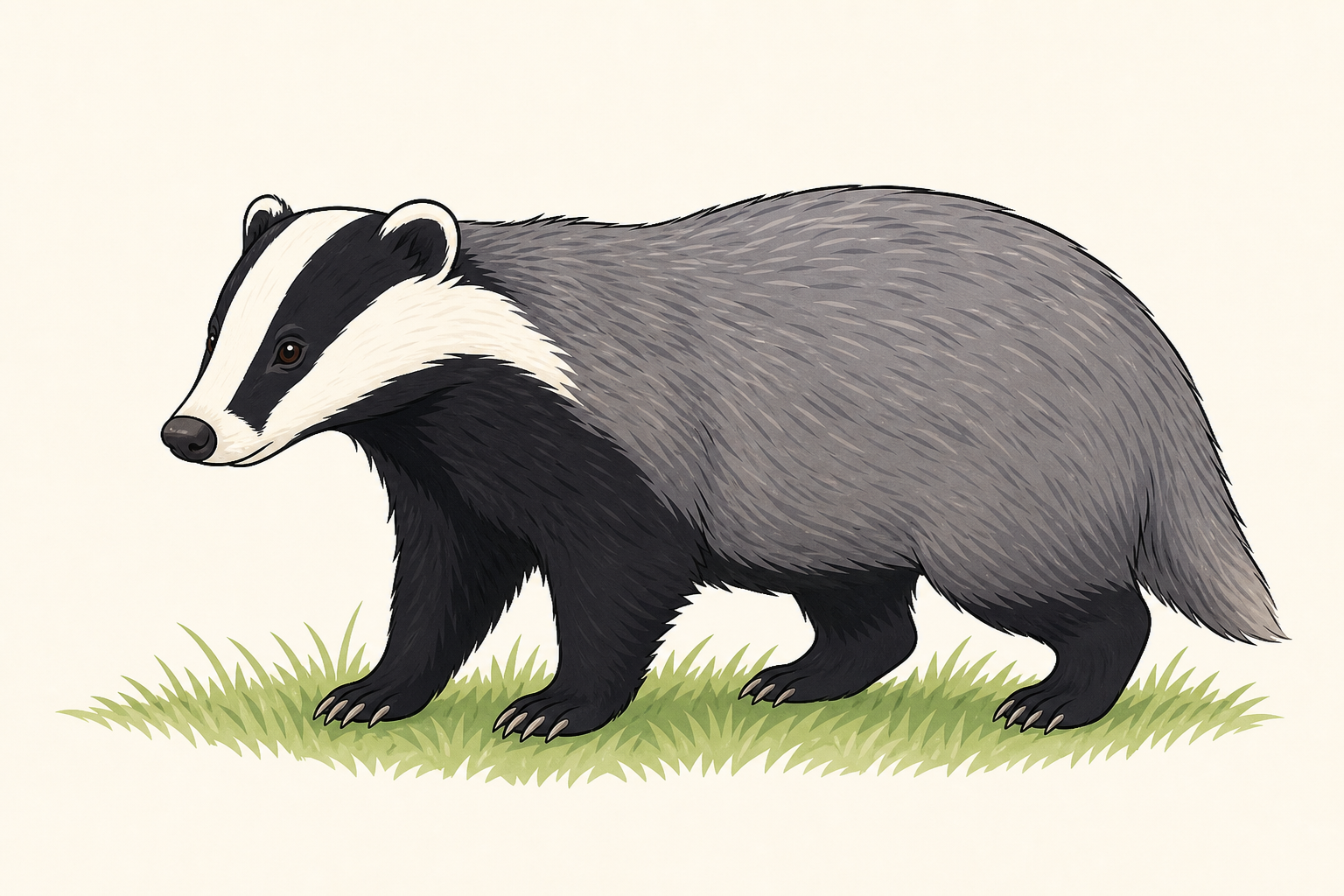
A mystery Irish wildlife photo is on the board. It is not one of the eight cards you sorted. We will follow a shared class branching key of yes-or-no feature questions. Answer from what you can see, not from guessing a name. On your Investigation Journal page, record each feature decision and the name you reach at the end.
Mystery specimen (show on the IWB): a clear photo of a badger. Do not name it at the start. Cover any obvious name caption if the photo source has one. Badger is deliberately not in the eight-card build set, so pupils cannot short-cut by recognising a familiar card.
Shared class path (lead aloud; write the questions on the board if helpful):
Own keys vs shared key: groups’ paper keys only name the eight cards. For this mystery, everyone follows the shared class key on the board. Different valid paths are fine in science when features stay observable; here we use one shared path so the whole class can compare evidence.
How to run the investigation:
If time is short: do the mystery key-out as a whole-class path on the board and have pupils record only the final name plus three features.
You're previewing this lesson. Get full access to this lesson and hundreds more — each one ready to teach, with interactive activities, printable resources and pupil progress tracking built in.