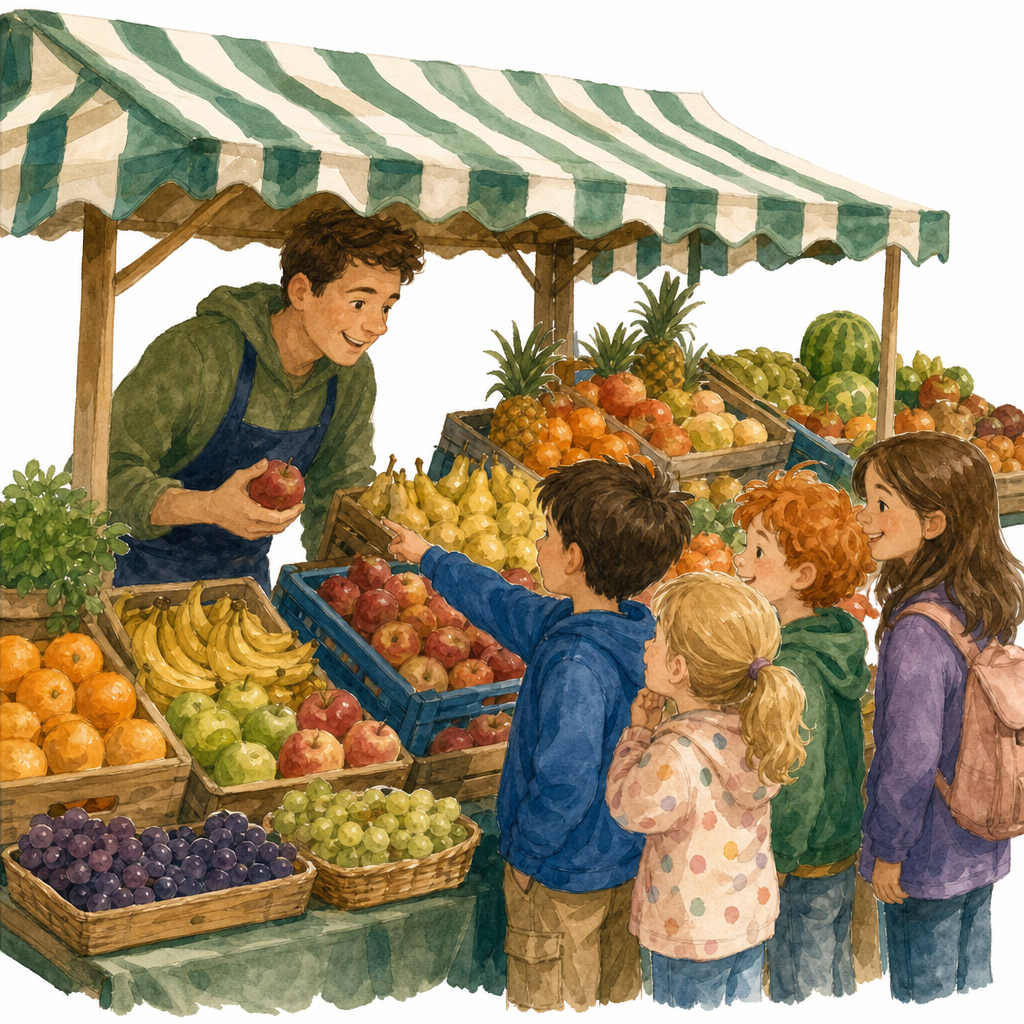
 You are at a Wochenmarkt fruit stall in Germany. Nobody speaks English. You want fruit, and you need a number or a weight. What two things must you be able to say?
By the end of this lesson, you will be able to:
- Ask for fruit by number or by the kilo in German
- Notice how market customs differ from shopping here
Listen as each fruit is played on the board, then say it back together. Watch the article every time: most take die, and one takes der. We meet the fruits in two groups of four, then learn how each name changes when you buy more than one.
Buying phrases we will use:
Zwei Äpfel, bitte. (tsvai EP-fel BIT-tuh): Two apples, please.
Ein Kilo Bananen, bitte. (ine KEE-lo bah-NAH-nen BIT-tuh): One kilo of bananas, please.
The list of the "more than one" forms stays up on the board for the rest of the lesson, so you can point at it and read a form off it whenever you need one.
You each have a paper bingo card. Listen for each fruit as it is called in German. Mark it on your paper card when you hear it. When every fruit on your card is marked, shout Bingo! (or Voll! if you fancy a German twist).
Open your copy. You may copy the models and swap in any fruit from the plural strip still on the board. Write one sentence with a number and one with a kilo, each ending with bitte.
Models (stay on screen):
Zwei Äpfel, bitte.
Ein Kilo Bananen, bitte.
Plural strip: Äpfel, Bananen, Orangen, Erdbeeren, Trauben, Kirschen, Birnen, Zitronen
- der Apfel — apple
- die Banane — banana
- die Orange — orange
- die Erdbeere — strawberry
- die Trauben — grapes
- die Kirsche — cherry
- die Birne — pear
- die Zitrone — lemon
The plural strip stays on the board. Spin the wheel. When it lands on a fruit, that pupil asks to buy some, using a number or a kilo and ending with bitte.
Plural strip (point and speak):
Äpfel, Bananen, Orangen, Erdbeeren, Trauben, Kirschen, Birnen, Zitronen
Zwei …, bitte. | Ein Kilo …, bitte.
Unlock the full learning experience
You're previewing this lesson. Get full access to this lesson and hundreds more — each one ready to teach, with interactive activities, printable resources and pupil progress tracking built in.
This lesson is copyright of Coding Ireland 2017 - 2025. Unauthorised use, copying or distribution is not allowed.