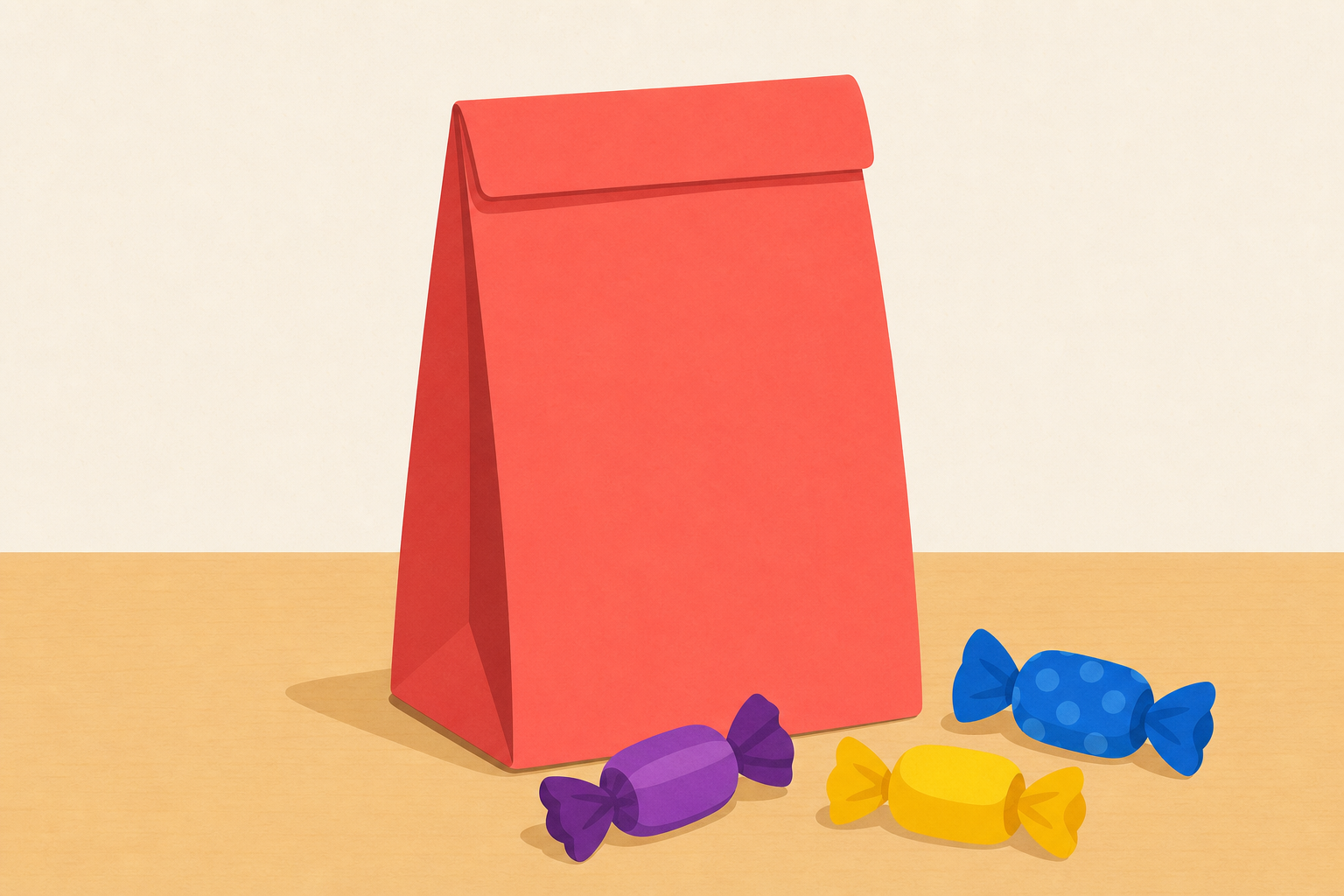
Here is a sentence: Aoife has some sweets, and then she gets 5 more.
We do not know how many sweets Aoife started with. Instead of writing a number we do not know, we can use a letter. If we call her starting number t, how could we write in symbols what she has now?
Take two or three hands-up answers. Some pupils will say t + 5, some will guess a number. Accept both for now and hold the answer open.
Do not confirm the symbol answer yet — the model step draws it out. Just get the class comfortable that a letter can stand for an unknown amount.
Watch four word situations turn into expressions on the board. In each one, look for the word that tells us which operation to use.
Now a situation where a number is taken away. The order matters here.
Now a shopping situation, where the same item is bought again and again.
And one where an amount is shared out fairly.
Say an expression has no equals sign and no single answer — it is a rule that changes with the value of the letter.
Today we build expressions together, one at a time. Name the operation word before we write the symbols. We will work through these situations:
Talk this one through together — pupils take turns at the board and the class agrees or corrects out loud.
Run each on the word-problem interactive: a pupil taps the operation word and the matching sign appears on the board. This is a build-and-say tool, not a marked task — the interactive shows the operation and sign, and then the class writes the full expression on the board and reads it aloud together (b + 3, 10 − k, 50g, 8 ÷ s) so the letters and signs are said out loud. Do not wait for any grade; the expression the class agrees is the answer.
In your maths copy, write each of these word situations and its expression side by side, one under the other. Circle the operation word that gave you the sign.
Walk the room glancing at the circled operation word and the sign each pupil chose. Watch for the flip on 'less than' — 20 − w, not w − 20. No marking, this is whole-class copybook practice.
Today we work through these, each one a step harder:
This is the practice round — pupils take turns at the board, check each answer, and the class confirms before moving on. Keep the board work brisk rather than over-explaining.
Stretch (off screen): once the three board items are done, pose the open task aloud — write your own situation for the expression 5x − 2. This has no single right answer: any sensible story (e.g. five bags of x sweets, take 2 away) is correct. Strong pupils write theirs in their copy and read one out; the interactive does not grade this open task, so keep it as a talk-and-share beat.
You're previewing this lesson. Get full access to this lesson and hundreds more — each one ready to teach, with interactive activities, printable resources and pupil progress tracking built in.