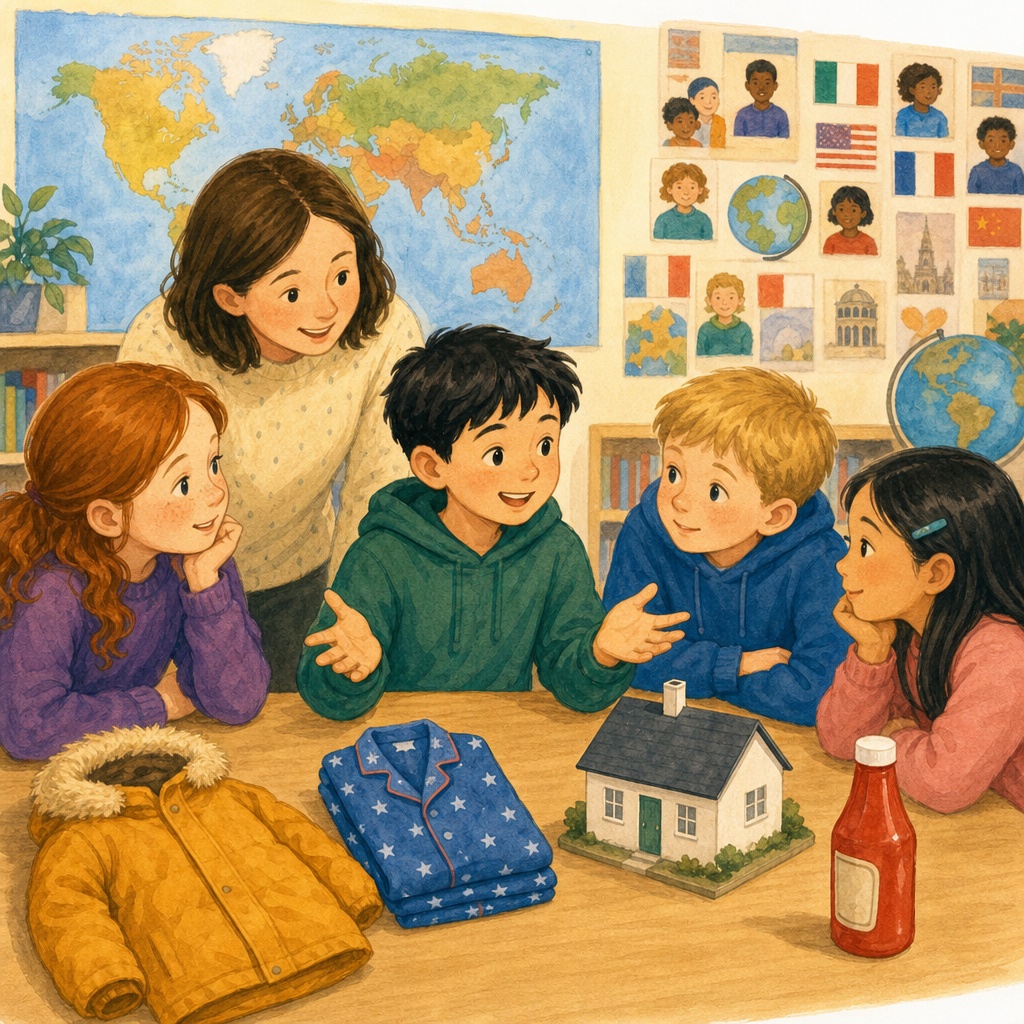
 You already know the words anorak, pyjamas, bungalow and ketchup. They sound like ordinary English, but none of them started life as English words.
Today we investigate how words travel. We will notice everyday English words that came from far away, tell apart words that really match and words that only look the same, and put some borrowed words back near the places they began.
By the end of this lesson, you will be able to:
- Spot that everyday English words often came from far away
- Tell apart words that really match and words that only look the same
- Put a borrowed word back on the map near where it began
Technology words also travel. Some look related; some mean the same thing with a different shape.
Watch each pair. Show hands: same family, same idea but different word, or not sure?
No stress if you change your mind: detectives do that. You do not need to learn the foreign spellings.
Watch the Asia map on the board. Look at today's borrowed words from the start of the lesson.
Which ones began somewhere on this Asia map, and which one did not? Vote with your hands, then watch that part of the map open.
Great noticing if you spot which word did not start here. When a country opens, listen for which languages live there today.
Open your copy and write two words English has borrowed and where each came from. Choose any two from this list, and spell them carefully.
- anorak: hooded winter jacket (from Greenlandic)
- pyjamas: sleep clothes (from Urdu)
- bungalow: single-storey house (from Hindi)
- ketchup: the sauce we put on chips (word travelled from Chinese Hokkien fish-sauce, then changed in English)
💬 Discussion time
Anorak still has a suitcase sticker from Greenland. Ketchup came on a long trade journey. Both feel ordinary in English now.
- Does the sticker ever come off once we use the word every day?
- Can a word belong to more than one language at the same time?
- Is there a word you hear at home that English also uses?
Unlock the full learning experience
You're previewing this lesson. Get full access to this lesson and hundreds more — each one ready to teach, with interactive activities, printable resources and pupil progress tracking built in.
This lesson is copyright of Coding Ireland 2017 - 2026. Unauthorised use, copying or distribution is not allowed.