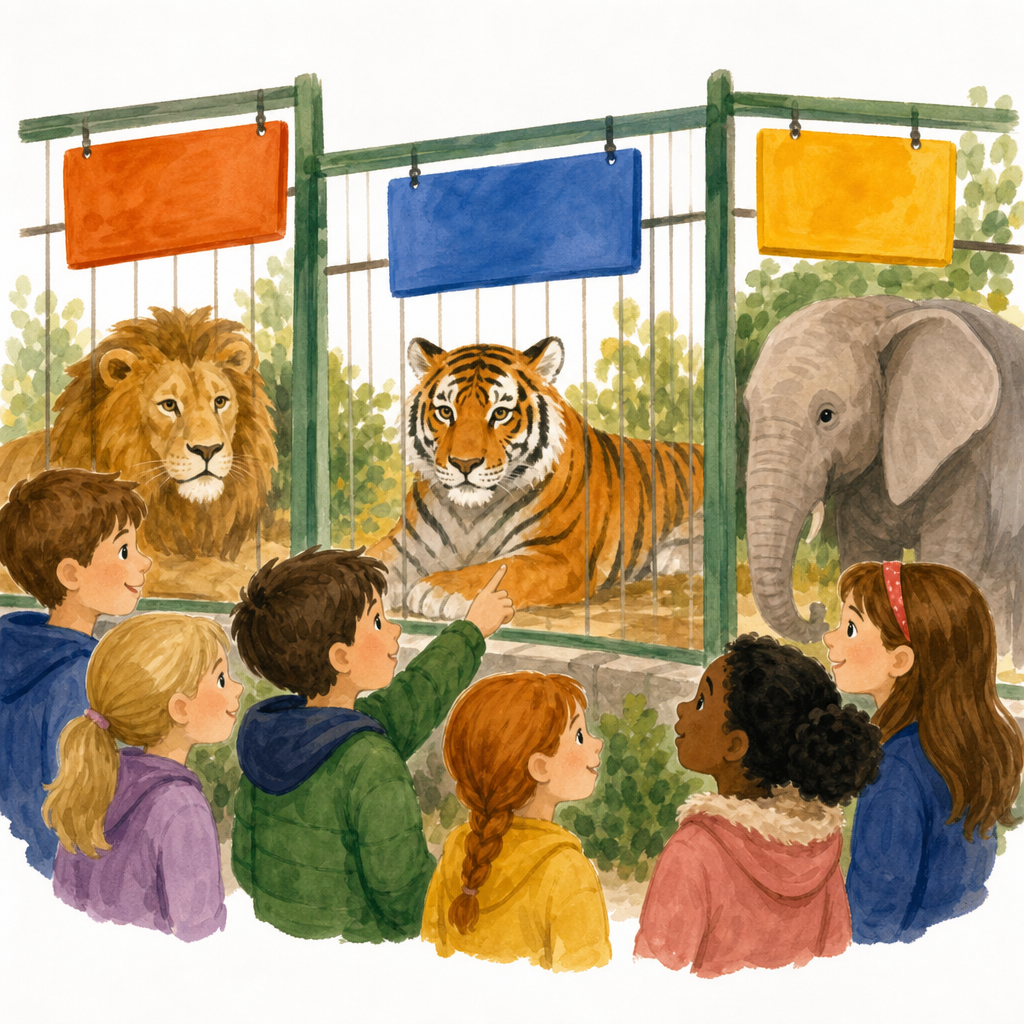
 Imagine you are reading cage signs at Dublin Zoo and the same animal keeps popping up in English, Irish, French, German and Spanish. You already know more words in other languages than you think. Today we will prove it with three animals.
Quick teaser: is gift in English the same as Gift in German? Hold that thought. We will meet true cousins and words that only pretend to match.
By the end of this lesson, you will be able to:
- Spot animal words that look and sound alike across languages
- Tell true cousin words from ones that only pretend to match
- Talk about what shared words can tell us about people
We are reading cage signs for three animals in five languages. Watch and listen as we play each animal across English, Irish, French, German and Spanish. Look for words that look almost the same. Which letters keep turning up?
Some words really are cousins and share a meaning. Others only look alike and mean something different. For each pair we will vote together: thumbs up = true cousins, thumbs sideways = only a lookalike. Then we reveal and check what the note says.
Keep the board list in view. From what you can see, copy two true cousin pairs and one pretend pair. Label the pretend pair. You are copying from the model, not spelling from memory.
Write it like this:
- Cousins: English tiger / German Tiger
- Cousins: English elephant / French éléphant
- Pretend: English gift / German Gift (looks alike, means poison)
You may use these models or other labelled pairs still on the board, as long as you have two true cousins and one pretend pair.
You will get a bingo card (on screen or on paper). Each square shows one animal picture with one written form of that animal in one of our five languages. Listen as if the zoo guide is calling cage names. Cross off a square when you hear a match for that square (same animal and same written form, or the matching picture if your card uses pictures). When your whole card is crossed off, stand and say Bingo, then read two crossed squares and say the animal in English.
Unlock the full learning experience
You're previewing this lesson. Get full access to this lesson and hundreds more — each one ready to teach, with interactive activities, printable resources and pupil progress tracking built in.
This lesson is copyright of Coding Ireland 2017 - 2026. Unauthorised use, copying or distribution is not allowed.