1 - Introduction
 Have you ever wondered how people say hello in other countries or where some of your favourite words come from? Languages are like secret codes that connect us all around the world.
In this lesson, you will:
- Find out about languages spoken around the world and in Ireland.
- Discover loan words – words that travel from one language to another, like 'pizza' and 'café'.
- Explore greetings from different cultures, such as 'Bonjour' and 'Namaste'.
- Play fun guessing games to spot where words and greetings come from.
- Learn why knowing languages helps us understand others and make new friends.
2 - Why Languages Are Important
 People all around the world speak different languages. A language helps us share ideas, tell stories, and talk to other people.
Learning new languages can be exciting because it helps us understand different cultures and make new friends from around the world.
- Languages help people communicate.
- They help us learn about other cultures.
- They allow us to travel and meet new people.
Speaking more than one language is like a workout for your brain. It helps you think faster, solve problems better, and even remember things more easily as you grow older.
3 - Languages Around the World
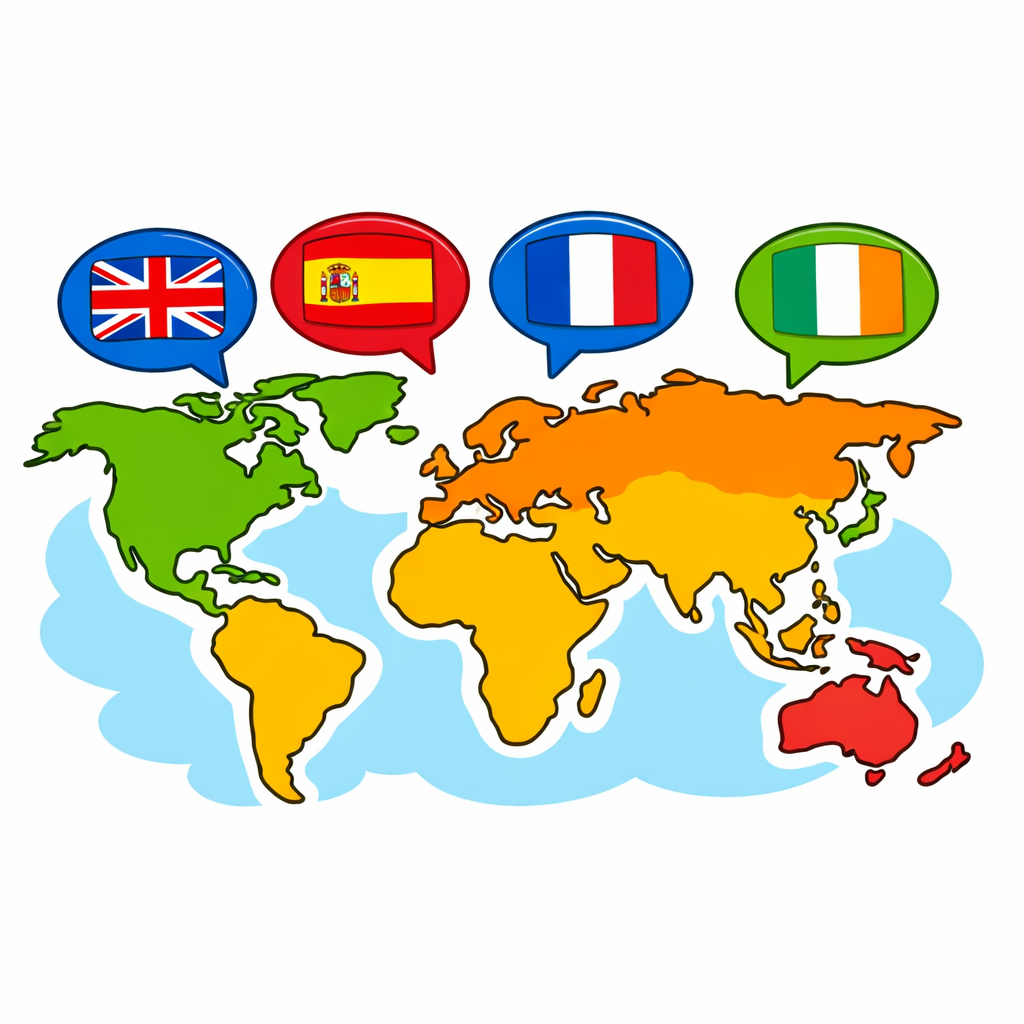 There are more than 7,000 languages spoken around the world! Some languages are spoken by millions of people, while others are spoken by smaller communities.
For example:
- English is spoken in many countries.
- Spanish is spoken in Spain and many parts of South America.
- French is spoken in France and other parts of Europe and Africa.
- Irish (Gaeilge) is an important language in Ireland.
Papua New Guinea has over 800 languages spoken there, even though it is a small country. That makes it one of the most linguistically diverse places on Earth.
4 - Greetings
Around the world, people greet each other in different ways. A greeting is how we say hello, welcome someone, or show respect when we meet them.
Some greetings use words, while others use actions like bows, handshakes, or hugs. These greetings are part of each country’s culture and traditions.
| Greeting | Country / Culture | What it Means |
|---|---|---|
| Handshake | Many countries | A polite way to greet someone by shaking hands |
| Céad Míle Fáilte | Ireland | Means “one hundred thousand welcomes” in Irish |
| Wai | Thailand | A greeting where people press their hands together and bow slightly |
| Abrazo | Spain / Latin America | A friendly hug used to greet friends and family |
| Bonjour | France | A common way to say hello during the day |
| Namaste | India / Nepal | A respectful greeting with hands together and a small bow |
| Konnichiwa | Japan | A polite way to say hello |
Unlock the full learning experience
You're previewing this lesson. Get full access to this lesson and hundreds more — each one ready to teach, with interactive activities, printable resources and pupil progress tracking built in.
This lesson is copyright of Coding Ireland 2017 - 2026. Unauthorised use, copying or distribution is not allowed.