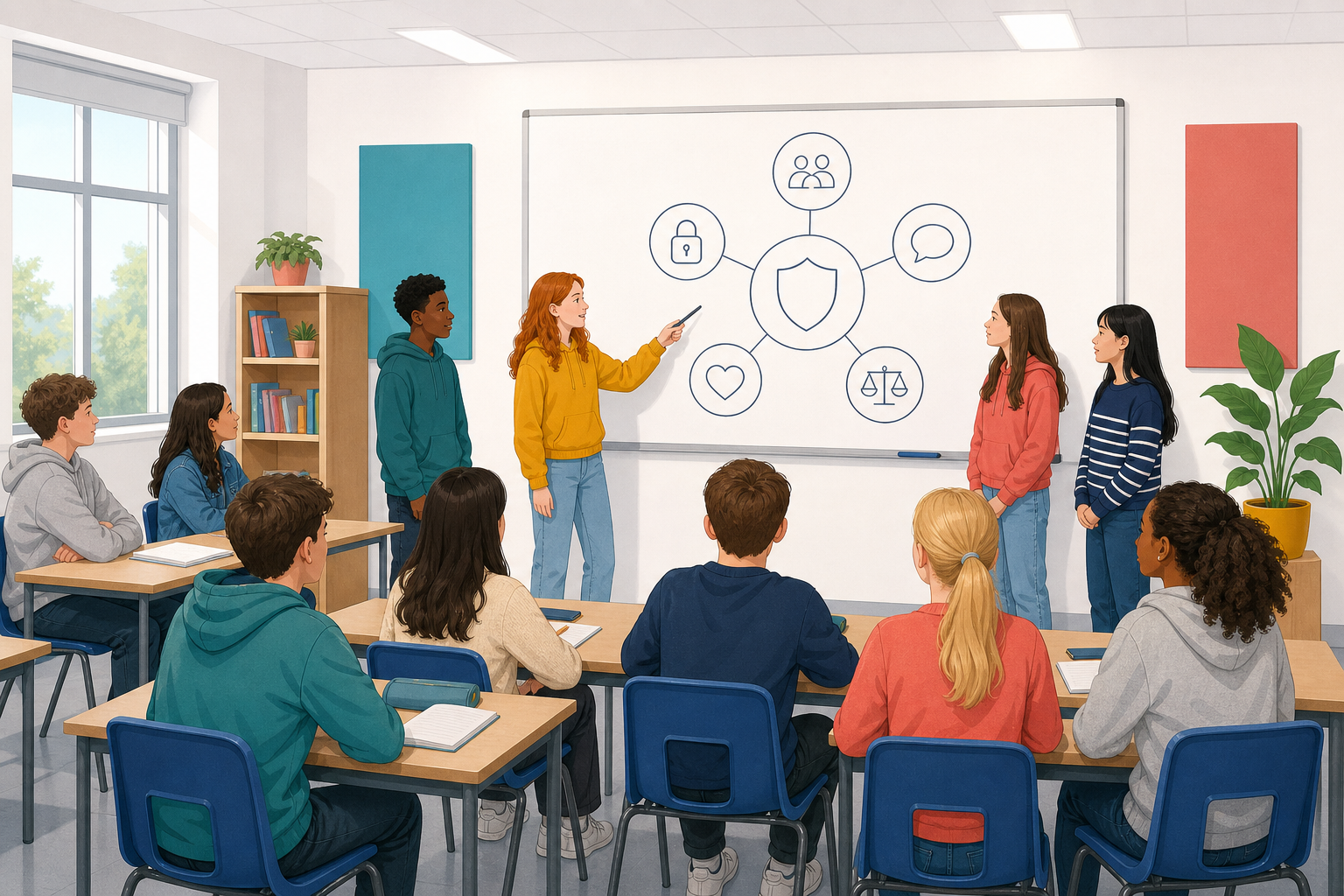
 You already know some online rights young people have, like the right to information, to free expression (saying what you think), to protection as a young person and to data protection (keeping your personal information safe). Today you will look at who can help when something goes wrong online, what each of them can do, and who should put it right.
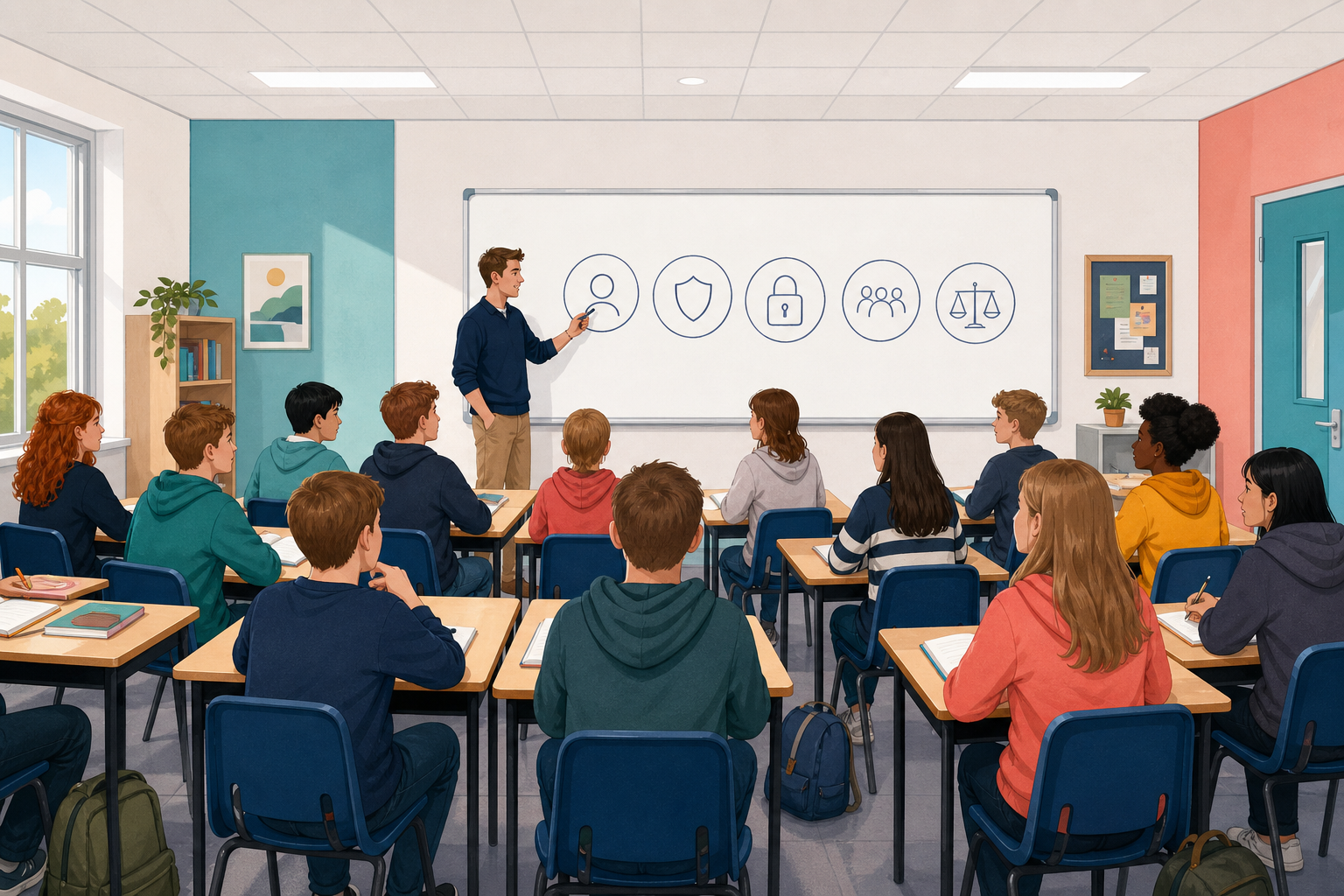 When something goes wrong online, who can do something about it? Here an actor means a person or group who can help, not a film actor. The table shows what five kinds of actor in Ireland can and cannot do.
| Actor | Can | Cannot |
|---|---|---|
| You | Report, block, keep evidence, tell a trusted adult, use the platform’s tools. | Force a company to change its rules on your own. |
| A parent or guardian | Support you, help you report, set boundaries at home, contact a school or company with you. | Read every private message, or fix a platform by shouting. |
| The company | Design safety features, respond to reports, remove content under its rules and the law. | Check every post the moment it goes up, or solve harm that happens offline on its own. |
| Government online-safety rules and data-protection rules | Set rules platforms must follow, investigate when those rules are broken, and take a complaint further if the platform has not fixed it. | Delete one nasty comment for you the same day, arrest a user, or replace the report button. |
| Civil society support and information groups | Explain options, calm someone down, point you to the right report tool, form or trusted adult. | Force a platform to remove content, issue legal orders, or change the law. |
A guardian is an adult who looks after you, and civil society means helpful groups outside home, school, companies and government.
Your teacher puts the class into five groups and gives each group one actor. Your group becomes the class expert on what that actor can and cannot really do. The box below shows your actor and your three complaints.
Group 1: The young person. Complaints A, C and E.
Group 2: A parent or guardian. Complaints B, D and F.
Group 3: The digital technology company (the platform or app). Complaints A, D and F.
Group 4: Government. Complaints B, C and E.
Group 5: Civil society (helpful organisations outside school, home, companies and government). Complaints A, B and F.
A. Private photos from a group chat were screenshotted and posted publicly without everyone's consent, meaning their permission.
B. A young person asked a platform to delete their account and personal data. Weeks later, nothing has changed.
C. A stranger keeps sending abusive (nasty or threatening) direct messages after being blocked once.
D. A video of a fight outside a school is spreading on a short-video app and several students want it taken down.
E. A free game app is collecting exact location data that the user never knowingly agreed to share.
F. A young person keeps seeing harmful content in their recommended feed that they have already tried to stop seeing, and wants stronger action than "not interested".
The three labels
For each of your three complaints, choose one of these labels and give one short reason.
- Act: your actor can do something about it directly.
- Support only: your actor can help, give advice or pass the problem on, but someone else has to do the main fix.
- Not our job: this is outside what your actor can really do.
Complaint C, the young person: Act. They can block the stranger again, report the messages, keep screenshots and tell an adult they trust.
If you are the government group
Government does two different jobs, so for each complaint say which job you mean.
- The online-safety job makes rules that platforms must follow to keep users safe, and checks that they obey them. Problems about content usually belong here, but only after they have been reported to the company.
- The data-protection job protects people's rights over their personal information. Problems about an account, personal data or location usually belong here.
Neither job deletes a post the same day. As a hint, B and E often point to the data-protection job. C usually goes to the platform first, and then to the online-safety job if the platform does not fix it.
Prepare in your group (about 9 minutes)
- Look back at what the table in the last step says about your actor.
- Pick the one power and the one limit that matter most for your three complaints. If your group can explain a power or limit that the table leaves out, add it.
- Give each of your three complaints a label, with one short reason.
Teach the class (about 6 minutes)
Each group has about 60 seconds, so do not read out your whole list. Say who your actor is in one sentence and name one power and one clear limit. Then pick one of your complaints and say which label you gave it and why.
While other groups present, listen for complaints where two actors both say they can help, and for complaints that nobody can fully fix alone.
Now that you know what each actor can and cannot do, think about a harder question. There is no single right answer.
When something goes wrong online for a young person, who should have the main responsibility for putting it right?
View 1: The platforms first. Companies design the feeds, the report buttons and the rules. They make money from people's attention, so they should carry the biggest duty to prevent harm and fix it for everyone.
View 2: Parents and guardians first. Under-18s are still learning to make good decisions. The adults who care for them should set limits, notice early when something is wrong and take it further when needed.
View 3: Young people themselves. Rights come with the power to act for yourself. Knowing how to block, report, keep evidence and choose what to share is the skill that works fastest when something happens.
View 4: Everyone shares it. No single actor can cover every case, so each one does its own part. Government sets the basic rules, companies build safe systems, families give support, civil society gives advice, and the young person still has decisions only they can make.
What to do
- On your own, pick the view closest to what you think, or mix two. Be ready to name one strength of your view and one weakness that someone who disagrees with you would fairly point out.
- With a partner, swap views, but do not try to win. Say your partner's view back in one fair sentence, as strongly as you can, until they agree you have it right.
- As a class, you will hear from two people with different views. Notice where people agree about what each actor can do, and where they disagree about who should do the most to put things right.
Make sure you can say what you think and give the strongest argument against it. You should also be able to name one actor whose limits would make your view harder to put into practice.
Protecting your online rights is a shared job. You can act quickly on some problems, and a parent or guardian can help with others. A company controls its tools and content rules. Government makes sure platforms follow rules and protects personal data. It cannot fix things the same day, and you usually go to the company first. If the company does not help, government can look into some complaints. Civil society groups can advise you. Problems go unfixed when people expect one actor to do another's job.
Unlock the full learning experience
You're previewing this lesson. Get full access to this lesson and hundreds more — each one ready to teach, with interactive activities, printable resources and pupil progress tracking built in.
This lesson is copyright of Coding Ireland 2017 - 2026. Unauthorised use, copying or distribution is not allowed.