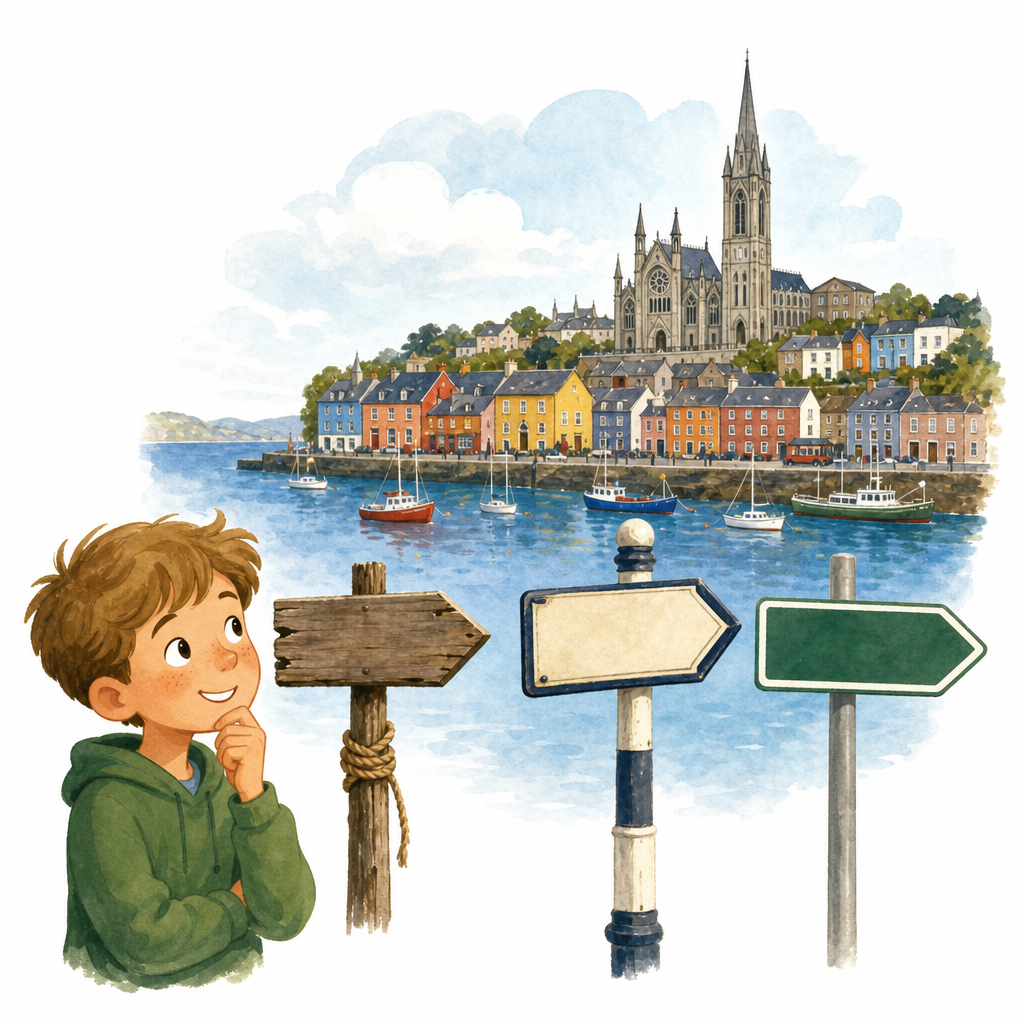
 Look at Cobh on Cork harbour. The same place has worn three names: Cove (the old local name), Queenstown (a later royal rename), and Cobh (the Irish form used today). One place, three labels from three different times.
What you'll learn
- Notice who left a word in a place name
- Spot places that still have two names
- Talk about how it feels when a name changes
Watch as we open each city name on the board.
First we say two small word pieces aloud: short bits of Irish that turn up again and again inside place names. When you hear one of them hiding inside a city name, thumbs up. Then we will ask who might have put that word there.
Same place, two names still alive. Read these pairs on the board first:
- Dublin and Baile Átha Cliath
- Cork and Corcaigh
- Cardiff and Caerdydd
- Cologne and Köln
- San Sebastián and Donostia
We will find each country on the map and notice which languages live there. For every pair, be ready to say both names and who might use each one.
Open your copy. Pick one place from today's cities or map. Use this frame:
Place: _______________
Name 1: _______________ (who or where it comes from)
Name 2: _______________ (who or where it comes from)
Board example (already filled):
Place: Dublin / Baile Átha Cliath
Name 1: Dublin — used widely in English
Name 2: Baile Átha Cliath — Irish name (baile = town at the ford)
Or: write a place you will ask about at home and who you will ask.
Spelling helpers while you write: baile (town), port (a landing place).
Discussion time
All over Munster, placenames still remember families and clans who once held the land centuries ago. The name often outlasted the people, the house, and why they were in charge.
Think of a place from today that still has two names (like Dublin and Baile Átha Cliath, or Cove / Queenstown / Cobh).
- If the name on your street sign changed tomorrow, what would feel strange on the way to school?
- Who might still say the old name at home?
Unlock the full learning experience
You're previewing this lesson. Get full access to this lesson and hundreds more — each one ready to teach, with interactive activities, printable resources and pupil progress tracking built in.
This lesson is copyright of Coding Ireland 2017 - 2026. Unauthorised use, copying or distribution is not allowed.