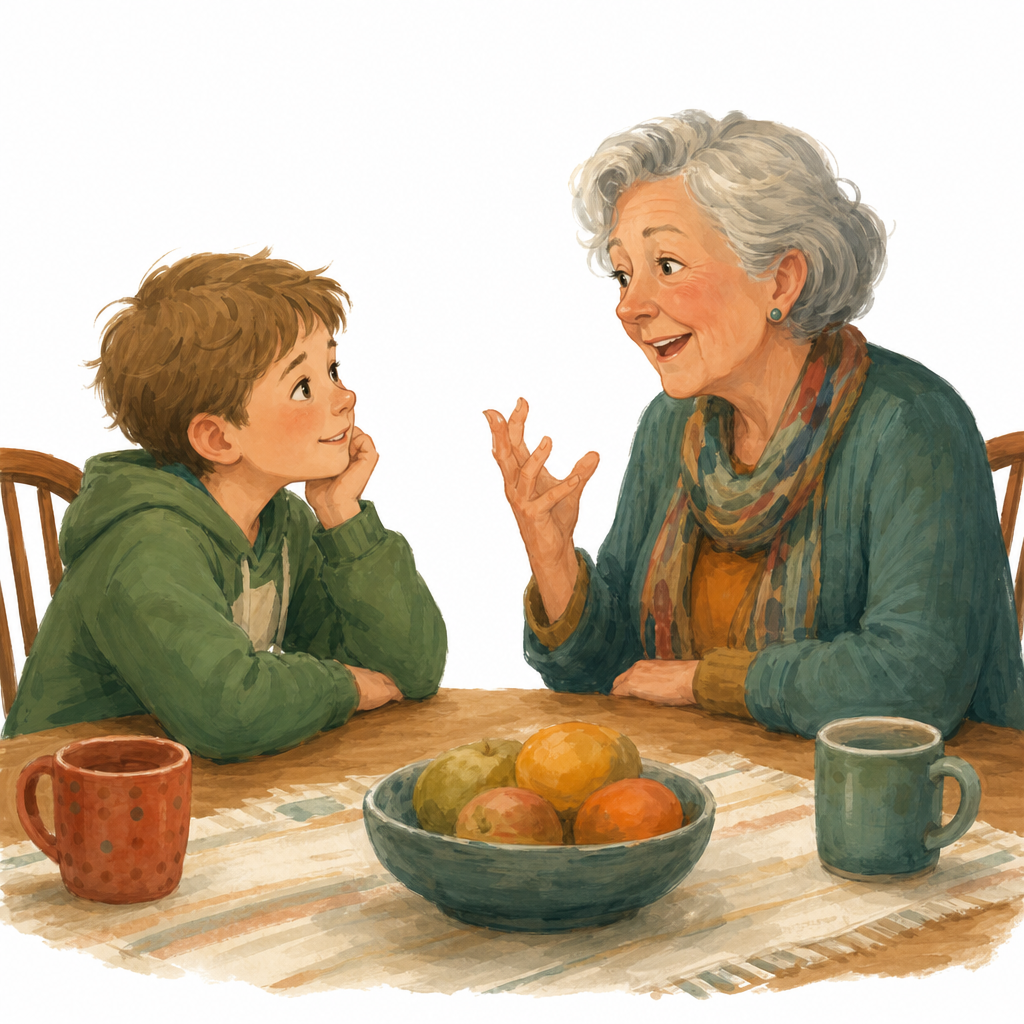
 Every folk tale on a page once lived only in someone's mouth. Somebody had to sit down, listen, and write it. Who were they, and what did they leave out?
Today you will:
- Find out who wrote the old tales down
- Think about a story from your own family
Between 1937 and 1939, Irish schoolchildren were sent out with notebooks. Their teachers asked them to collect stories, sayings and customs from their own families and neighbours.
More than half a million pages came back (around 740,000 in total). That is the Schools Folklore Collection, and it still sits in the National Folklore Collection today.
A story has a different name in each language:
- Irish scéal (say: shkayl)
- French conte (say: kont)
- German Märchen (say: MAIR-khen)
Here is one kind of entry those children wrote, in words close to a child's own voice:
My grandmother told me that if you leave milk out for the fairies on May Eve, they will not spoil the butter. She said her mother did it every year, and so did she. I asked her if she still does it. She laughed and said she does not leave the milk now, but she still thinks about it when May comes.
Your job — notice:
- Who told it?
- What is missing that a neat printed book might add?
Ireland was not alone. Across Europe, over the 1800s and early 1900s, people were writing down the stories their neighbours told — in many different languages.
Watch the map on the board. When a country opens, help name the language the stories would have been spoken in. Find Ireland first, then one other country.
Open your copy. Write one story or saying from your own family, the way the 1937 children did.
Include who told it to you and what they said. If you know whether they still believe it or still do it, add that too. A short saying counts.
You can write in English, Irish, or another language your family uses at home.
If you cannot think of one yet, write who you will ask at home tonight — that is a full answer.
Collectors in many languages wrote down the same animal characters. The same animals walk through stories told in Irish, French, German and Spanish — let's see which animal words sound related.
Worked example first:
- English wolf and German Wolf look like cousins — related words for the same animal.
- English fox and French renard mean the same animal, but the words do not look related.
On the board, join the words that mean the same animal. Each time a set is joined, look at the words together: do they look like cousins, or not really related?
Unlock the full learning experience
You're previewing this lesson. Get full access to this lesson and hundreds more — each one ready to teach, with interactive activities, printable resources and pupil progress tracking built in.
This lesson is copyright of Coding Ireland 2017 - 2026. Unauthorised use, copying or distribution is not allowed.