 Before you choose what to open, an app has already chosen what to show you, and in what order. The rules it uses to choose are called an algorithm.
How does an app decide what to show you first, and what is it aiming for?
Today you will:
- put five posts in the order you would want to see them
- watch a feed put the same posts in a different order when it chases a different goal
- look at a feed you use yourself and name what it gives up
 An algorithm is a set of rules an app uses to put posts, search results and recommendations in order. It is not a person reading your feed. It is a computer program.
- Recommendations are what the app suggests you watch, listen to or read next, like the next video YouTube lines up for you.
- Signals are the clues the program uses, such as how new a post is, who shared it, and how many people liked or watched it.
- Some of the strongest signals are about you: what you watched to the end, what you liked, what you searched for and who you follow. That is why no two people's feeds look the same.
How do you think YouTube knows which video to recommend to you next?
Imagine the same five posts are waiting. What changes when the feed is told to keep you scrolling, keep you informed, or show the newest first?
- As a class, choose the two posts you would put at the top of the feed, and move them up with the arrows. Say why. Use the clues on each card, such as who it is from, how people reacted, how old it is, and whether it looks useful or just shocking.
- Then choose a goal and watch the posts jump into the order a real app would use for it. Your order stays on screen, under the goal's explanation, so you can compare. Are your top two still near the top? Name one post that moved, and one useful post that dropped down under that goal.
- Last, build a For You page at the bottom of the activity: vote each topic up or down, then press Build my For You page. Change one vote and see what the page shows you, and what it never shows you.
Be the algorithm: your feed

Now be a detective on a feed you really use, such as the app you open first in the morning. It could be social media, videos, music or shopping. Work on your own and write four short notes:
- The name of the feed, and what you think it mainly chases: keeping you scrolling, keeping you informed, showing the newest first, or something else.
- Two signals it seems to use, such as what you watch to the end, what you like, what your friends share, or how new a post is.
- One kind of post that rises in that feed, and one kind that sinks, even if the one that sinks is more useful.
- One sentence that finishes the line below.
When this feed chases ___, it gives up ___.
- A video app. It mainly chases keeping me watching.
- It seems to use which videos I watch to the end, and what my friends like.
- Short funny clips rise. Longer how-to videos sink, even the useful ones.
- When this feed chases watch-time, it gives up the slower videos that teach me something.
Click Enter Your Work under this step and write your four notes in the box that opens. What you write is kept, so you can finish it next time.
If school rules block the app, write about it from memory. If time runs out, finish your notes at home and bring your sentence to share next lesson.
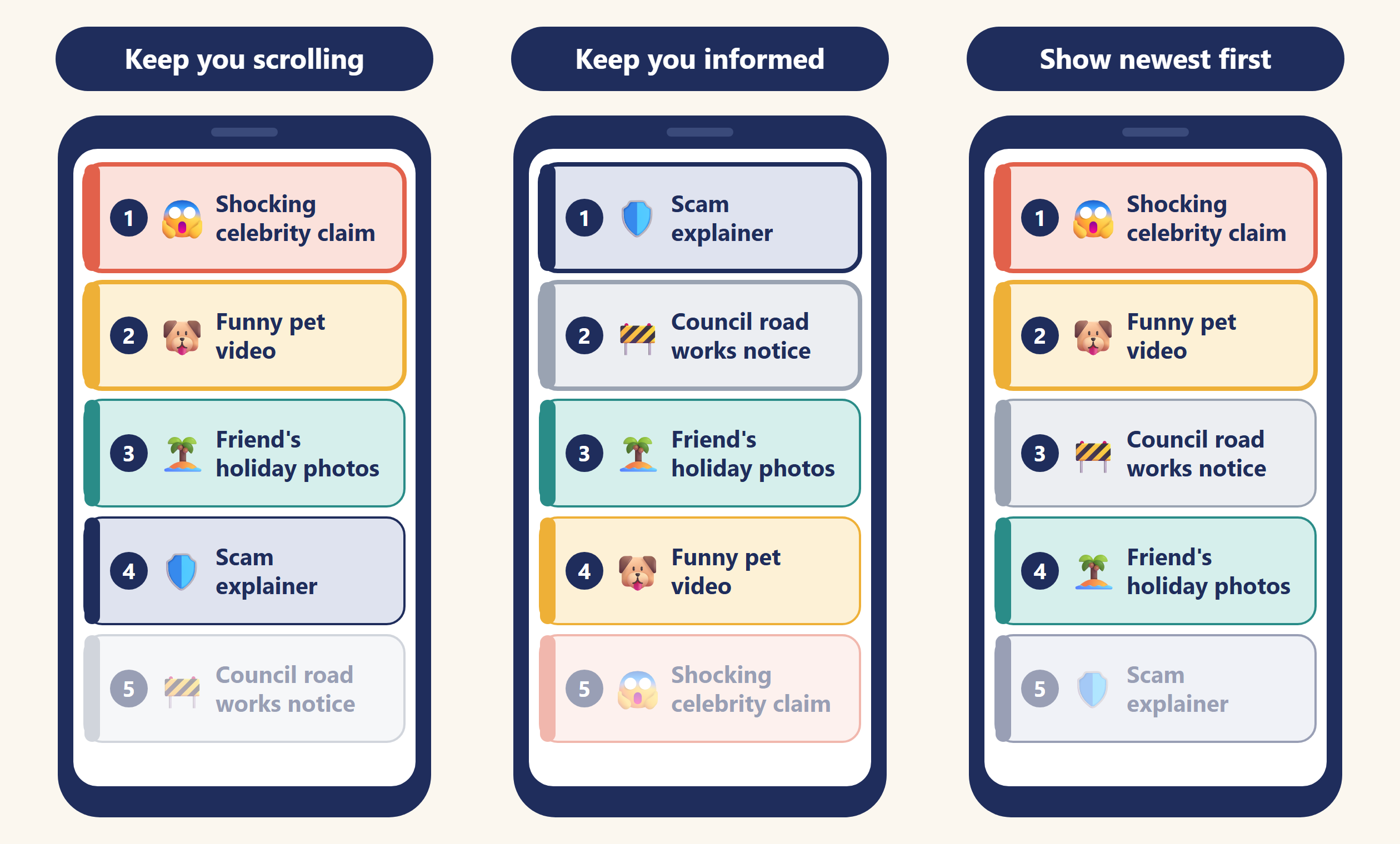
Here is what each goal did to the same five posts.
| Goal | What rises | What sinks |
|---|---|---|
| Keep you scrolling | Posts that stir up strong feelings or get watched and shared a lot, like the shocking claim and the funny pet video | Useful but quiet posts, like the scam explainer and the council notice |
| Keep you informed | Useful posts from trusted sources, like the scam explainer and the council notice | The shocking claim and the pet video, even though people react to them the most |
| Show newest first | Whatever was posted last, like the shocking claim, before anyone checks it is true | Older posts, like the scam explainer, even when they are the most useful |
Feeds, search results and recommendations are put in order for a reason. When you know the reason, you can ask why a post is there and what is missing.
Unlock the full learning experience
You're previewing this lesson. Get full access to this lesson and hundreds more — each one ready to teach, with interactive activities, printable resources and pupil progress tracking built in.
This lesson is copyright of Coding Ireland 2017 - 2026. Unauthorised use, copying or distribution is not allowed.