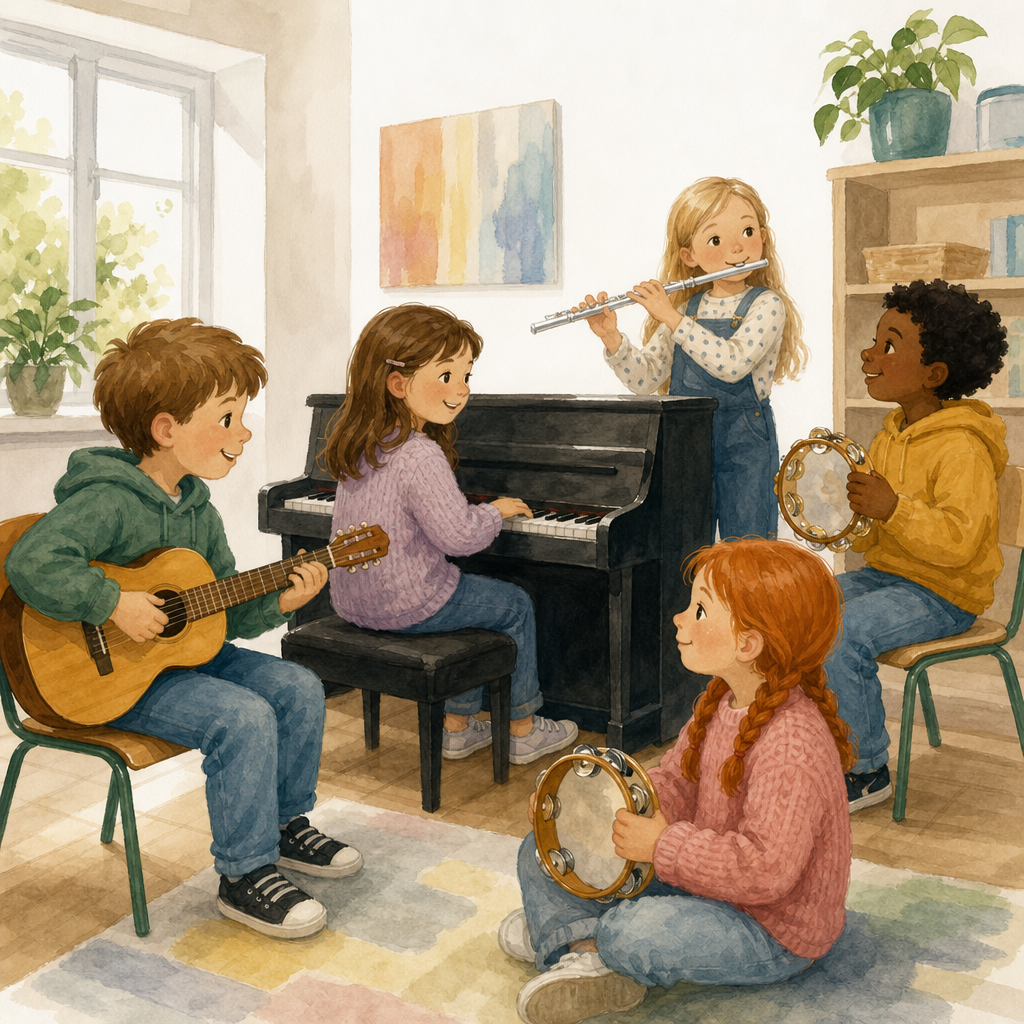
 Who in this class already plays an instrument? Who would like to learn one? Today we name eight instruments in Spanish, and we learn how to say both what we play and what we would like to play.
By the end of this lesson, you will be able to:
- Name eight musical instruments in Spanish
- Say an instrument you play or would like to play
- Notice what a borrowed instrument name can tell us about history
Here are today's eight instruments. Tap each one, listen, then say it back together. Watch the article: some take el and some take la.
When the names feel steady, lock these two sentence patterns one at a time:
Pattern 1: Toco la guitarra. (I play the guitar.)
Pattern 2: Me gustaría tocar el piano. (I would like to play the piano.)
Look at the band picture (think of a school rehearsal or a plaza concert). Volunteers come up and place the Spanish label with el or la. Everyone else says the full name quietly in their seat when the label is placed.
First say your sentence quietly. Then open your copy and write one sentence about an instrument you play or would like to play. Use Toco... or Me gustaría tocar... and keep the article with the instrument.
- la guitarra — Guitar
- el piano — Piano
- el violín — Violin
- la flauta — Flute
- la pandereta — Tambourine
- la trompeta — Trumpet
- el saxofón — Saxophone
- la batería — Drum kit
You need a bingo card: your teacher will give you one (or copy one from the board). Listen for each instrument word and mark it on your card. When every word on your card is crossed off, call Bingo! Say the word quietly to yourself as you mark it.
Unlock the full learning experience
You're previewing this lesson. Get full access to this lesson and hundreds more — each one ready to teach, with interactive activities, printable resources and pupil progress tracking built in.
This lesson is copyright of Coding Ireland 2017 - 2025. Unauthorised use, copying or distribution is not allowed.