Mathematics
Intermediate
50 mins
Teacher/Student led
+65 XP

What you need:
IWB/Projector/Large Screen
Weighing scales

Weight, Estimate and Weigh in Kg and G on a Scale

Estimate the weight of classroom objects by hefting them, then read a weighing scale to check how close you were. Learn when to use grams and kilograms.
Teacher Class Feed

Load previous activity

    1 - Getting Started ~4 mins

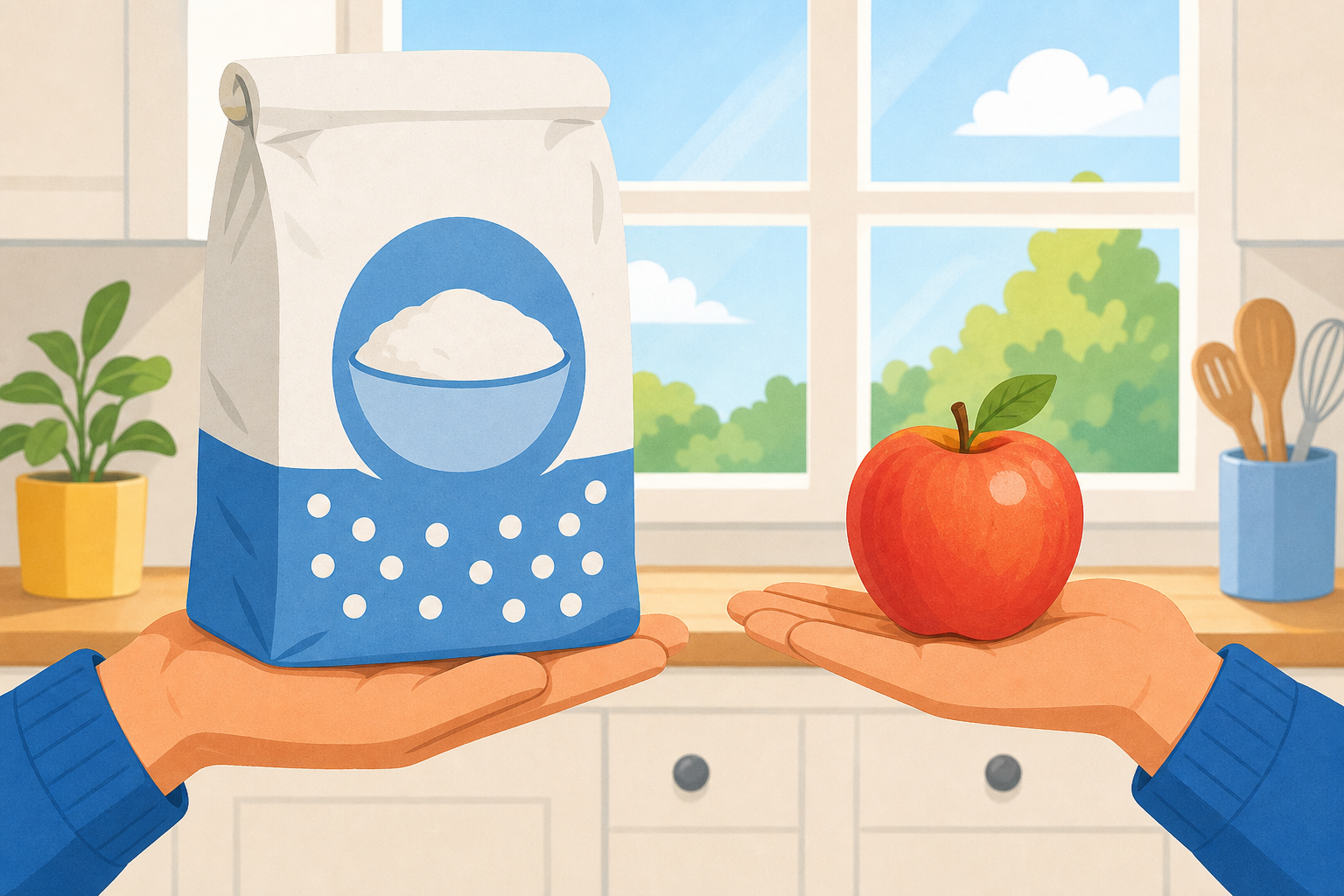
    Illustration for Getting StartedI am holding a bag of sugar in one hand and an apple in the other. One of them is a kilogram and one is only a couple of hundred grams. Just by lifting them, hands up: which one do you think is the kilogram, and how did your hand help you decide?

    2 - Watch and Notice ~9 mins

    Reading a weighing scale

    Watch the scale at the front as I weigh four things. First an apple: the needle settles near 200 g. A gram is our small unit, so light things are counted in grams. Predict before the next one: is a bag of pasta heavier or lighter than the apple?

    Now the bag of pasta reads 500 g. Notice the needle points exactly at a marked line, so we read it straight off. Now the bag of sugar tips right over to 1 kg, our big unit, and it is the same as 1,000 grams.

    Last of all the loaf. The needle does not sit on a big mark. It lands between two of them, so we count the small divisions to read it.

    1. Name the two big marks the needle sits between: 700 g and 800 g.
    2. Check how the gap is split. On this scale there are two equal small steps between those marks, so each small step is worth 50 g (half of 100 g).
    3. Count how many small steps the needle has moved past the lower mark. It has moved one step past 700 g.
    4. Add that on: 700 g + 50 g = 750 g.

    So the loaf weighs 750 g. Whenever the needle lands between marks, use this same four-step count.

    3 - Try It Together ~12 mins

    Now we weigh together at your tables. We weigh these four items in this order: a rubber first, then a full pencil case, then a hardback book, then a schoolbag. Before each one goes on the scale, we say our estimate out loud, choosing grams or kilograms, and then we read the scale and see how close we were. Write each estimate and reading on your Weighing Record Sheet as you go.

    Hands-on Task

    4 - Write Your Estimates in Your Copy ~3 mins

    COPYBOOK MOMENT

    In your maths copy, write four classroom items, one under the other. Beside each one write your estimate and the weighed reading from your Weighing Record Sheet, choosing grams (g) or kilograms (kg).

    • Rubber
    • Pencil case
    • Hardback book
    • Schoolbag

    5 - Class Challenge ~10 mins

    Now it's time to compare and put weights in order. A fresh set of objects will come round the room: a small water bottle, a tin of beans, a bag of oranges and a big dictionary.

    Key point

    Weigh each one, then order all four from lightest to heaviest on your Weighing Record Sheet. Some of these weigh less than a kilogram and some weigh more, so watch your units carefully, and mark which ones cross the 1 kg line.

    Stretch

    For a stretch, find something on your desk that weighs about half a kilogram, that is 500 g, half of our 1 kg bag of sugar.

    Hands-on Task

    Pupil practice
    Module 4 · Measures: Length, Weight and Capacity Measures
    Lesson 50 · Weight, Estimate and Weigh in Kg and G on a Scale
    Download Activity Book page (PDF)
    123learn · Online learning platform

    Unlock the full learning experience

    You're previewing this lesson. Get full access to this lesson and hundreds more — each one ready to teach, with interactive activities, printable resources and pupil progress tracking built in.

    Hundreds of curriculum-aligned lessons
    Interactive activities in every lesson
    Printable resources & progress tracking
    Copyright Notice
    This lesson is copyright of Coding Ireland 2017 - 2025. Unauthorised use, copying or distribution is not allowed.
    🍪 Our website uses cookies to make your browsing experience better. By using our website you agree to our use of cookies. Learn more