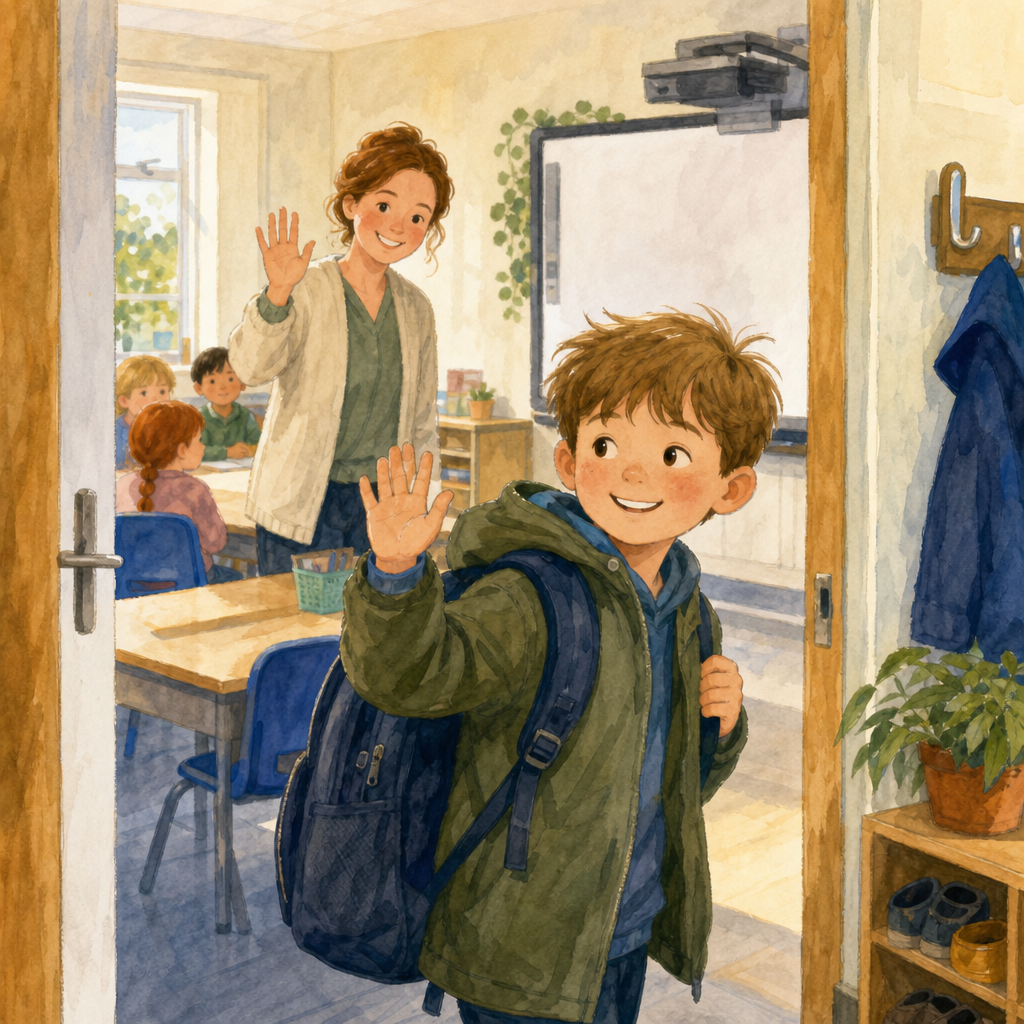
You already know how to say hello in French. Try greeting your teacher now!
Nice one. But wait: how do you end the chat? Walking away without a goodbye feels odd in any language. Today we fix that.
Invite the class to greet you using a hello from last time (for example Bonjour, bohn-ZHOOR, or Salut, sah-LOO). Accept two or three greetings, then pause and look expectantly as if waiting for them to finish the exchange. When nobody can close it, smile and say that is exactly today's job.
Keep the hook light and short. Do not teach any goodbye yet; the flashcards in the next step do that work.
Today's goodbyes appear one card at a time. Listen to the French audio first, repeat it together, then check the English meaning.
Handy tip: Salut works both ways (hi and bye) but only with friends.
Run the flashcards on the IWB. On this first meeting, show the French with the image and play the audio before the English. Class repeats twice: once all together, once by table. Do not ask anyone to guess the French out loud before they have heard it. A silent think is fine; spoken guessing waits until after the first listen.
Salut does double duty: replay that they already used it as hi last time, then show today's goodbye use. Same word, friends only, both ends of a chat.
Core five for clear speaking today: Au revoir (oh ruh-VWAHR), Salut (sah-LOO), À bientôt (ah bee-an-TOH), À demain (ah duh-MAN), Bonne journée (bun zhoor-NAY). Lean on choral practice for these. The other three (À plus tard, Bonne nuit, À tout à l'heure) are bonus ears: hear them, smile at them, no pressure to produce them yet.
After Au revoir, add a quick aside: that vwah sound is the stylish bit. Chin up, small wave, say it like you are leaving a café.
When-to-use tags as each core card appears:
Bonus ears in brief: À plus tard and À tout à l'heure suit friends when you will see them later the same day; Bonne nuit is bedtime, not a classroom exit.
End with a 30-second board sort into three columns the class can still see in the copy step: Friends (Salut, and later À plus tard, À tout à l'heure); Anyone / adults (Au revoir, Bonne journée); When we meet again / bedtime (À bientôt, À demain, Bonne nuit).
Model one full mini-exchange once before the matching game. You say Bonjour (bohn-ZHOOR). A volunteer answers Bonjour. You close with Au revoir. They reply À bientôt.
Watch the board. Volunteers flip two cards at a time to match each French goodbye with its English meaning. When a French card is turned, everyone at their desk whispers the French together.
Default is whole-class IWB play with volunteers taking turns. Only if class tablets are already out should pairs play on devices; otherwise stay on the board. Audio plays on every flip, so keep the volume up.
Every pupil has a job on every turn: whisper the French when a French card appears, and thumbs-up if they already knew it. Non-volunteers should never be sitting idle.
If the same pair is missed twice, stop and say the French together before moving on. Listen for the soft v in revoir and the nasal ending in demain.
Keep the three groups on the board. Open your copy and write three goodbyes. Next to each one, note when you would use it.
| Friends | Anyone / adults | When we meet again / bedtime |
|---|---|---|
| Salut À plus tard À tout à l'heure | Au revoir Bonne journée | À bientôt (soon) À demain (tomorrow) Bonne nuit (bedtime) |
Pause the board games and leave the three-column sort fully visible for the whole copy minute so spelling, accents, and use-type stay accurate (watch the accent on À in À bientôt and À demain).
Answer guide (use-type, not just friend vs adult):
Any three with a sensible label count as a pass. Prefer at least one from the core speaking set. Walk the room and check labels; do not collect the copies.
Hello reminder: open with a hello you already know, then finish with a clear goodbye that fits the person.
Work with a partner on two mini-scenes. Follow the dialogue frame on the board and the partner-practice prompts. Swap roles so each of you tries both parts.
Before pairs start, spend about 30 seconds replaying the two hellos on the board with audio: Bonjour (bohn-ZHOOR) and Salut (sah-LOO). Then leave these two dialogue frames fully visible beside the partner-practice interactive for the whole activity (write them up quickly, or keep a slide ready):
Scene 1: leaving class with a classmate
A: Salut ! / Bonjour !
B: Salut ! / Bonjour !
A: Salut ! / À plus tard ! / À tout à l'heure !
B: À bientôt ! / Salut !
Scene 2: leaving a shop, or saying goodbye to your teacher
A: Bonjour !
B: Bonjour !
A: Au revoir ! / Bonne journée !
B: Au revoir ! / À bientôt !
Pair pupils so they face each other if seating allows. Model Scene 1, then Scene 2, with a volunteer, speaking slowly. Point at each line as you say it.
Scene 1 is peer register (casual goodbyes). Scene 2 is polite register with an adult or shopkeeper. Circulate and listen for a clear close rather than a mumbled fade-out. If a goodbye trails off into a mumble, ask them to rewind and give it a proper exit: big clear finish, then smile.
After a few minutes, ask pairs to swap who starts. Core production targets: Au revoir, Salut, À bientôt, Bonne journée. Bonus phrases on the frame are optional stretch.
You're previewing this lesson. Get full access to this lesson and hundreds more — each one ready to teach, with interactive activities, printable resources and pupil progress tracking built in.