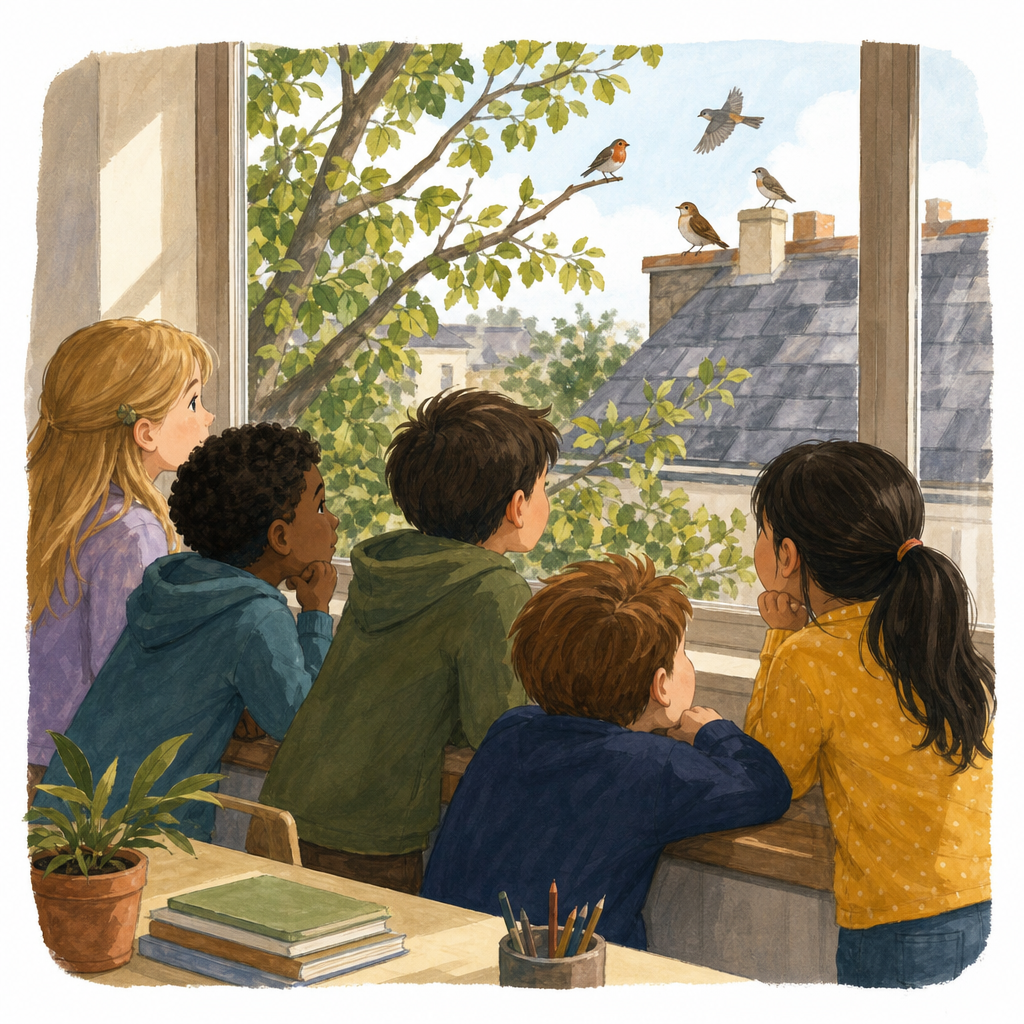
Name every bird you have seen in the school yard this week. How many can the class collect in thirty seconds?
Collect bird names quickly in English: pigeon, crow, robin, seagull, whatever the class actually sees. Do not correct or translate yet. The point is to get them thinking about birds they already know before the Spanish words land. Keep it to about a minute of calling out, then move on.
Here are today's eight birds, in two groups of four. Listen first, then repeat with the class. Listen for the silent u in el águila (sounds like AH-gee-la) and the strong rolled rr in el gorrión.
Work through the deck on the board in two chunks. Do not ask for unaided recall on first contact.
Group 1 (window birds): play audio or model, class repeats twice (once together, once by table), then show the English and flip to check. Words: el gorrión (el go-rree-ON), el cuervo (el KWER-bo), la gaviota (lah gah-BYO-ta), el petirrojo (el peh-tee-RO-ho).
Quick finger-check: hold up 1–4 fingers for each of the four; class chorus the matching Spanish with its article.
Group 2: same hear → repeat twice → then English/flip. Words: el búho (el BOO-o), el cisne (el THEES-ne), el águila (el AH-gee-la), el flamenco (el flah-MEN-ko).
Insist on the article every time: bare gorrión is not enough; el gorrión is the answer.
Pronunciation anchors (keep visible near hard items):
Quick curiosity (one line, then move on): águila is a feminine word, but Spanish uses el águila because la águila is awkward to say (same trick as el agua). You would still say el águila alta and las águilas.
Cheer: when the class nails el gorrión with a real rolled rr, or el águila with the hard g, give a quick round of applause — those are trophy sounds.
Volunteers flip two cards at a time on the board and find each Spanish bird with its English meaning. When a Spanish card appears, we all whisper it with el or la.
Whole class on the IWB with volunteers taking turns. Audio plays on every flip, so keep the volume up. When a Spanish card appears, pause for a full-class whisper of the phrase with its article before the next flip. If a pair is missed twice, pause and say the Spanish together before moving on. Watch for el águila and el búho, which pupils often mix up at first, and for the rolled rr in el gorrión.
Cheer: first clean match that the whole class whispers correctly earns a silent wing-flap (hands under armpits, one flap).
Open your copy and write the names of three birds, with articles, and draw a quick sketch beside one. Use the list on the board — copy carefully, including el/la and any accent.
Pause the board. Everyone writes: this is the only three minutes where every pupil's pen is moving. Keep all eight target forms visible for the full three minutes so they can copy spellings and accents (especially el gorrión, el búho, el águila). Check that the article is going in front of every word. Do not collect these.
The wheel lands on a bird. We all whisper the Spanish with its article. Then one volunteer answers with a mini-phrase: Es el búho or Veo la gaviota.
Spin on the board. Flow every spin: (1) whole class whispers the full phrase with the article, (2) you call a volunteer (or take a hand), (3) they answer alone with a mini-phrase such as Es el cuervo / Veo el petirrojo / Es la gaviota. Accept only the full phrase with the article, not a bare noun. If a pupil hesitates, let the class whisper-support once, then they try alone. Keep pronunciation anchors visible near the hard items (el águila AH-gee-la, el gorrión go-rree-ON, el petirrojo peh-tee-RO-ho). Aim to hit most of the eight words at least once.
Cheer: first full mini-phrase of the spin earns a class bird-call (hands under armpits, one flap).
You're previewing this lesson. Get full access to this lesson and hundreds more — each one ready to teach, with interactive activities, printable resources and pupil progress tracking built in.