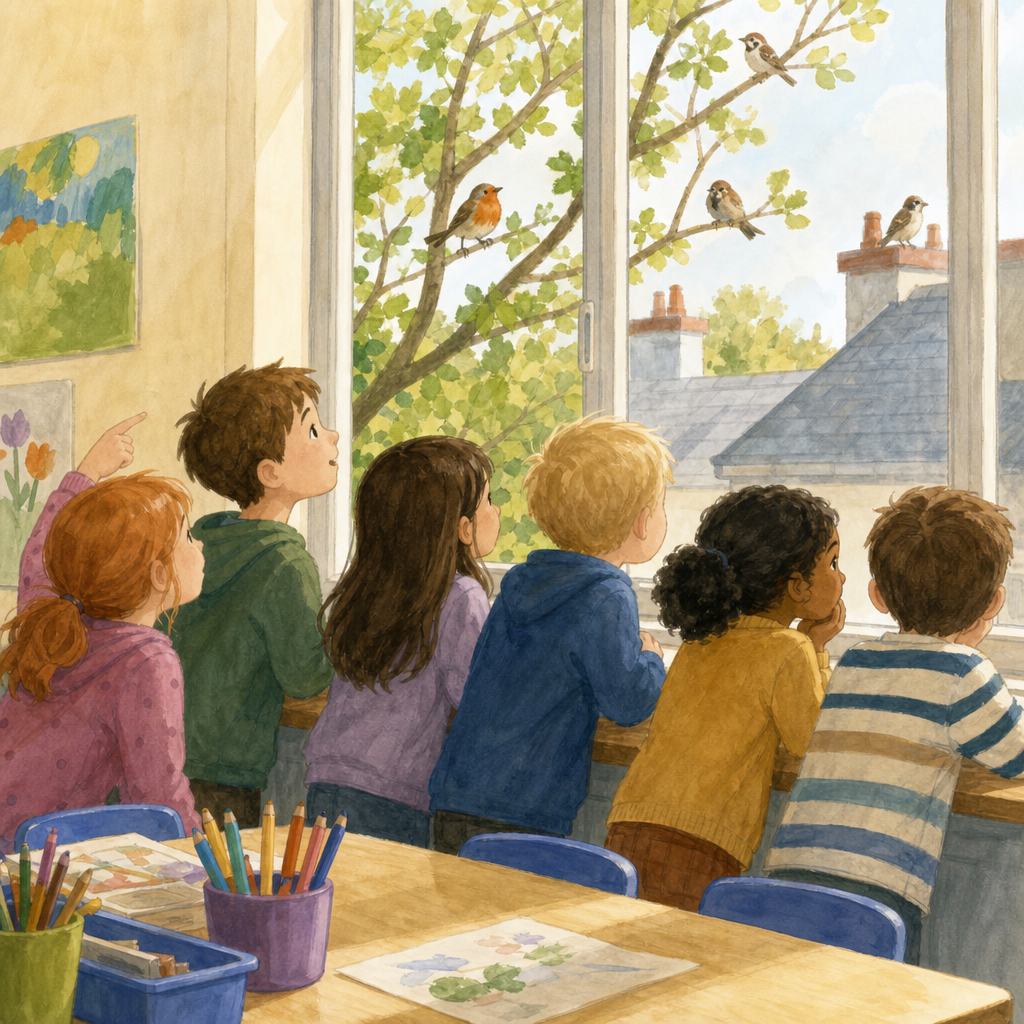
Name every bird you have seen in the school yard this week. How many can the class list in thirty seconds?
Take a quick hands-up or shout-out list: robin, crow, pigeon, seagull, whatever they offer. Do not translate yet. The point is to wake up the topic before the French words arrive. If nobody has noticed any birds, ask what they might see near a park pond or on a rooftop instead.
These are birds you might spot in a Paris park, along a river path, or circling a village bell tower, plus one famous visitor from the south of France. We will learn them in two groups of four.
Group A first: English shows first. Try to say the French before you flip, then listen and repeat together. Watch which ones take le, la or l'.
After Group A, a quick thumbs-point check, then Group B the same way. Before we leave, we will do a rapid re-pass of all eight: picture up, class says the French.
Frame the set as real French places, not a random list: a Paris park bench, a Loire towpath, a village square, and (for le flamant rose) the Camargue wetlands we will meet properly in the discussion. Work in two groups of four on the IWB so earlier words are not lost.
Group A: le moineau (luh mwah-NOH), le corbeau (luh kor-BOH), le hibou (luh ee-BOO), la mouette (lah moo-ET). For each card: invite a guess, flip, play the audio, class repeats twice (all together, then by table). Point at the article every time. Celebrate the first clean la mouette or le hibou with a big reaction, then class echo.
Thumbs-point check: hold up two bird images and ask which is which; whole class points or whispers.
Group B: le cygne (luh SEEN-yuh), l'aigle (LAY-gluh), le rouge-gorge (luh roozh-GORZH), le flamant rose (luh flah-MAHN rohz). Same routine. On le flamant rose, add one line: "We will hear why this bird is famous in the south of France in a few minutes." The soft zh in rouge-gorge and the apostrophe on l'aigle are worth a second listen. Note: le hibou keeps le (aspirated h), not l'.
Rapid re-pass before leaving: show each image once, class says the full French with article. No English this time. Every word heard and said again while still on the board.
Volunteers flip two cards on the board. Everyone else whispers the French with its article when a French card turns. After each match, hands up if you had it too.
Whole class on the IWB with volunteers taking turns at the board. Seated pupils have a clear job every turn: whisper the French (with article) as each French card flips, then hands-up "got it" after a match so row 3 stays in the game. Audio plays on every flip, so pronunciation keeps landing while they play. If the same pair is missed twice, pause and say the French together before moving on. Insist on the article: corbeau is not the full answer; le corbeau is. When a pair lands cleanly, name the win: "Yes — le rouge-gorge with the article. Bien joué!"
Open your copy and write the names of three birds you feel sure of, with articles, and draw a quick sketch beside one. Use the list still on the board to help with spelling. Take care with the articles, with the apostrophe on l'aigle, and with the hyphen in le rouge-gorge.
Pause the board but leave all eight target forms (with articles) visible for the full three minutes. Everyone writes: this is the only three minutes where every pupil's pen is moving. Pick-any-three means weaker spellers need not force themselves onto the hardest items. Walk the room and check the article is going in front of every word, and that l'aigle keeps the apostrophe and le rouge-gorge keeps the hyphen. Do not collect these.
Spin the wheel. When it lands on a bird, say the French word aloud with its article. Your table can back you up if you need it.
Before the first pupil spin, run one safe warm-up: you spin once, whole class chorus answers with the article. Then start calling pupils. Keep audio one-tap ready on every spin. If a pupil hesitates on their first try, allow "phone a table" (the table says it together), then let the pupil repeat alone. The pupil still aims for the full phrase (la mouette, not just mouette). Keep the pace brisk so most of the class gets at least one turn. When someone nails l'aigle or le flamant rose with the article, name the win out loud: "Parfait, le/la + bird." For a very shy class, default to table chorus on early spins and move to solos as confidence builds.
You're previewing this lesson. Get full access to this lesson and hundreds more — each one ready to teach, with interactive activities, printable resources and pupil progress tracking built in.