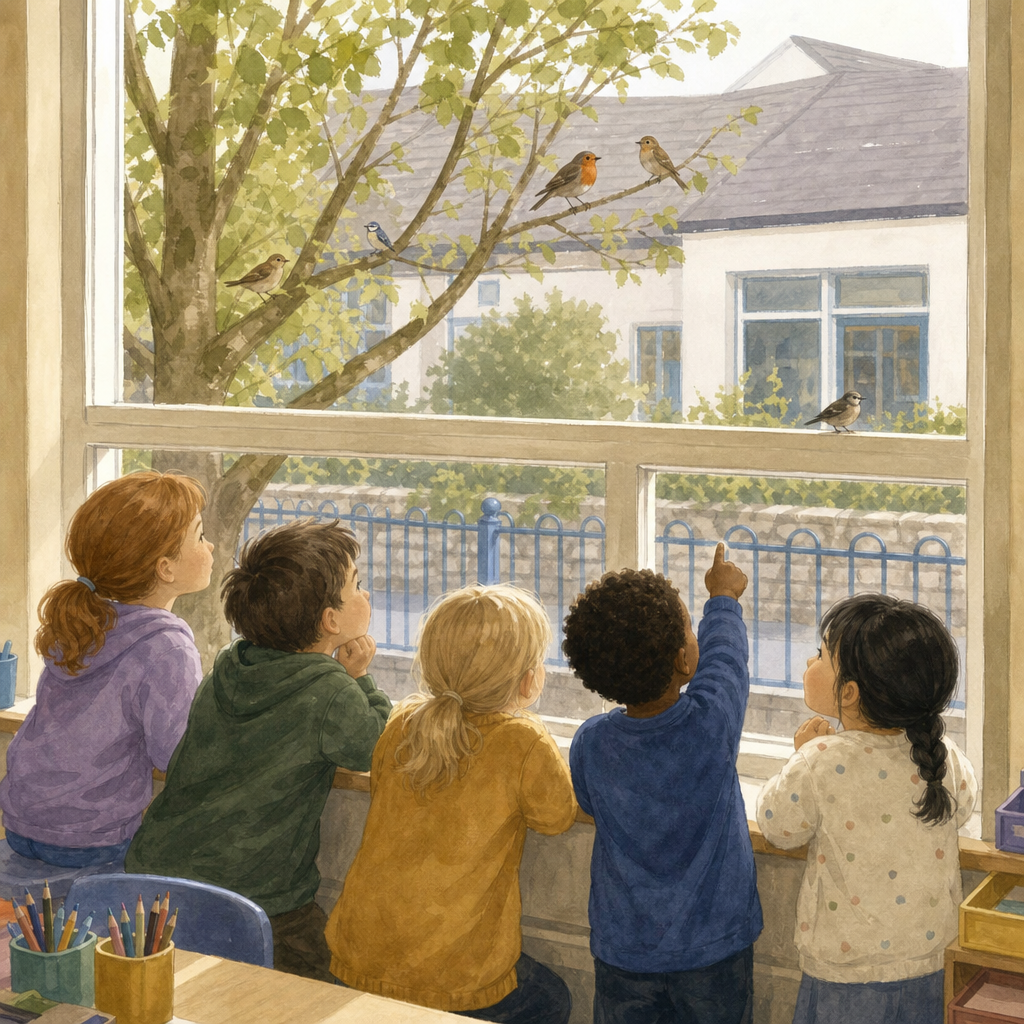
Name every bird you have seen in the school yard this week. How many can the class collect in thirty seconds?
Take quick hands-up answers only: robin, crow, seagull, pigeon and so on. Do not translate yet. The point is to notice how many birds they already know in English before the German words appear on the flashcards. After thirty seconds, tell them: today those same birds get German names, and one of them is a rooftop celebrity in German towns. You can also put the collective label on the board once: die Vögel means the birds.
We are birdwatching on a bench in a Stadtpark in Hamburg. Eight birds you might spot are waiting on the cards.
First pass (two sets of four): See the English and picture. Listen to the German with its article, then say it together twice. Flip to check the spelling. Do set A (four birds), then set B (four birds).
Second pass: Volunteers try the German before the flip.
Listen for the sh-sound in Schwan: same shape as English ship.
Run this as whole-class flashcards on the IWB. Split into two mini-sets of four so each word is heard and said more than once before matching.
Set A: Der Spatz, Die Möwe, Die Eule, Der Schwan.
Set B: Der Adler, Die Krähe, Das Rotkehlchen, Der Papagei.
First pass (hear then say): English and image show first. You say the German with the article (use the guide or play the audio), then the class repeats chorally twice. Flip to confirm the written form. Finish set A, then set B the same way.
Second pass only: Invite a volunteer to try the German before the flip; class echoes.
Pronunciation guides: Der Spatz (dair SPAHTS), Die Möwe (dee MUR-vuh), Die Eule (dee OY-luh), Der Schwan (dair SHVAHN), Der Adler (dair AH-dluh), Die Krähe (dee KRAY-uh), Das Rotkehlchen (dahs ROHT-kehl-khen), Der Papagei (dair pah-pah-GY). Point at the article every time so the gender pair sticks, including das on Rotkehlchen. Celebrate the first clean Der Schwan: that sch is the sound of the week.
Still in the Stadtpark: flip two cards at a time and find each German bird with its English meaning. When a card is flipped, everyone whispers the German with its article; the volunteer at the board finds the match.
Volunteers take turns on the IWB, or tables call out matches if you prefer whole-class play. Desk pupils always whisper the German with the article as each card turns so the whole class is speaking, not only the volunteer. If a pair is missed twice, pause and say the German word together with the article before moving on. This consolidates meaning after first contact on the flashcards. When a table lands a tricky pair, give them a quick class clap.
Copy three bird names with der, die or das from the board and sketch one of them.
Pause the board. Keep a reference strip of all eight target forms with articles visible on the IWB for the whole three minutes so every pupil is copying from a model, not guessing spellings. Everyone writes; this is the only three minutes where every pupil's pen is moving. Check that the article is going in front of every noun (including das for Rotkehlchen): a list of bare words will not carry the gender pairing. Do not collect these.
The park ranger's wheel picks the next bird you have to name (picture or English). The whole class says the German with its article once, then the pupil whose turn it is repeats it. If you need a hand, phone a table once.
Spin on the IWB. Before any cold-call, run a quick choral rehearsal: whole class says the word with the article once, then the chosen pupil repeats. Allow 'phone a table' once so nobody is stranded on a half-heard word. Insist on the full form with the article: Spatz is not enough, Der Spatz is the answer. If pronunciation slips, model it once using the guides below (also in step 2 teacher_notes, Eight German birds) and have the class echo before the next spin. Pronunciation guides: Der Spatz (dair SPAHTS), Die Möwe (dee MUR-vuh), Die Eule (dee OY-luh), Der Schwan (dair SHVAHN), Der Adler (dair AH-dluh), Die Krähe (dee KRAY-uh), Das Rotkehlchen (dahs ROHT-kehl-khen), Der Papagei (dair pah-pah-GY). If someone nails Der Adler or Das Rotkehlchen with the article, pause and let the class echo it like a victory chant.
You're previewing this lesson. Get full access to this lesson and hundreds more — each one ready to teach, with interactive activities, printable resources and pupil progress tracking built in.