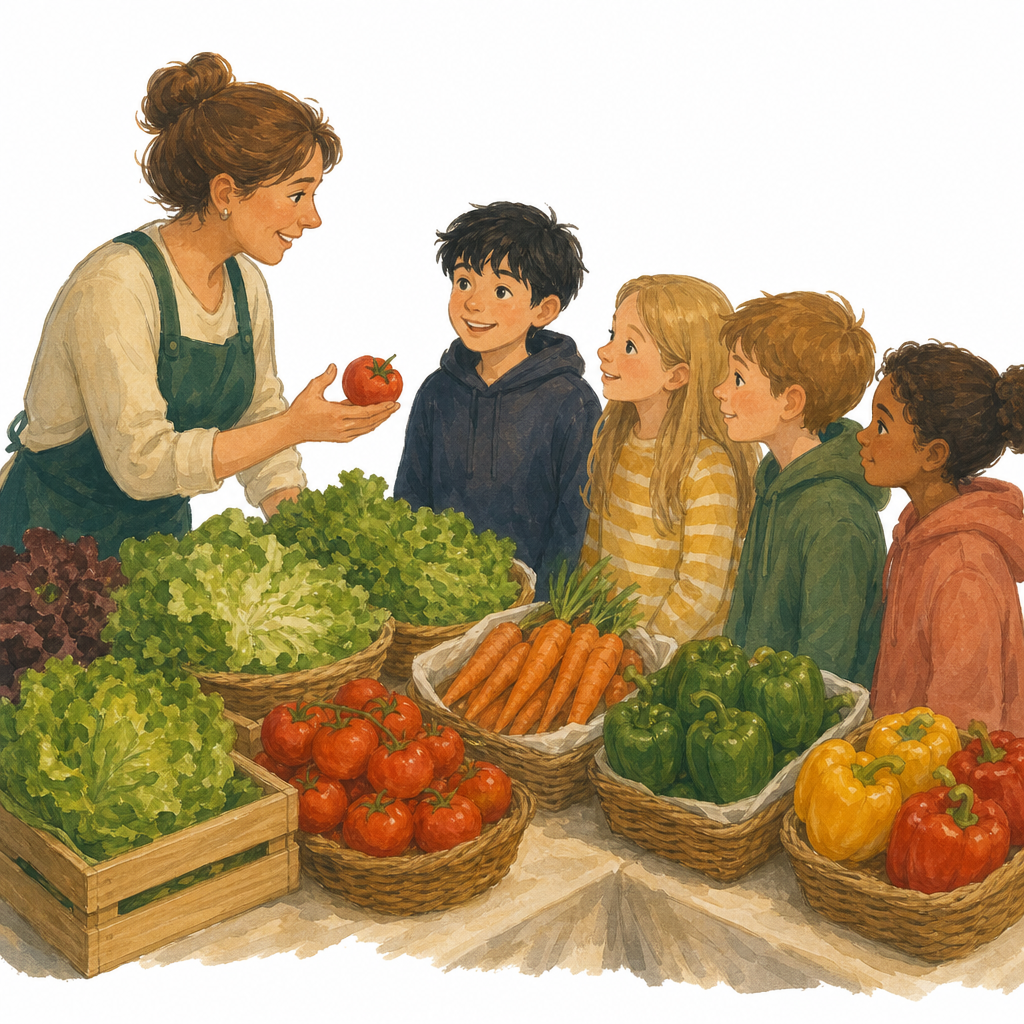
 Is a tomato a fruit or a vegetable? Tell your partner in one word, then we learn eight Spanish vegetable words with el or la from a market stall.
By the end of this lesson, you will be able to:
- Name eight vegetables in Spanish with el or la
- Sort each noun into the right gender column
- Spot words that look like English but sound different out loud
You are at a vegetable stall in a Spanish mercado. We meet the labels in two crates.
Crate 1: plate vegetables. English and picture first. Listen to the full Spanish with el or la, repeat twice, then flip to check the spelling.
Crate 2: salad vegetables. Same routine. These are fun to say: lean into the long ones.
When both crates are done, say all eight together one more time with the articles glued on.
Still at the mercado stall. The crate labels and their meanings are in two columns on the board, and one of you may be called up to match a pair. When a pair matches, everyone says the full Spanish phrase together with its article, not just the person at the board. Cheer a clean el/la match out loud.
From today's eight vegetables on the board, choose four you like (or have eaten) and write each one in your copy with el or la. Copy the Spanish spelling exactly from the list.
- el tomate (tomato)
- la zanahoria (carrot)
- la patata (potato)
- la cebolla (onion)
- el pimiento (pepper)
- el pepino (cucumber)
- la lechuga (lettuce)
- el brócoli (broccoli)
Back at the stall: we sort the crate labels into two piles, and one of you at a time comes up to move a label. Before every drop, everyone says the full Spanish phrase and shows a hand signal: left hand for el, right hand for la. Only then does the label go into a column. Four and four: can you fill both columns clean without a peek?
Unlock the full learning experience
You're previewing this lesson. Get full access to this lesson and hundreds more — each one ready to teach, with interactive activities, printable resources and pupil progress tracking built in.
This lesson is copyright of Coding Ireland 2017 - 2025. Unauthorised use, copying or distribution is not allowed.