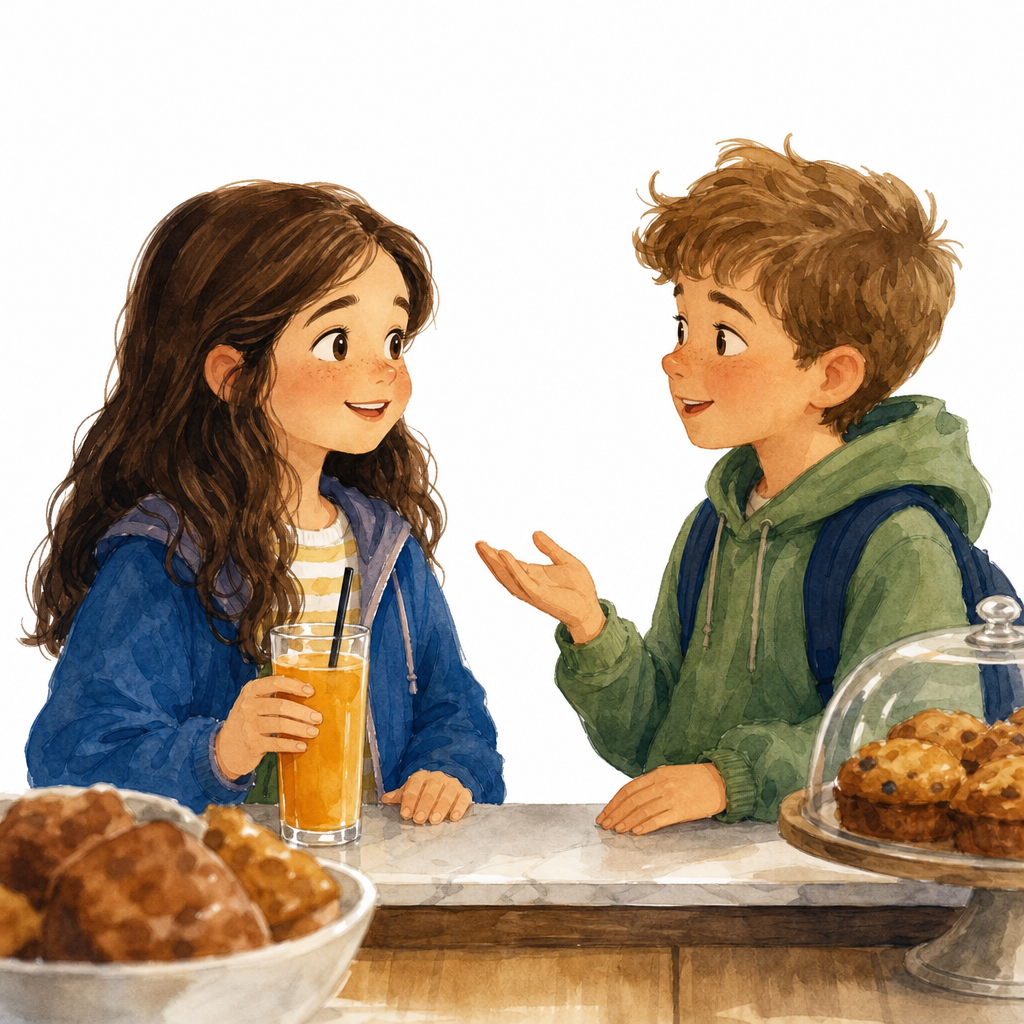
In English, one small word can change how a request lands. Watch what happens when we add please, then meet the Spanish words that do the same job.
Today you will learn eight Spanish polite phrases so you can ask for something properly, not just point.
Do a quick two-line demo: first ask a pupil for a pencil with no please, then ask again with please. Keep it light and funny (a raised eyebrow when the first ask falls flat usually gets a laugh), then land the point that Spanish speakers often reach for these courtesy words in everyday situations too.
Do not teach the new phrases yet. The word-table in the next step is where the class meets them with audio.
We will meet today's eight polite phrases in two short passes. Tap each row, listen, then say it back together.
Pass 1: the request loop (please, thank you, you're welcome, sorry). Listen carefully and copy the stress you hear.
Pass 2: excuse me, yes and no (two ways to say excuse me, plus yes and no).
You will need the request loop later for a full order like this:
A: Un zumo, por favor.
(B hands over the juice)
A: Gracias.
B: De nada.
Un zumo, por favor. = A juice, please.
Run two passes so the load stays manageable. Pass 1 first: tap por favor, gracias, de nada, lo siento; class repeats each twice (once all together, once by table). Pass 2: perdona, perdone, sí, no the same way. Pass 2 phrases appear only as the word-table is tapped; do not rewrite them on the board.
Pronunciation guides if you need them: por fah-VOR, GRAH-thyahs, deh NAH-dah, loh SYEN-toh, per-DOH-nah, per-DOH-neh, see, noh.
Model the short worked exchange on the board once, in this order only: A asks for a drink with por favor → you (or a volunteer as B) hand it over in silence → A says Gracias → B replies De nada. Never put De nada before the thanks. Leave the English gloss under the model so every pupil can read it. Point out that un zumo is a drink word from earlier, so they are joining old words with new manners: "you already know zumo; now you can make it polite."
Drink-word pronunciations for the model and later banks: un zumo (oon THOO-moh), un agua (oon AH-gwah), un té (oon teh).
Quick label for the excuse pair: perdona with a friend or classmate; perdone with an adult. Sí and no are the polite yes/no they will hear at a counter.
Flip two cards at a time and find each Spanish polite phrase with its English meaning. Say the Spanish quietly as you turn each card; even if it is not your turn, whisper along so the whole class stays in the game.
Run this on the IWB with volunteers taking turns. Insist they say the Spanish aloud before claiming a match, not just the English. Everyone else whispers each Spanish card as it turns so the room stays active.
If cards look similar, give a one-line usage hint under the English side as you go: lo siento = sorry you did something serious (broke a pencil, hurt feelings); perdona = excuse me / light bump with a friend; perdone = excuse me, more formal / with an adult; por favor / gracias / de nada = the request loop; sí / no = yes / no. If the same pair is missed twice, stop and chorus it together before moving on.
Celebrate the first clean por favor match out loud; a warm "¡Qué educados!" (keh eh-doo-KAH-dohs) keeps the energy up.
After the last match: 60-second situation chorus. Call a situation and the class fires back the phrase: "you bump someone" → Perdona; "you broke a pencil / hurt someone's feelings" → Lo siento; "you need a teacher's attention" → Perdone; "you want a juice politely" → Por favor; "someone thanks you" → De nada; "yes, please / no, thank you" → Sí / No. This gives every phrase one meaningful oral beat before pair work. Production focus for speaking later stays on por favor, gracias, de nada, lo siento, perdona; treat perdone, sí and no as notice-and-chorus items unless a pair reaches for them naturally.
Open your copy and write the phrase for "please" and the phrase for "thank you", then write one whole sentence asking for a drink.
Drink bank (pick one): Un zumo · Un agua · Un té
Model to copy and adapt: Un zumo, por favor. (= A juice, please.)
Pause the board. Everyone writes; this is the only three minutes where every pupil's pen is moving. Keep the word-table on screen and write the small drink bank beside it before pens move: Un zumo (oon THOO-moh) / Un agua (oon AH-gwah) / Un té (oon teh). Leave the model sentence Un zumo, por favor. visible so nobody is stuck on spelling.
The sentence should look like Un zumo, por favor or Un agua, por favor, using a drink word from the bank plus today's please. Check accents and the comma before por favor. Do not collect these.
You are at the school juice counter. Partner A orders, Partner B hands it over, then you swap. Keep please and thank you in every exchange.
On-screen script (use this frame every time):
A: Un ____, por favor.
(B hands it over)
A: Gracias.
B: De nada.
Fill the blank from: un agua · un zumo · un té
Optional: if you bump your partner, apologise in Spanish, then back to ordering.
Pair pupils up. Anchor the scene in plain English first: you are ordering at the school juice counter or the comedor (canteen) counter. Model one full exchange with a volunteer first, reading slowly and miming the hand-over:
A: Un agua, por favor. (oon AH-gwah, por fah-VOR)
(B hands it over; no Spanish needed here)
A: Gracias. (GRAH-thyahs)
B: De nada. (deh NAH-dah)
Drink-bank pronunciations to keep visible: un zumo (oon THOO-moh), un agua (oon AH-gwah), un té (oon teh). Leave the gapped frame and the three drink nouns on the IWB for the whole step so every pair has the same script. Circulate and listen for please and thank you landing in the right places; De nada only after Gracias. When you hear a full please–thanks loop, freeze the room for a quick class round of applause. After about five minutes, ask pairs to swap so each child has been A and B.
Excuse/apology phrases stay optional: if a pair finishes early, they can add a quick bump-and-apologise beat (Perdona for a light bump; Lo siento if they "break" something) then return to ordering. Do not require perdone, sí or no in the pair task.
You're previewing this lesson. Get full access to this lesson and hundreds more — each one ready to teach, with interactive activities, printable resources and pupil progress tracking built in.