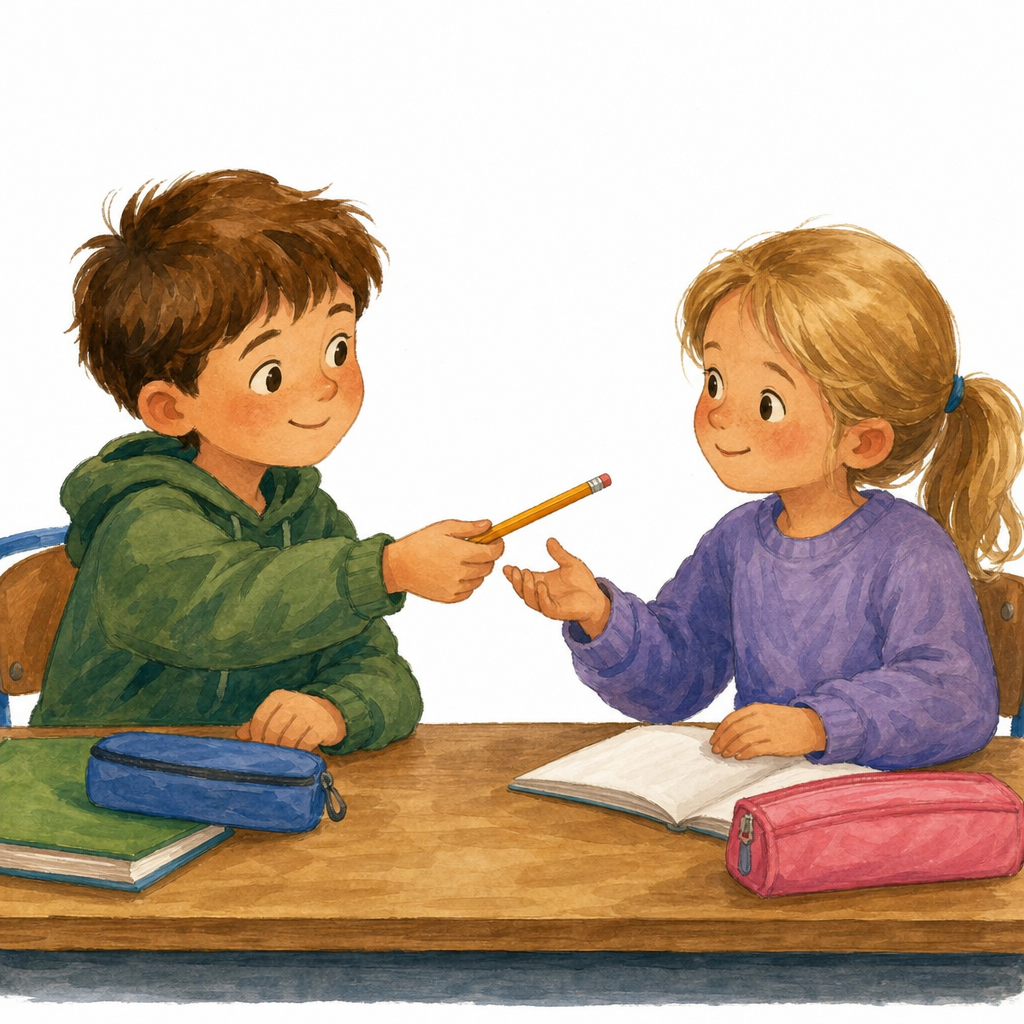
Watch what happens when we ask for a pencil, first without please, then with please. Which one works better?
Do a quick live demo with one volunteer: ask for a pencil with no please, then again with please. Keep it light and funny. The point is that politeness opens doors, not that the first request was rude. Do not introduce the French words yet; the word-table does that next. Pupils watch only; they do not pair up here.
We will hear today's eight polite phrases in two short groups. Listen to each one, then say it back together as a class. Listen for the soft zh sound in je (like the s in treasure) and notice that French often has a friendly form and a polite form.
Pass 1 (core request set): Tap s'il vous plaît (seel voo PLEH), s'il te plaît (seel tuh PLEH), merci (mair-SEE), then class repeats twice (once together, once by table). Flag the two please forms straight away: s'il vous plaît for adults and teachers; s'il te plaît for friends. Model one quick teacher-led goûter ask with a volunteer: hold up an imaginary juice and say Un jus, s'il vous plaît (un zhoo, seel voo PLEH), then prompt the class merci.
Pass 2 (replies and getting attention): Tap de rien (duh ree-EN), je vous en prie (zhuh voo zahn PREE), excusez-moi (ek-skew-zay MWAH), excuse-moi (ek-skew MWAH), pardon (par-DOHN). Point out the pairs: two you're-welcomes and two excuse-mes, same friendly/polite idea as the two pleases. Excusez-moi is the form pupils will use most with adults; with friends they may also hear excuse-moi.
Keep the word-table on the board for the rest of the lesson so pupils can glance back.
Flip two cards at a time and find each French phrase with its English meaning. When a pair is found, the whole class says the French out loud together before the next turn.
Whole class on the IWB with volunteers taking turns, or pairs if devices are available. Engagement beat: every time a match is found, freeze for one second and lead a quick choral repeat of the French card (class says it once, then move on). If a pair is missed twice, stop and say the French together before continuing. Watch for mix-ups between the two please forms and the two excuse-me forms: ask which one you would use with a teacher. When a volunteer correctly names the friendly vs polite form, give a quick two-second applause and name them.
Time for our French goûter counter. Partner A orders something politely; Partner B hands it over. Then swap. Follow the four beats below. Use the word-table on the board when you want the other please or you're-welcome form.
Mini-script
Other orders you can try: un croissant, un chocolat chaud.
Pair pupils up. Before they start, model the full four-beat exchange with a volunteer at the front (imaginary goûter counter):
Then remodel once with the formal please and formal reply: A: Un jus, s'il vous plaît (seel voo PLEH). B: Voici. A: Merci. B: Je vous en prie (zhuh voo zahn PREE). Point at the word-table so pupils see where the second please and second you're-welcome live.
Support chunks on the board (not for spelling tests, just for saying): un jus (a juice), un croissant (a croissant), un chocolat chaud (a hot chocolate), voici (here you go).
Circulate and listen for the clear PLEH ending and a natural merci / de rien. When you hear a clean PLEH or a natural merci / de rien, freeze the room for a two-second applause moment: name the pair and move on. After about five minutes, swap roles so both partners order and answer.
Open your copy. Write the two phrases below, then write one short café request using please.
Copy these:
Either please form is fine. The word-table stays on screen if you need a reminder.
Pause the interactive. Everyone writes: this is the only three minutes where every pupil's pen is moving. Keep the word-table on screen while they copy. The model on the board is the only spelling support they need; un jus is a supported chunk from the partner practice, not a new vocabulary card. Accept s'il te plaît if they can say when they would use it (with a friend). Do not collect these.
You're previewing this lesson. Get full access to this lesson and hundreds more — each one ready to teach, with interactive activities, printable resources and pupil progress tracking built in.