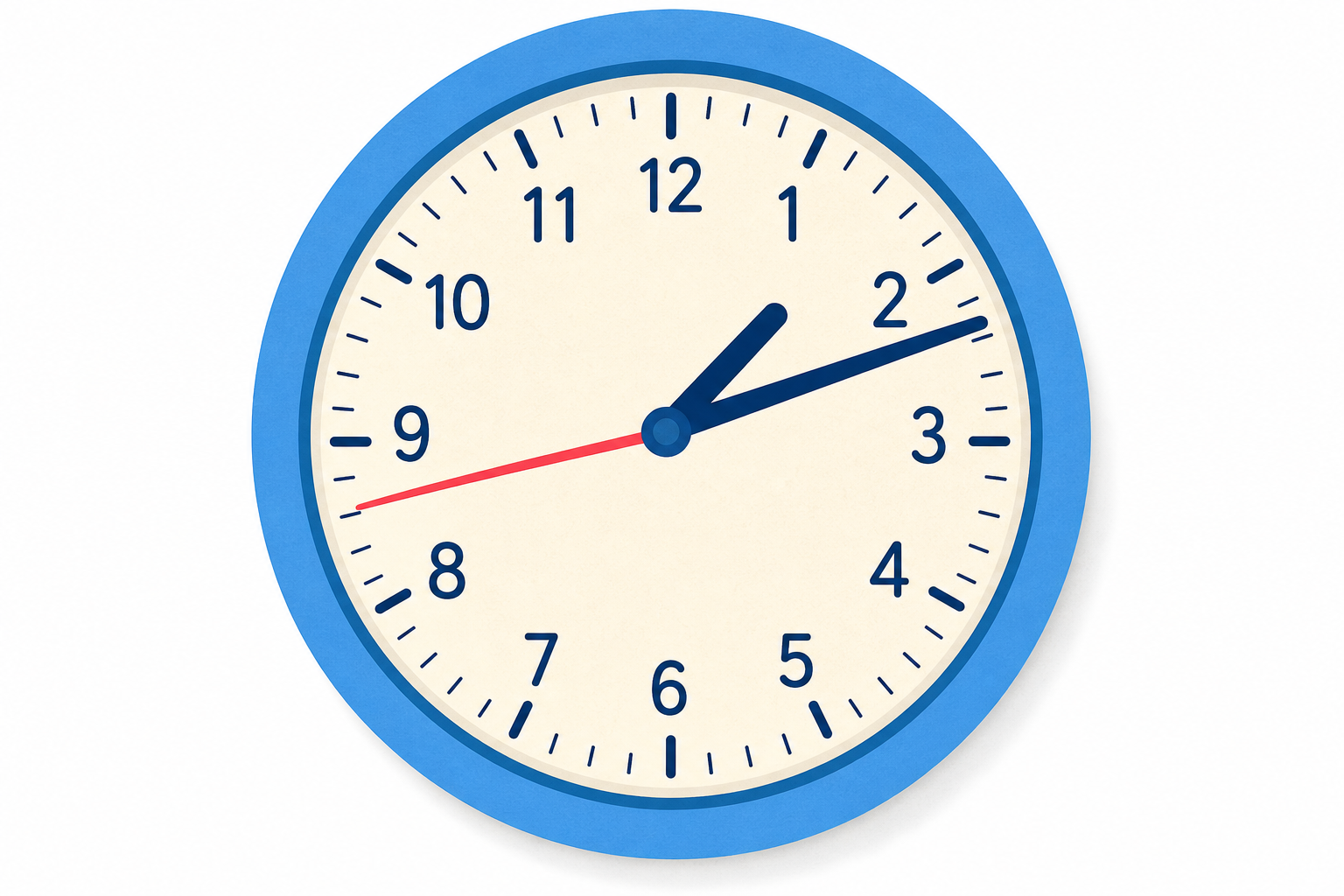
We are going to sit in complete silence for exactly one minute. Keep your eyes on the clock at the front of the room as the time goes by.
When the minute is up: how many seconds do you think passed? And how many of those quiet minutes would it take to fill one whole hour?
Run the silent minute on the IWB stopwatch or with the classroom clock's second hand visible at the front. Afterwards take two or three hands-up answers for the seconds, then the hour question. Don't confirm yet — hold the guesses; the model step proves them.
Look at the clock. The second hand goes all the way around, a full 60, just to move the minute hand on by one notch. So 60 seconds make one minute.
Look at the minute hand. It goes the whole way around, 60 minutes, to complete one hour. And a whole day is 24 hours: the hour hand goes right around the clock twice. Then 7 of those days make one week.
Each bigger unit is built from a fixed number of the next smaller one.
Point to the second hand's full sweep on the first clock: all that, for one little notch of the minute hand. That is the surprise worth naming.
On the second clock, trace the minute hand's full circle with a finger and land on the new hour. Then say a day is 24 hours — the hour hand around twice — and that 7 of those days make one week. Draw out the pattern: each bigger unit holds a fixed number of the next smaller one — 60, 60, 24, then 7.
Today we drive the clock together to show the units nesting. First we sweep the minute hand once right around to make one whole hour. Then we move the hour hand on one notch to show that hour passing. After that we take the hour hand around twice to show one whole day. And 7 of those days would make one week.
Talk this one through together — pupils take turns at the board and the class agrees or corrects out loud.
Call a pupil to sweep the minute hand a full turn and read off that one hour has passed; the class counts the sixty minutes with them. Rotate pupils through: one full minute-hand turn (1 hour), a second turn (2 hours), then the idea that the hour hand goes around twice to make a day, and 7 days make a week. Watch for pupils who think the minute hand moving a little means an hour — it takes a full sweep of 60.
In your maths copy, copy out and complete this fact list, filling in each blank:
Then write one time fact of your own underneath.
Walk the room glancing at the blanks being filled — 60, 60, 24, 7. This is whole-class copybook practice, not marking. If a pupil is stuck on the day-in-hours, point them back at the clock.
Converting just means saying the same length of time using a different unit, like saying 2 minutes as 120 seconds.
Using the fact list we built, we work through conversions together on the board.
First we do one full example together so everyone can see the method end to end:
Decide the direction first: seconds to minutes is a bigger unit, so the number gets smaller and we divide. Use the fact 60 seconds = 1 minute. Write 120 ÷ 60 = 2, so 120 seconds = 2 minutes.
Then we try these four together, each a little harder than the last:
For each one, decide first: are we changing into a smaller unit or a bigger one? A smaller unit needs a bigger number, so we multiply. A bigger unit needs a smaller number, so we divide (we share it out).
This is the practice round. Pupils take turns at the board, check each answer, and the class confirms before moving on. Keep the board work brisk.
Worked example first (do not skip): How many minutes in 120 seconds? Cue the class: smaller unit or bigger? Seconds → minutes is bigger, so divide. Fact: 60 seconds = 1 minute. Board: 120 ÷ 60 = 2, so 2 minutes. Point back at the tip: bigger unit, smaller number.
Then the four: (1) 3 × 60 = 180 seconds, (2) 2 × 60 = 120 minutes, (3) 2 × 24 = 48 hours, (4) 120 ÷ 60 = 2 hours. Item 4 is the divide check, same method as the worked example.
Make-or-break each time: which way are we going? Smaller unit → multiply; bigger unit → divide. Slip to watch: pupils who multiply on item 4 because they see 60, revoice minutes to hours is bigger, so share out, divide. For a pupil who is finding it hard, stay with the worked example and the first two multiplies and count in 60s on the clock face. For a pupil who is flying, ask how many seconds in half an hour, or how many hours in one week. Half an hour catch: half of the 60 minutes in an hour is 30.
You're previewing this lesson. Get full access to this lesson and hundreds more — each one ready to teach, with interactive activities, printable resources and pupil progress tracking built in.