1 - Introduction ~5 mins
Welcome
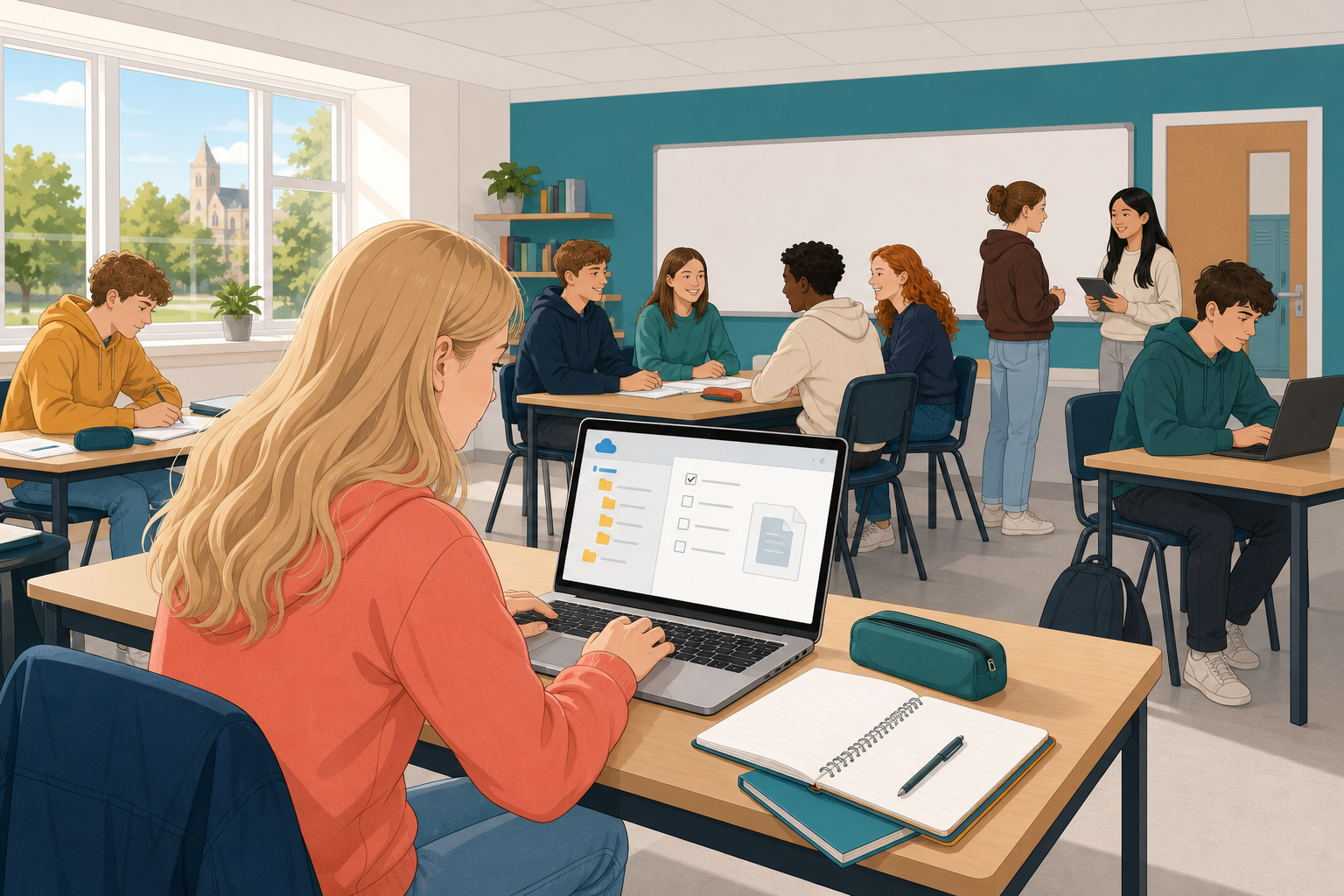 You have spent nine lessons learning how computers, files, storage, and settings actually work. Today you pause, check what stuck, fix one real snag, and write a short Unit 1 reflection that goes into your Project Portfolio as evidence that counts for the course.
By the end of this lesson, you will be able to:
- Demonstrate Unit 1 concepts through a short self-check
- Diagnose and fix one common problem using a written troubleshooting guide
- Recap how Unit 1 learning outcomes have been met
- Reflect on confidence gains and how ICT1 supports your Something Real project
Before we start: Open your school OneDrive or Google Drive. If you cannot see your Project Portfolio folder, raise your hand. Search for {{code:Portfolio}} or {{code:Project}}, and check you are signed into your school account, not a personal one.
Warm-up
Without looking at your notes, name one thing you can do now with files or folders that felt awkward at the start of ICT1. Keep the answer in your head. You will use it later in your reflection.
2 - Key Concepts ~5 mins
Skim this table with your teacher — do not copy it. You only need it as a map for the self-check. Unit 1 covered the foundations you will reuse for every document, spreadsheet, and portfolio task later in the course.
| Concept | Why it matters | Example |
|---|---|---|
| Hardware vs software — hardware is the physical machine; software is the instructions that run on it | You choose tools more clearly when you know what is the device and what is the app | Your laptop keyboard is hardware; the word processor you type a Work Experience note in is software |
| Storage vs memory (RAM) — storage keeps files when power is off; RAM holds work only while the machine is on | Knowing the difference stops the "I closed it and it vanished" panic | Your Project Brief in cloud storage is still there after shutdown; unsaved text in an open tab is not |
| Files and folders — a file is one piece of work; a folder is a labelled place that groups related files | Sensible names and folders mean you can find work weeks later for a portfolio task or Student Task | Saving {{code:01_project_brief}} inside your Project Portfolio instead of leaving {{code:document1}} on the desktop |
| Cloud storage on a shared machine — your school OneDrive or Google Drive holds files online; signing out protects your account | On classroom PCs, leaving yourself signed in risks someone else opening your portfolio | Opening your Project Portfolio from a second machine, then signing out before you leave |
| Accessibility settings — OS tools such as larger text, magnifier, high contrast, or dictation | Small setting changes make long project work more comfortable and usable | Larger text or magnifier while reading a long Work Experience note so you are not squinting for 20 minutes |
Unit 1 learning outcomes you have already practised
- Key ICT concepts, devices, storage, and software
- File storage, management, and retrieval
- Basic computer functions used effectively
Your self-check and troubleshooting task prove those outcomes with real work from your portfolio, not with guesswork.
3 - Unit 1 Self-check ~8 mins
Open your Project Portfolio, run a quick five-question self-check on paper, then choose one real snag to fix in the next activity. If some older files are missing, that is normal — use it as evidence, not as a fail.
Minimum to continue today: you can open your Project Portfolio folder (or recover it with search) and you can create a new document inside it. You do not need every past file perfect before you start.
Class checkpoint: After question 3, stop. The whole class checks the answer key together for Q1–Q3 so nobody is left mid-list. Then finish Q4–Q5, mark any UNSURE items, and choose your snag (about 20 seconds — a shout-out or a tick on paper is enough).
4 - Common Issues ~3 mins
Common Issues
Keep this table open while you fix your snag and create the reflection file. Jump here if you get stuck.
| Issue | Solution |
|---|---|
| I cannot find my Project Portfolio folder | Use the search bar in your cloud storage and type {{code:Portfolio}} or {{code:Project}}. Check you are signed into your school account, not a personal one. |
| My new reflection file appeared in the wrong place | Delete the empty wrong copy if needed. Open the Project Portfolio folder first (the root, not {{code:01_brief}}), then create {{code:01_unit1_reflection}} from inside that folder so it auto-saves there. |
| I do not have a real problem to troubleshoot | Simulate one safely: move a non-essential practice file out of the portfolio, then use search and Move to put it back. Record those steps in the Troubleshooting note. |
| I blanked on the self-check answers | Re-read the Key concepts table, then retry the five questions. Note which idea was shaky so your reflection is honest about practice needs. |
5 - Fix One Snag and Start Reflection ~12 mins
Apply only the one fix that matches the snag you chose, then create {{code:01_unit1_reflection}} at the root of your Project Portfolio. Fill only the Troubleshooting note for now — leave the other three headings blank for the Portfolio Build.
Gate: Find your snag letter (A–E) only — skip the other letters. Do that single fix, then go straight to creating the reflection file. Do not work through every branch.
Unlock the full learning experience
You're previewing this lesson. Get full access to this lesson and hundreds more — each one ready to teach, with interactive activities, printable resources and pupil progress tracking built in.
This lesson is copyright of Coding Ireland 2017 - 2025. Unauthorised use, copying or distribution is not allowed.