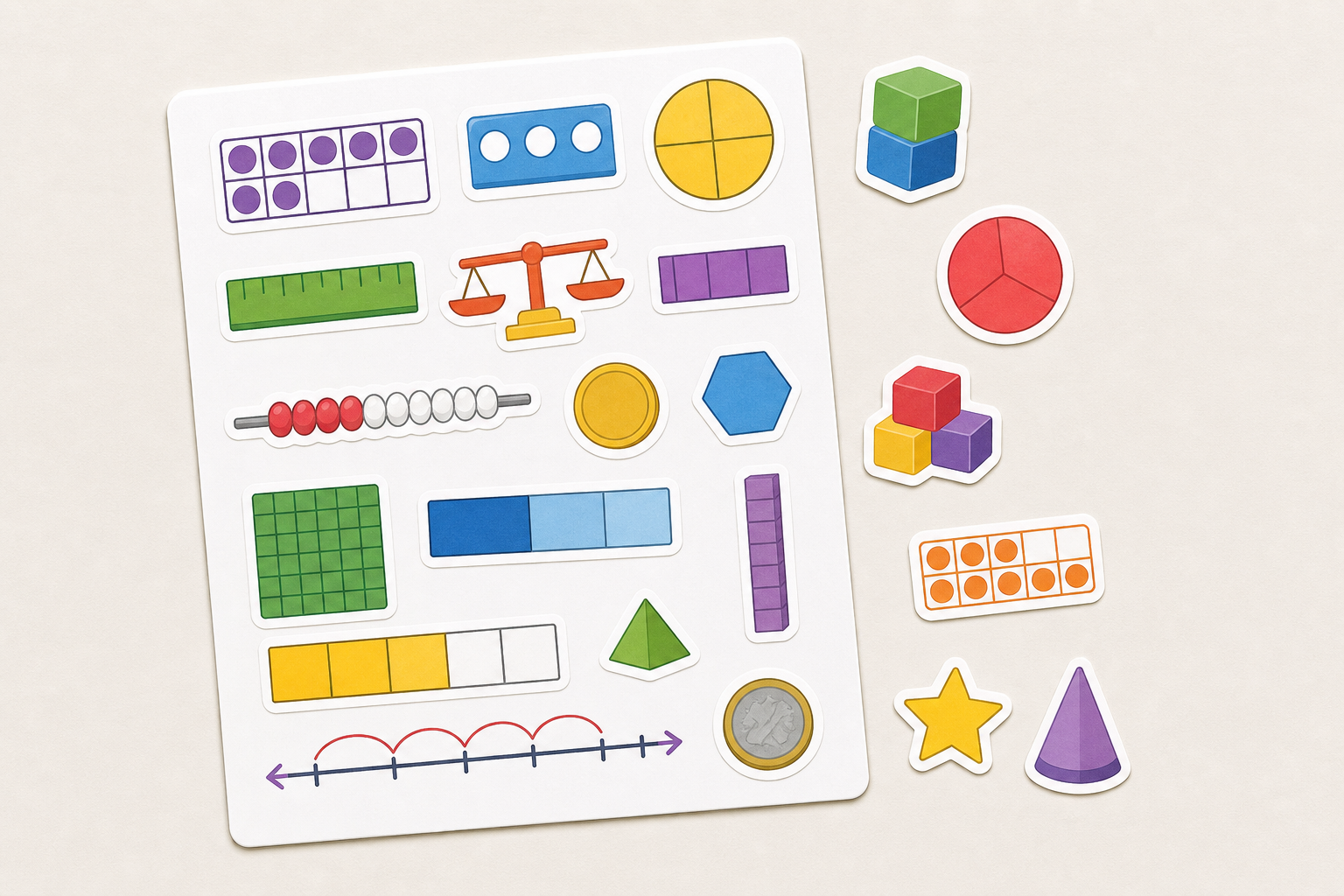
Here is a little story. "Saoirse had some stickers. She got 4 more. Now she has 10 stickers."
We do not know how many stickers Saoirse started with. That is our missing number. What number sentence, with a box for the missing part, would match this story?
Read the story aloud once, then again slowly. Take two or three hands-up answers for the number sentence, not open call-outs. Do not confirm the value yet — hold the class on which sentence matches the story (something like box + 4 = 10), because building that sentence is today's real work.
Watch the balance. Each story turns into a number sentence with one missing part, and the beam only hangs level when we find the number that fills it.
Before we build any sentence, listen for the action words. Words like more, got, or altogether mean the parts join, so we write a plus sentence. Words like gave away, spent, or left mean something is taken away, so we write a minus sentence.
Here is one take-away story worked all the way through on the board (not on the balance). "Cara had 10 stickers. She gave 3 away. How many did she have left?"
Step 1: the words gave away and left tell us to take away, not join. Step 2: write the number sentence with a box, 10 − 3 = □. Step 3: find what belongs in the box, 10 take away 3 leaves 7. Step 4: write the full true sentence, 10 − 3 = 7.
The last balance story also takes some away. When you have spent some money, the amount you started with is everything you spent joined back together with the amount you had left. So the start is bigger than what is left.
Work each balance live; the class predicts the missing number before you reveal it.
Now we work through two stories together on the balance. For each one we say the number sentence with a box out loud first. Then we find the number that makes the beam hang level.
Try Together: work each balance live with the class, taking hands-up answers and revoicing pupils' reasoning; the class agrees or corrects out loud before you reveal each missing number.
Do the buns story first. That is 7 plus a missing part joining to make 11. This is the tricky one — the missing number is a part, not the total, so ask which number is missing, one of the parts or the whole total? before you reveal it. Then do the conkers story. Cian gave away 5 from his 12, so the missing amount left plus the 5 he gave away joins back to 12. The unknown block is the amount left, so pupils slide it until the beam levels. Insist the sentence is spoken before anyone predicts the answer.
In your maths copy, write the number sentence, with a box for the missing number, for this story: "Aoife had 8 marbles and won some more to make 15."
Then work out what belongs in the box and write the full true sentence underneath.
Walk the room glancing at whether pupils wrote 8 + box = 15 rather than 8 + 15 — no marking, this is whole-class copybook practice. Prompt any pupil who is stuck to reread the story for the words "won some more".
Now we balance a sentence with a box for four more stories, in order:
For each one we build the sentence first. Then we slide the block until the beam is level.
This is the practice round. Pupils take turns at the board, check each answer, and the class confirms before moving on. Keep the board work brisk rather than over-explaining.
The set moves from a simple join, to a missing part where the coins come first, then two missing-part join stories where the missing number is the part added. On each missing-part story hold out for the reading: ask which number is missing, one of the parts or the whole total? before anyone builds it, because pupils find the missing-part form hardest. Use the ✓ as part of your narration — "yes, that levels it".
You're previewing this lesson. Get full access to this lesson and hundreds more — each one ready to teach, with interactive activities, printable resources and pupil progress tracking built in.