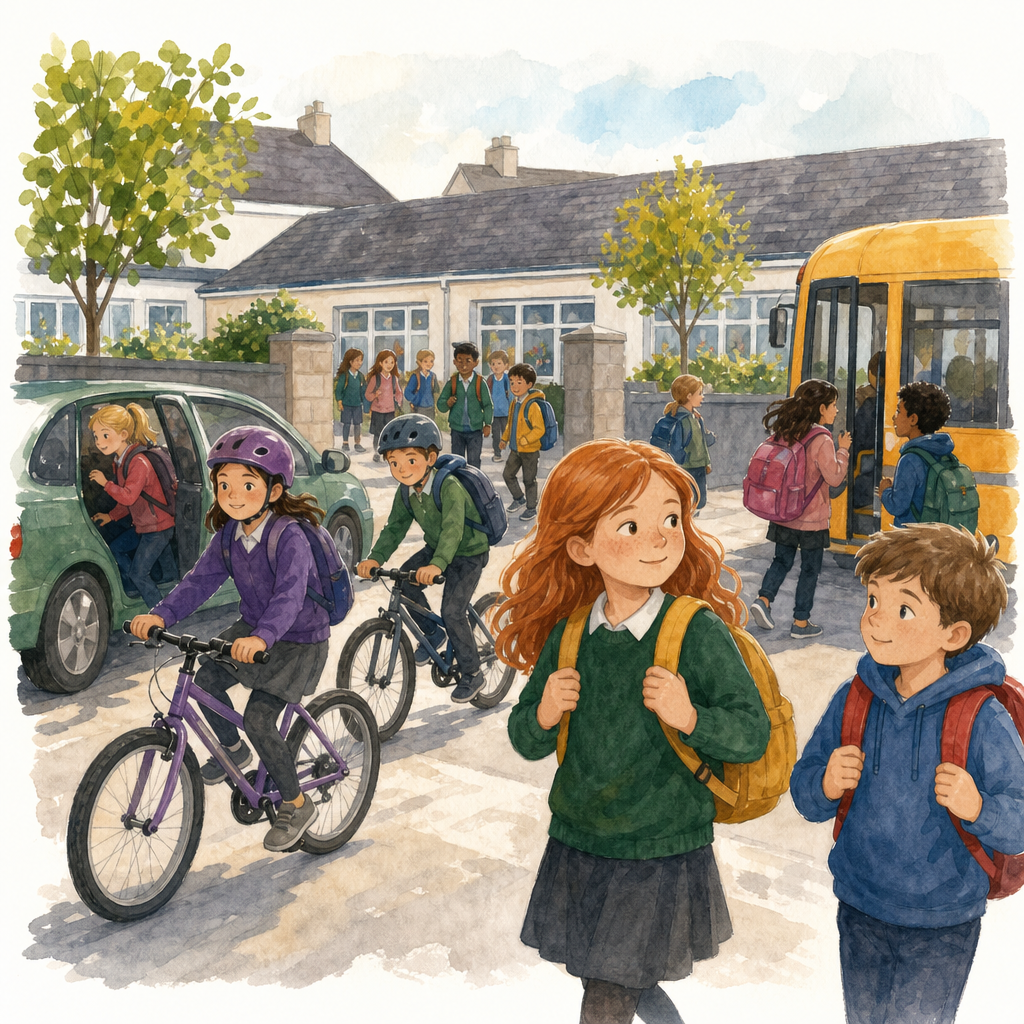
How did you get to school today? Hands up for walkers, then bikes, then cars, then buses. Count the different ways in the room.
Today you will name eight ways of getting about in Spanish, and put four of them in order from slowest to fastest.
Take a quick show of hands for each way of travelling. Keep it brisk: the point is to notice how many different answers are already in the room before any Spanish is heard. Do not introduce the Spanish words yet; the word-table in the next step does that. Smile at the variety — even one pupil who came by bike is a win to name later.
Here are today's eight forms of transport. We will meet them in two groups of four. Tap each card, listen, then say it back together. Watch which ones take el and which take la, and listen for the accent marks.
Chunk 1 — road: open only the first four cards if the board allows, or point them out one by one: el coche (el KOH-cheh), el autobús (el ow-toh-BOOS — stress on BOOS), la bicicleta (lah bee-thee-KLEH-tah), la motocicleta (lah moh-toh-thee-KLEH-tah). Class repeats twice each (whole class, then by table). Point at the article every time. For la bicicleta and la motocicleta, tongue lightly between the teeth on the soft th — like thinking, not like kicking. Do one silly slow version together, then a smart fast one. Celebrate the first clean el autobús with the stress in the right place — big reaction, then class echoes.
Quick recap: call the four English meanings; class fires back the full Spanish with article. Keep those four cards visible as a growing word bank.
Chunk 2 — rail, air, water, taxi: el tren (el tren — short e, like ten, not English "train"), el avión (el ah-BYOHN), el barco (el BAR-koh), el taxi (el TAK-see). Same repeat routine. Only la bicicleta and la motocicleta are feminine; the rest take el. Standard forms follow everyday Spanish usage (Real Academia Española conventions).
A busy street near Atocha station in Madrid — label each vehicle before the next train pulls in. A volunteer places the label on the board. Everyone else points at the vehicle and whispers the full phrase with el or la.
Run this whole-class on the IWB. Invite volunteers to the board one at a time; the rest stay at desks pointing and whispering the full phrase. If a label is placed wrongly, say the correct word together before moving on. Insist on the article: coche alone is not enough — el coche is the full answer. Praise a clear whisper from the back row as loudly as a correct board click. The hotspots are the eight transport items only (no path or pavement labels).
Copy from the board. We will agree four ways of travelling in order from slow to fast, then you write those four with their articles. Watch the accents on el autobús and el avión.
Model order: la bicicleta → el coche → el tren → el avión.
Before pens move, do a 30-second whole-class sort on the board: agree la bicicleta → el coche → el tren → el avión and leave that order visible. Keep the full word-table on screen as a spelling bank. Everyone writes those four with articles and accents — this is the only three minutes where every pupil's pen is moving. Walk the room and check the article is going in front of every word. Cheer a neat accent mark when you spot one. Do not collect these.
Volunteers flip two cards at a time on the board and find each Spanish word with its English meaning. When a Spanish card is turned, everyone whispers it with el or la before the match is made.
Whole class on the IWB with volunteers turning cards — desks stay closed. Every pupil has a speaking job: whisper the full Spanish phrase as soon as the Spanish card appears. If a pair is missed twice, stop and say it together before moving on. Listen for the stress on el autobús and the soft th in la bicicleta / la motocicleta. When a pair is found, class high-fives the Spanish aloud. Keep energy up — this is still practice, not a silent spectator sport.
You're previewing this lesson. Get full access to this lesson and hundreds more — each one ready to teach, with interactive activities, printable resources and pupil progress tracking built in.