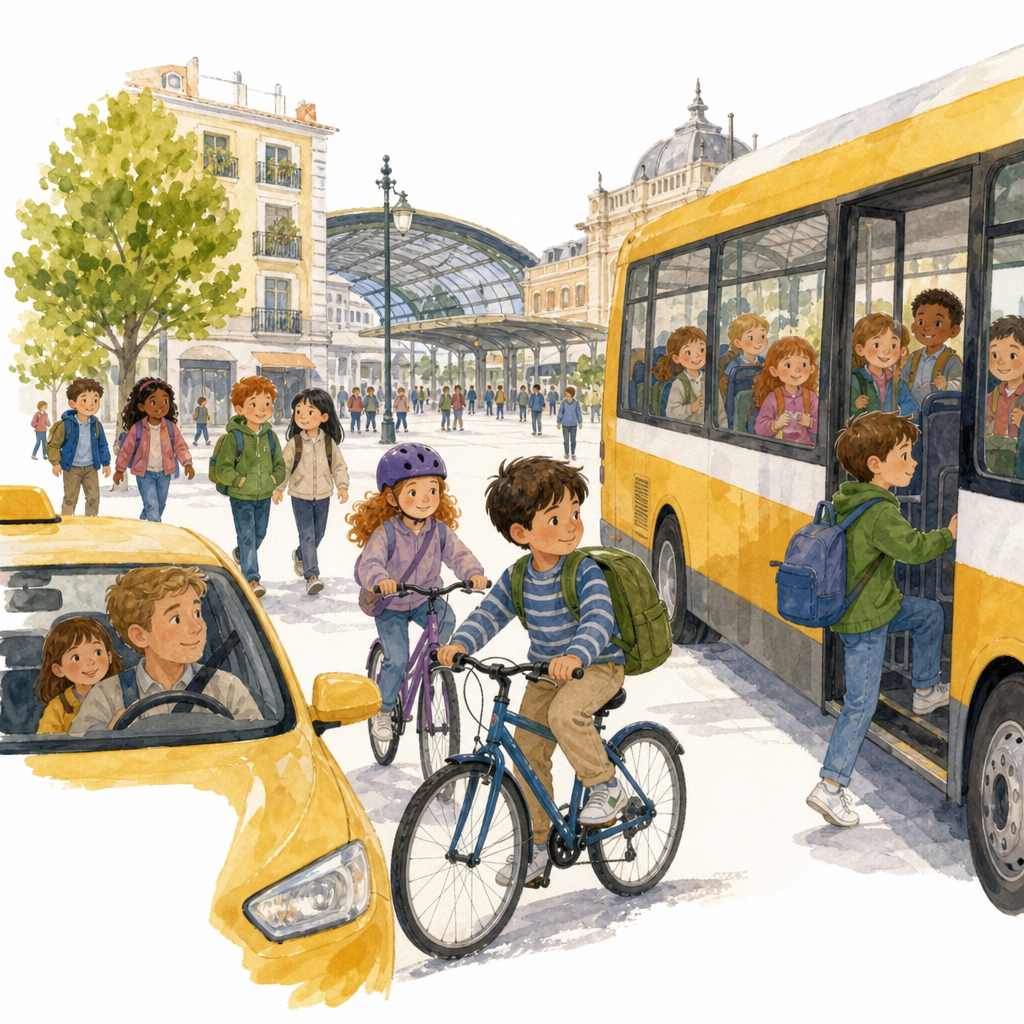
How long does it take you to get to school, and how do you travel? Tell a partner in English in one short sentence.
In Spain you will see la motocicleta weaving past el autobús and people hopping into el taxi with a coffee. Today those words go in your mouth, and you will say how you get to school and how long it takes using: Voy al colegio en … y tardo … minutos.
Take three or four quick answers in English only. The point is to wake up the idea of journey plus time, not to start Spanish yet. You will model the Spanish pattern on the word-table next.
If pupils offer times, nod them through; they already met clock language earlier in the course and will reuse it today.
Hook line if energy is low: in Spanish cities the street is a moving puzzle of buses, taxis and motos. Today pupils get the words for that puzzle.
Here are today's eight forms of transport. We will learn four, then four more. Tap each one, listen, then say it back together with el or la.
Two board models (side by side):
After en we do not repeat el or la: say en autobús, en bicicleta.
Split the list. First block: el autobús, el tren, el coche, la bicicleta. Second block: el taxi, el avión, el barco, la motocicleta. For each block: tap, class repeats twice (all together, then by table). Point at the article every time so pupils hear el or la as part of the dictionary form.
Pronunciation guides: el autobús (el ow-toh-BOOS), el tren (el tren), el coche (el KOH-cheh), la bicicleta (lah bee-thee-KLEH-tah), el taxi (el TAK-see), el avión (el ah-BYOHN), el barco (el BAR-koh), la motocicleta (lah moh-toh-thee-KLEH-tah). Autobús has the stress on BOOS: punch that syllable together, then whisper-shout el autobús once more.
Article vs journey form: Write both models on the board. Say clearly: when we name the word we keep el/la; after en we drop the article (en autobús, en bici is fine later if it comes up, but today's full form is en bicicleta).
Sentence chorus (do not skip): Model slowly: Voy al colegio en + bare transport + y tardo + time. Script at least three or four full choral repeats with different transports, e.g. Voy al colegio en tren y tardo diez minutos, then en coche, en taxi, en bicicleta. Use known times: cinco minutos (THEEN-koh), diez minutos (dee-eth), quince minutos (KEEN-theh), veinte minutos (BEYN-teh). Then one quick pair pass: partner A says a full sentence, partner B repeats it once. That is the oral backbone before writing.
Madrid colour while you model: "Someone racing to Atocha might say Voy al colegio en metro in real life, but our eight words today are the ones on the table; try en autobús or en taxi for a city commute feel."
Morning rush near Atocha station in Madrid: buses, taxis, bikes, motos. Look at each picture, click the correct Spanish label, then the whole class says the word with el or la together.
Run this on the board with volunteers placing labels. After every correct place, the whole class choruses the full phrase with the article: el tren, not bare tren. Pupils in the back rows still speak every time.
If a label is wrong, say the correct pair together once, then let another pupil try. Keep the pace brisk so every word is heard again.
Before you leave the step: a rapid teacher point-and-all-say pass of all eight pictures so every pupil says each word once more. Celebrate a clean la bicicleta or a punchy el autobús when you hear one.
Open your copy and write one sentence saying how you get to school and how long it takes.
Use the pattern: Voy al colegio en … y tardo … minutos.
Time bank on the board: cinco / diez / quince / veinte minutos.
Before pens up (about one minute): run a short whole-class oral drill. Class repeats three or four full model sentences with different transports and times from the bank, e.g. Voy al colegio en autobús y tardo quince minutos, Voy al colegio en bicicleta y tardo diez minutos. Then two volunteers say their own; class echoes one of them.
Leave on screen: the sentence frame, the word-table, and the time bank with stress marks in your head: cinco (THEEN-koh), diez (dee-eth), quince (KEEN-theh), veinte (BEYN-teh) minutos.
Pause the interactive. Everyone's pen should be moving for these three minutes. Look for one full sentence with a bare transport after en and a time after tardo, not a bare noun. A strong example is Voy al colegio en bicicleta y tardo diez minutos. If a pupil gets the full journey down, that is a real Spanish sentence: give them a quiet tick. Do not collect the copies.
Drag each transport word into the correct gender column: masculine el or feminine la. Trust what you heard with the article earlier.
Whole class on the IWB first, with volunteers dragging. Say the article aloud as each word lands: el autobús, la motocicleta. This is retrieval of the dictionary form, not a new rule pile-on: keep it light and quick after the writing.
Expected split: masculine el for autobús, tren, coche, taxi, avión, barco; feminine la for bicicleta, motocicleta. La motocicleta tricks people because many motorbike words feel short and end in -o in other languages; celebrate anyone who still drops it under la. If someone hesitates, ask the class to say the pair together before the next drag.
You're previewing this lesson. Get full access to this lesson and hundreds more — each one ready to teach, with interactive activities, printable resources and pupil progress tracking built in.