 How long does it take you to get to school, and how do you travel? Say it in English in one short sentence.
Today you will build the same kind of journey in German: which vehicle, and how long it takes, using a clear sentence frame on the board.
By the end of this lesson, you will be able to:
- Name eight ways to travel in German with der or das
- Say a short journey with a board frame and a taught time chunk
- Sort today's transport words by gender (der and das), with the die column still on screen for German
Tap each transport word on the table, listen, then say it back together with its article. Work in two clusters of four: finish and recycle the first cluster before you open the second.
When both clusters are secure, lock in today's journey frame. Every vehicle in this lesson takes mit dem.
Journey frame (stay with the board):
Ich fahre mit dem Bus. Es dauert zehn Minuten. (I go by bus. It takes ten minutes.)
After mit: der and das both become dem, so today you always say mit dem … (not mit der or bare mit Bus).
Time chunks only: fünf Minuten (FUENF mi-NOO-ten) · zehn Minuten (TSAYN) · fünfzehn Minuten (FUENF-tsayn) · zwanzig Minuten (TSVAN-tsikh)
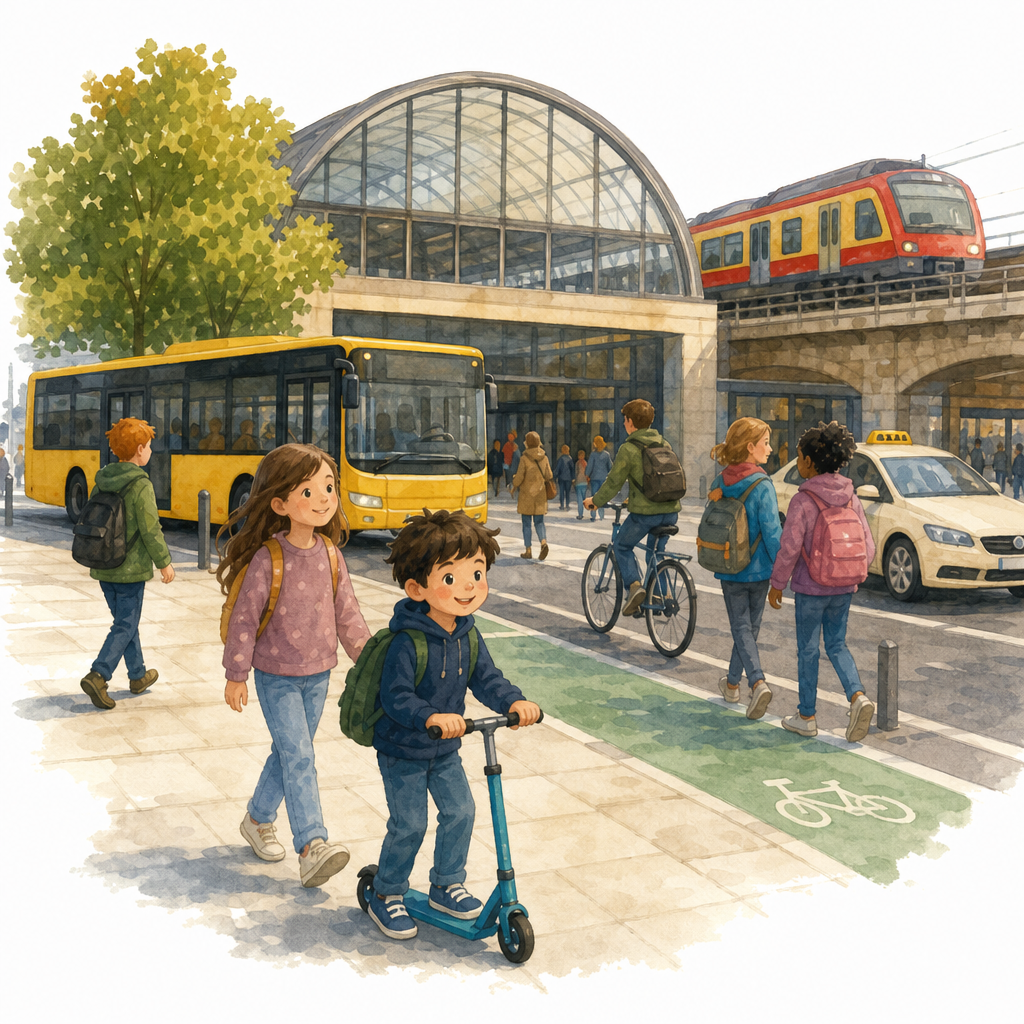
Picture a busy street near a Berlin Bahnhof: buses, taxis, bikes and more of today's vehicles. Look at each picture and drag the correct German label onto it. After each label lands, the whole class says the full word with its article once.
Open your copy. On the board you will see the journey frame and the ready-made mit dem … list plus the four time chunks.
First say your sentence once with a partner (vehicle from the list, time from the strip). Then write one line, copying carefully:
Ich fahre mit ____. Es dauert ____ Minuten.
School journeys suit bus, train, car, bike, taxi or motorbike. For aeroplane or lorry, write about a holiday or a longer trip instead. Keep every capital letter and dem careful.
- der Bus — the bus
- der Zug — the train
- das Auto — the car
- das Fahrrad — the bicycle
- das Flugzeug — the aeroplane
- das Taxi — the taxi
- das Motorrad — the motorbike
- der Lastwagen — the lorry
Now drag each transport noun into the right column: der, die or das. Sorting uses the dictionary form you heard on the word-table (der Bus, das Auto), not the mit dem journey form.
Today's eight words are der or das only, so the die column may stay empty. That is a real find about this set, not a mistake.
Unlock the full learning experience
You're previewing this lesson. Get full access to this lesson and hundreds more — each one ready to teach, with interactive activities, printable resources and pupil progress tracking built in.
This lesson is copyright of Coding Ireland 2017 - 2025. Unauthorised use, copying or distribution is not allowed.