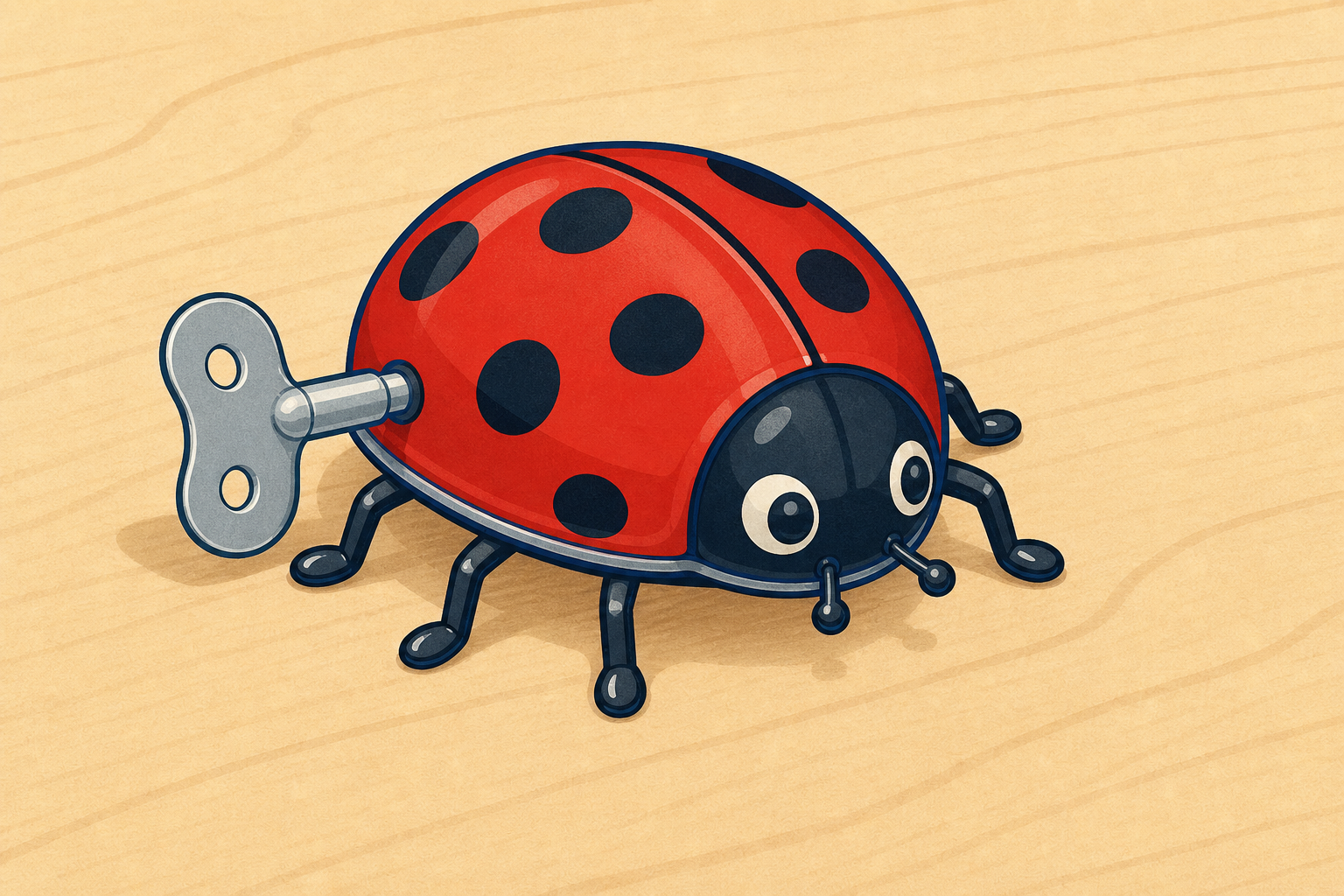
Look! This little toy is moving… but nobody is holding it. How did it start to go?
What do you think made it move?
Have one wind-up toy ready out of sight. Wind it under the table, set it on the floor or desk so it moves on its own, and let the class gasp and call out ideas. Keep the other toys covered for now.
Key question: How did it move without me pushing it just then?
Accept every idea with a smile. Guesses are never wrong; they start the fun. Do not name winding, switching or pushes yet.
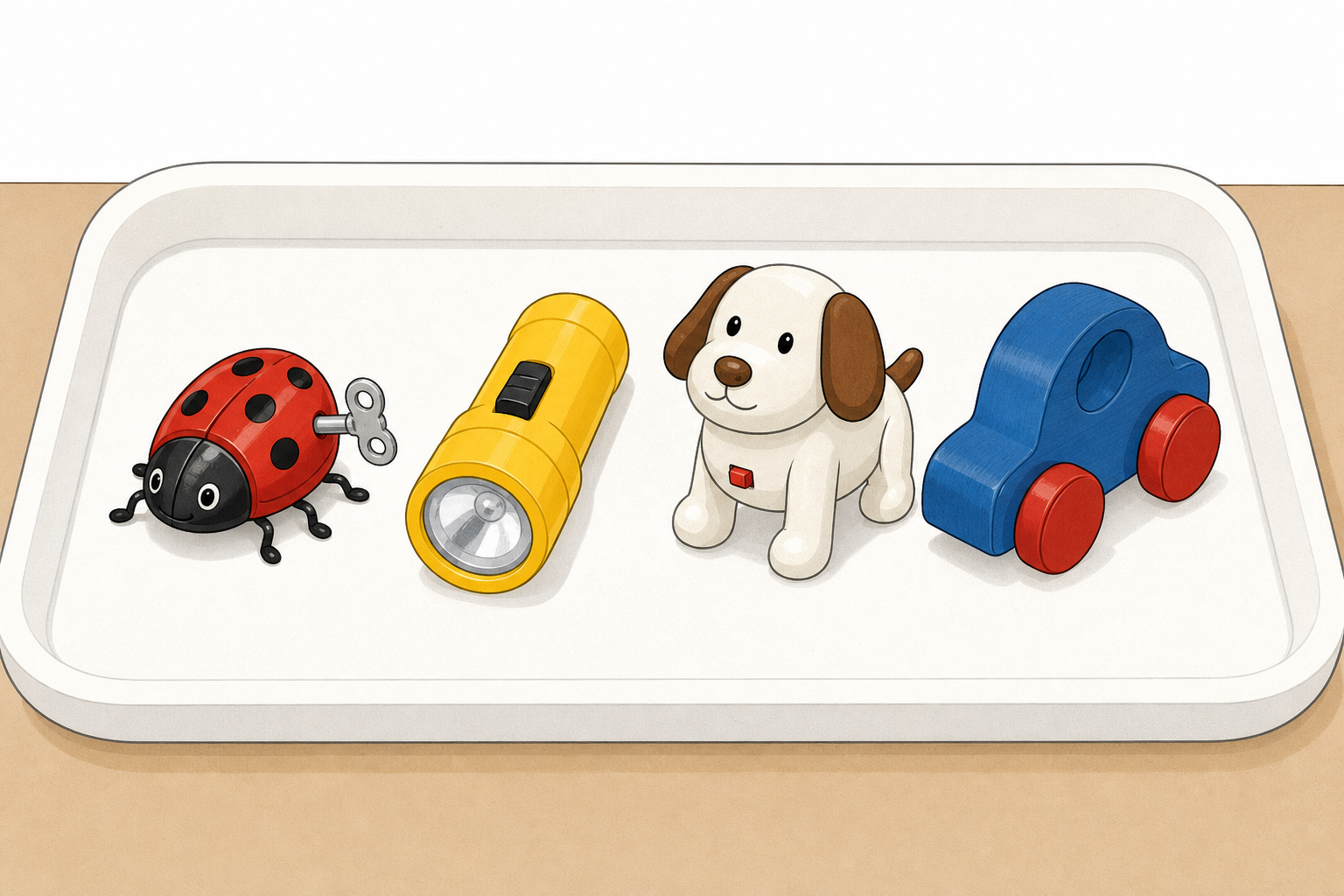
Toys need something to help them go. Look at our four toys. What do you notice? What do you think each one needs?
Uncover the four toys on a tray: a wind-up toy, a sealed battery torch, a simple push car and a spinning top. Hold each one up briefly so every child can see it. Invite a few guesses by pointing or calling out. Do not try all the toys yet and do not put a vocabulary list on the board.
One simple idea for the class: toys need something to help them go — different toys start in different ways.
You already use the word energy from earlier work (what makes things move, light up or make a sound). Keep that as teacher language for now; children will meet the three ways through trying.
| Concept | Why it matters | Example |
|---|---|---|
| How toys go — different toys start in different ways (wind, switch on, or push/spin) | Toys do not go by magic; we do something so each one can start | Wind a walking toy; switch on a torch; push a car or spin a top |
Model one toy before play (full cycle, think aloud) — use the wind-up toy:
That is the pattern for play: wonder, guess, try (or watch), notice, say wind / switch / push.
Teacher language only (not on the board yet): after the switch action later, you may revoice that the torch’s energy is stored in a battery inside. After a wind or a push, you may say that gave it energy to go.
We will try our toys together. When it is your turn, try the toy gently. When it is not your turn, watch closely. Be ready to show or say: wind, switch, or push.
You have only about two of each toy, so this is shared try-and-watch play, not every child trying every toy. Set out one shared tray on a low table or the carpet, or two short station spots if space allows. Plan about 4-minute bursts with a quick regroup. Floor spots help groups sit safely.
One child tries a toy while the others watch. After each try, ask the watchers first: Wind, switch, or push? Fold the whole group in with talk — watching is real participation. Rotate who holds the toy so several children get a hands-on turn across the four toys, but do not promise every child every toy.
Prompts while you circulate: What did you do to make it go? Was it a wind, a switch, or a push? What happened? Watchers — show me with your hands.
Safety watch: only toys with sealed, screwed-shut battery compartments. No button or coin cells. If any cover can pop open, remove that toy from play at once. Push and spin away from faces and toes. One child tries at a time; others watch and talk. Nothing near mouths.
Differentiation: less confident children point or mime the action (wind / switch / push) while you name it. Confident children can say which toy was most surprising and why.
Regroup signal: a clap pattern or song phrase so turns stay short for four- and five-year-olds.
Come back to the circle. Which toy did we try? Show us with your hands: wind, switch, or push. What made the toy go?
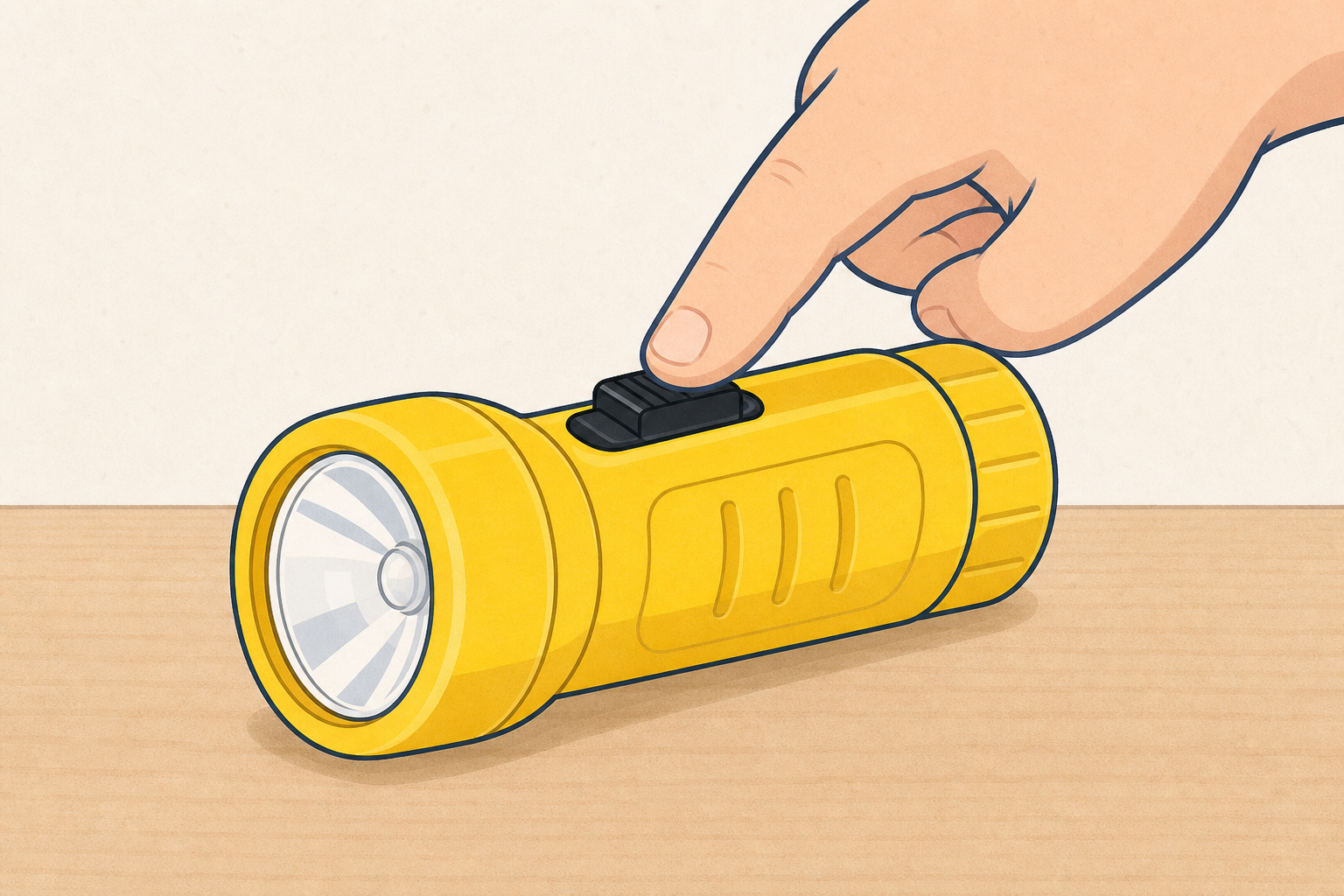
Whole-class oral observation share. Hold up each toy in turn and invite two or three children to show the action (winding motion, finger on a switch, push with both hands) and say one thing they noticed. Use the same three child words everywhere: wind, switch, push.
Look-fors:
Teacher revoicing (after the child action):
Misconception to head off gently: some children may say the torch is "magic" or that every toy needs batteries. Point back to what hands did: We wound this one. We switched this one. We pushed these ones.
Keep this beat snappy and joyful.
Different toys start in different ways. Some we wind. Some we switch on. Some we push.
Point to a toy. Is it wind, switch, or push? Which of our toys would you like to play with, and how does it go?
Display-only, oral make-sense talk. Line the four toys up where everyone can see them. Touch each one as you revoice the action the children already showed:
Then a light science link only: That is how each toy gets the energy to go.
Concrete choice (not inventing a new toy): hold up two toys at a time and ask children to point and say wind, switch or push. Or: Which of these four would you play with? Show me how it goes — wind, switch, or push. Take a few oral ideas. No writing and no typing.
Optional tiny home noticing (oral only, in the door chat if useful): find one toy at home and tell an adult whether it needs a wind, a switch, or a push. Not a worksheet and not an interactive.
You're previewing this lesson. Get full access to this lesson and hundreds more — each one ready to teach, with interactive activities, printable resources and pupil progress tracking built in.