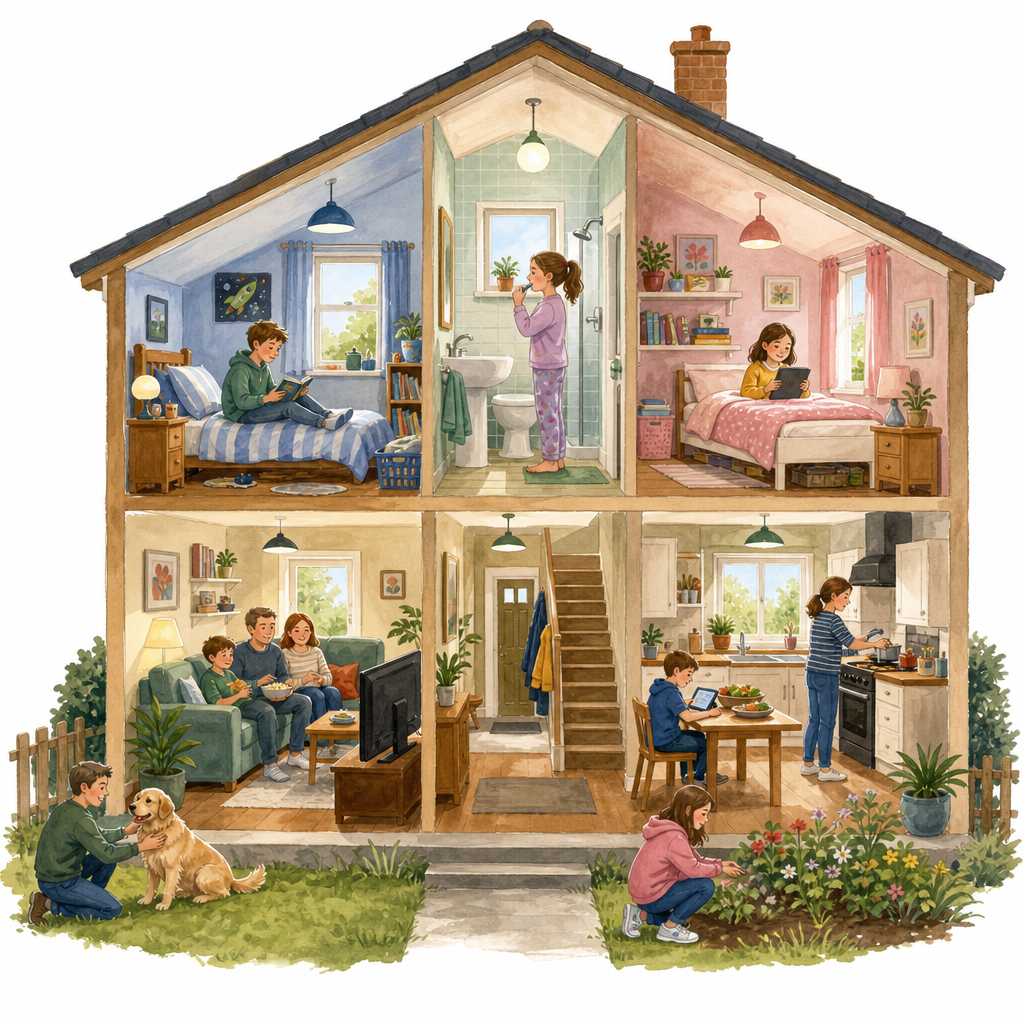
 How many rooms does your house have? Count them quietly in English first. Today we learn the German names for eight rooms, and we keep the little words in front: der, die or das.
By the end of this lesson, you will be able to:
- Name eight rooms of a house in German
- Sort each room under der, die or das
- Say one thing you do in a room when the wheel lands on it
English is on the front of each card. First listen to the German with its article, then say it with the class twice. After you have heard and said it, flip to check the spelling. Look for the capital letter on every German noun and notice which rooms take der, die or das.
First we say all eight rooms together with their articles. Then the wheel lands on a room. Whisper the German name with its article to your shoulder partner, then share when you are called. Add one thing you do there in English. Example on the board: die Küche (dee KÜ-khe), I cook dinner.
Use the list on the board (each room with der, die or das, plus a tiny image). Open your copy and write the rooms in your own house in the order you would walk through them, each with its article. Take care with capital letters and any umlauts.
- das Wohnzimmer — living room
- die Küche — kitchen
- das Schlafzimmer — bedroom
- das Badezimmer — bathroom
- das Esszimmer — dining room
- der Flur — hallway
- die Treppe — stairs
- der Keller — cellar
We refresh the articles first, then volunteers drag each room on the board into der, die or das. The rest of us say the full phrase together after each drop. A reference list of the eight rooms with articles stays on screen: there is no clever shortcut; you learn each pair as a team.
Unlock the full learning experience
You're previewing this lesson. Get full access to this lesson and hundreds more — each one ready to teach, with interactive activities, printable resources and pupil progress tracking built in.
This lesson is copyright of Coding Ireland 2017 - 2025. Unauthorised use, copying or distribution is not allowed.