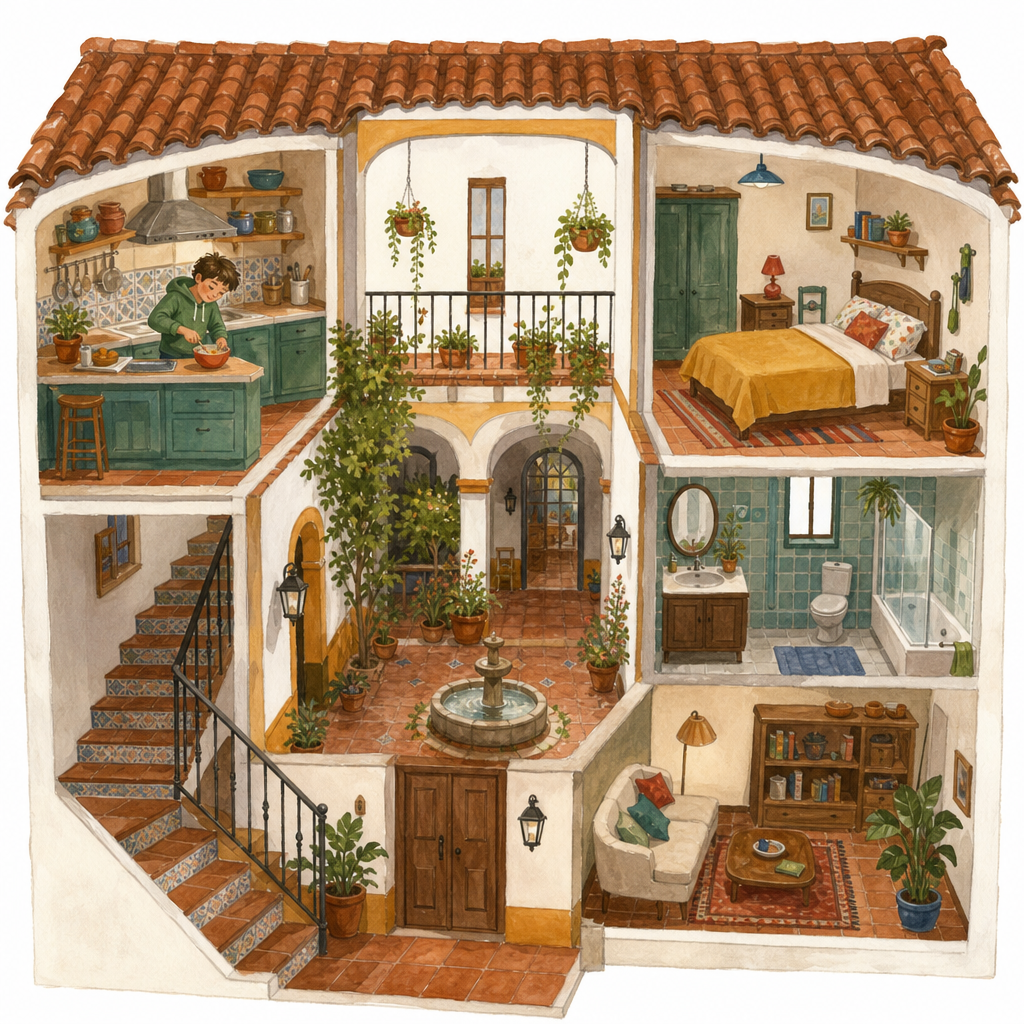
Today we are visiting a house in Seville. How many rooms can you spot? Count them in English first: kitchen, bedroom, bathroom, and the rest. Keep that number in your head.
Today you will learn the Spanish names for eight rooms, each with el or la in front.
Frame the opener as a quick imaginary visit to a Seville house so the later patio talk already has a place to land. Take a quick show of hands for room counts (four, five, six or more). Do not dig into floor plans; the point is to wake up the idea of rooms before the Spanish words arrive. Keep the energy light and move on once a few pupils have shared.
Here are today's eight rooms, in two sets of four. Listen to each room in Spanish, repeat it with el or la, then flip to check. Watch for the ñ in baño and the stress on salón and jardín.
Teach in two banks of four so the set sticks. Bank 1: la cocina, el baño, el dormitorio, el salón. Flip each card on the board first, then the class repeats twice (all together, then by table). Point at the article every time so the pair sticks. Quick thumbs-up check, then bank 2: el comedor, el jardín, la escalera, el garaje. Same flip-then-repeat pattern.
Pronunciation guides: la cocina (lah koh-SEE-nah), el baño (el BAH-nyoh, the ñ is like ny in canyon), el dormitorio (el dor-mee-TOH-ree-oh), el salón (el sah-LOHN), el comedor (el koh-meh-DOR), el jardín (el har-DEEN, j is like h), la escalera (lah es-kah-LEH-rah), el garaje (el gah-RAH-heh, j like h). Only la cocina and la escalera take la; the rest take el.
Make a meal of the ñ in baño: pinch your nose on the ny and grin. Celebrate the first full el or la pair said cleanly out loud.
Help us sort each room into the correct column on the board: masculine (el) or feminine (la). Vote with your fingers (1 for el, 2 for la), then we drag it together. Think back to the flashcards and trust the article you heard with each word.
Leave a reference strip or the flashcard pack visible for the whole sort. Model the first two on the board yourself, saying the full phrase (for example el baño, la cocina) so the class hears the article before they vote. Then run it whole-class: fingers up, 1 for el, 2 for la, and drag together on the board. If 1:1 devices are in use, pupils may drag at their seats only after those first two models. If a room lands in the wrong column, say the full phrase together before trying again. Remind them there is no rule from the English meaning; they learn each article with its noun.
Open your copy. From today's list on the board, write the rooms you have at home, each with el or la. Skip any you do not have. If you finish, add one more from the list in the order you would walk to it. Take care with accents and the ñ. If your home has a garden or a garage, use el jardín and el garaje, both very common in Spanish homes too.
Pause the board. Keep the flashcards or a clear word list visible for the full three minutes so pupils can copy spellings, accents and the ñ. Frame it as copy-from-the-board, not unaided spelling. Everyone writes; this is the only three minutes where every pen is moving. Walk the room and check the article is in front of every noun. A list of bare words will not carry the gender pairing. Do not collect these.
Spin the wheel. When it lands on a room, say the Spanish name with its article, then say one thing you do there in English. Ready for your turn?
Before any cold-call, spin once for a full class rehearsal: everyone whispers the room plus article to their palm, then one volunteer shares. Keep a visible word bank on the board. Allow phone a table so a stuck pupil can hear the phrase once more before saying it.
Insist on the full phrase first (el dormitorio, not dormitorio). Then ask for one short activity in English (I sleep, I cook, I wash my hands). If a pupil freezes, prompt with a simple choice: sleep or play? Keep the pace brisk so several pupils get a turn. Sample model from our Seville house: the wheel lands on la cocina. The pupil says la cocina, then I cook breakfast. Big cheer when someone gives article plus room without a prompt.
Optional stretch for confident volunteers only (not required for the whole class): cocino (koh-SEE-noh, I cook), duermo (DWER-moh, I sleep), veo la tele (BEH-oh lah TEH-leh, I watch TV), me lavo las manos (meh LAH-boh las MAH-nohs, I wash my hands), como (KOH-moh, I eat), juego (HWEH-goh, I play).
You're previewing this lesson. Get full access to this lesson and hundreds more — each one ready to teach, with interactive activities, printable resources and pupil progress tracking built in.