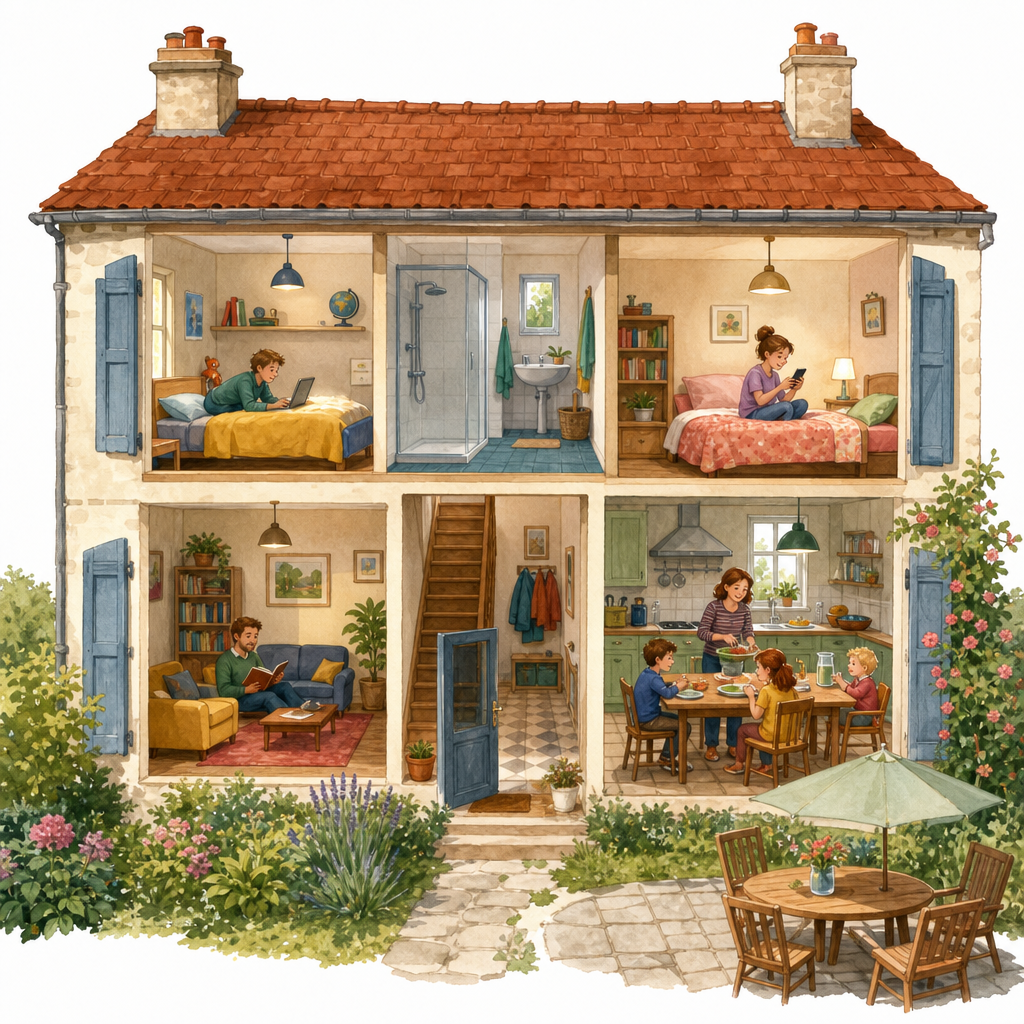
 How many different places does your home have? Count the kitchen, bedrooms, garden and the rest quietly in English, then share with a neighbour.
Today we tour Camille's house in Lyon: eight parts of a French home. By the end you will name each one in French and say one simple thing you do there.
By the end of this lesson, you will be able to:
- Name eight parts of a French home
- Sort each one into le or la
- Say one simple thing you do in a named place
Here are the places in Camille's house in Lyon. English and the picture show first. When each card flips, listen to the full French phrase (with le or la), then repeat it with the class. We learn four places, re-run them together, then meet the next four. Watch which ones take le and which take la.
Time to sort Camille's places. We sort as a class. When your table is called, say le or la and the full place name. One volunteer drags on the board. Everyone else: thumbs left for le, thumbs right for la, on every card.
From today's list only, write the places that are in your house, each with le or la, in the order you would walk through them. Copy each article and word carefully from the board (watch the à in la salle à manger). Only use places from today's list that you actually have, four places is fine.
- la cuisine — the kitchen
- le salon — the living room
- la chambre — the bedroom
- la salle de bain — the bathroom
- la salle à manger — the dining room
- le grenier — the attic
- le garage — the garage
- le jardin — the garden
First we learn three short frames together. Then spin the wheel on a place in Camille's house. When it lands, say what happens there.
French sentence if you can; otherwise English action + French place name is perfect. Frames stay on the board:
- Je mange dans… (I eat in…)
- Je dors dans… (I sleep in…)
- Je joue dans… (I play in…)
Listen for your turn!
Unlock the full learning experience
You're previewing this lesson. Get full access to this lesson and hundreds more — each one ready to teach, with interactive activities, printable resources and pupil progress tracking built in.
This lesson is copyright of Coding Ireland 2017 - 2025. Unauthorised use, copying or distribution is not allowed.