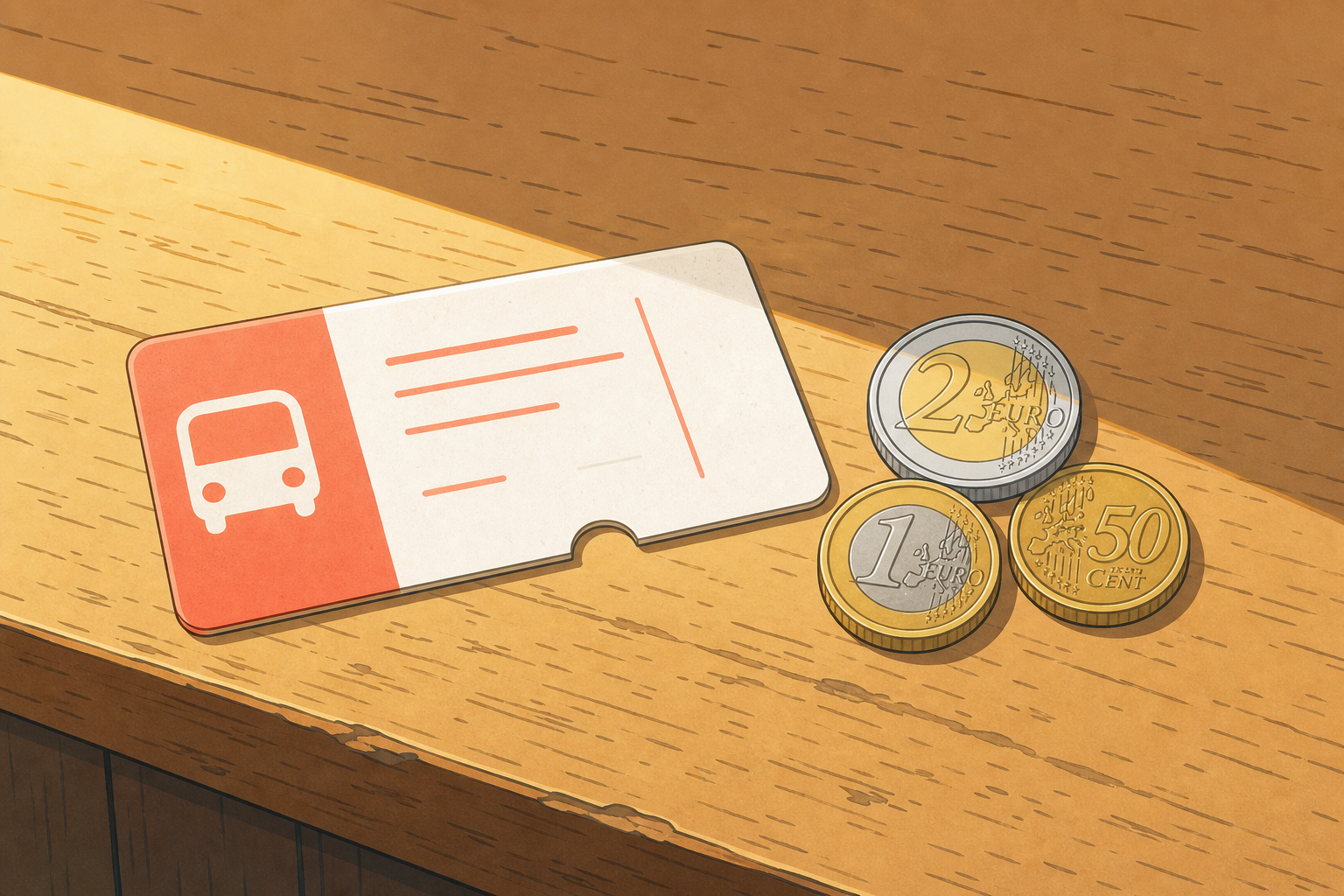
Imagine a day out. The bus leaves at 10 o'clock and the fare is €2. That little plan has a time question hiding in it and a money question hiding in it.
Which part of the day out is about the clock, and which part is about the money?
Take two or three hands-up answers, not open call-outs. Give a few seconds of quiet think-time first.
Draw out that the same short sentence carries two different maths jobs — when the bus goes and how much it costs. That split is the whole point of today's lesson.
Today we look at problems that mix time and money. Each part gets the right tool: the coin tray on the board for the money, and a clock face at the front for the time.
First watch two money amounts shown on the tray. One is a bus fare, and the other is the change from €2 for a roll. Then we turn to the real clock at the front and count on one hour, from two o'clock to three o'clock. Notice how each tool answers only its own part of the question.
Work each tray live at the board. For the first tray (€1.50), point at each coin as the class tallies aloud — one euro, one euro fifty. For the second tray, model change as counting on: build the roll's €1.40, then add coins one at a time up to €2, saying each step aloud (1.40, 1.50, 1.60, 1.70, 1.80, 1.90, 2.00) so the class sees the 60c grow rather than appear finished.
Then step across to the real printed clock at the front. This clock part is a physical aside, not on the screen: read the finish time and count on one hour, from two o'clock to three o'clock. Hold out for pupils to name which tool answers the money part and which answers the time part.
Today we build these on the tray at the board. A volunteer builds each one while the rest of us agree the total aloud. Say each total, then check it on the tray:
Talk this one through together — pupils take turns at the board and the class agrees or corrects out loud.
Watch for the euro-crossing moment: 30c and €1 make €1.30, but 60c and 50c make €1.10 (the cent part rolled past 100 into the euro). Ask the class to predict where the euro part changes before the tray is checked.
For the change build, insist on counting on from €1.75 up to €2, coin by coin, rather than subtracting.
In your maths copy, answer three mixed review questions the teacher displays: one is a clock reading, one is a total, and one is a change sum. Show your working for each one.
Display one clock face, one "price + price = ?" total, and one "cost, paid, change" sum. Walk the room glancing at working — this is whole-class copybook practice, not marking. Watch that the change sum is worked by counting on, and that totals keep euro and cent lined up.
First we read the clock at the front together. Look at where both hands sit, name the time, then we move on.
After that we work through these together, each a step harder:
Before the list, set the printed clock to quarter past 4 and work one full read with the class. Point: minute hand on 3 (that is 15 minutes, a quarter of the hour), hour hand just past 4. Class says quarter past 4 together. Slip to watch: pupils reading the hour hand as 5 because it has moved past 4.
Then the practice round, pupils take turns and the class confirms before moving on. Keep it brisk. Money parts run through the word-problem interactive. Clock/time parts stay on the printed clock at the front, not on screen. Keep the clock beside the tray so the class can point to which tool answers which part.
Final question is the two-part one: time answer (1 hour) AND change answer (€2.50 from €5). On change items the interactive expects subtract; pupils can still count on to work out the answer first.
You're previewing this lesson. Get full access to this lesson and hundreds more — each one ready to teach, with interactive activities, printable resources and pupil progress tracking built in.