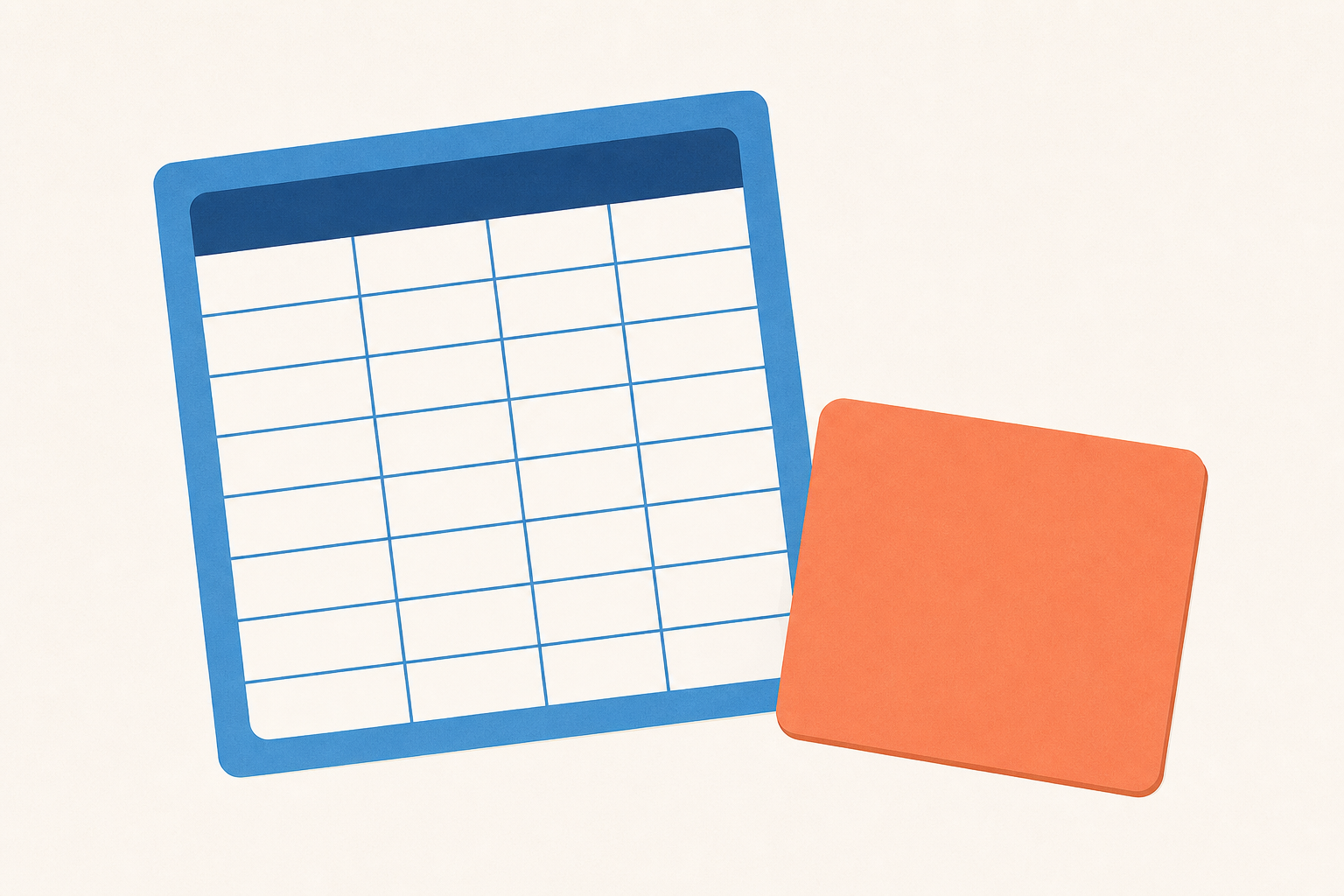
Here is an example train timetable and a ticket card side by side. The card says: Train ticket €18, 20% early-bird off if you arrive before 12:00. One problem today will use both. First, the elapsed time: the 09:00 train from Cork takes 2 hours 35 minutes. What time do we arrive?
Take three hands-up answers, not open call-outs. Give five seconds of quiet think-time first.
Listen for whoever tries to count up rather than subtracting the digits. The count-up route goes on to 11:00 first. Then thirty-five minutes more to 11:35. Flag that as the safe route for today.
Watch an example timetable for the Cork to Dublin Irish Rail route on the board. Next to it is our ticket card: €18 ticket, 20% early-bird off if you arrive before 12:00. We will resolve one clue, then use its answer inside the next clue. First: which service leaves and arrives, and how long is the journey? Then we check the arrival time against the card and knock the sale off the fare.
Point to the depart cell and the arrive cell as the class reads them. Model the count-up on screen: from 07:00 count on to 09:00, then thirty-five minutes more to 09:35, so the journey is 2h 35m. Do not say the answer to the ticket clue before the class works it. Hold out for which number carries forward.
Say the move aloud once: the arrival time from clue one is what tells us whether the early-bird fare applies in clue two. That carry-forward is the whole point of the lesson.
Today we work through this clue chain together on the board. First, find the arrival time of the 09:00 service into Heuston. The timetable prints the arrival, so read it off, then count up to confirm the 2h 35m journey. Next, check that arrival time against our card on the board: arrive before 12:00 = 20% off. Then take the €18 fare, knock the 20% off, and work out the change from €20. We name each carried-forward number aloud before we use it.
Talk this one through together. Pupils take turns at the board and the class agrees or corrects out loud.
Individual pupils tap the depart and arrive cells for the 09:00 service. The class reads the arrival (11:35) and counts up to confirm 2h 35m. Point to the card: 11:35 is before 12:00, so the early-bird fare applies. Then move off the board to the money working: 20% of €18 is €3.60, so the fare is €14.40, and €20 − €14.40 = €5.60. Hold each pupil to stating which earlier answer they are feeding into the next step.
In your maths copy, work each clue in turn. Show your time calculation, then your money working, and carry the answer forward to the next clue. Draw a short line between clues so it is clear which number you passed on.
Walk the room glancing at whether each pupil has carried the right number forward. The commonest slip is starting clue two from the marked price instead of from the arrival-time decision. No individual marking; this is whole-class copybook practice.
Today we crack a five-clue mystery together. Keep every answer ready, you may need an earlier one again:
For this challenge: tickets used before 18:00 get 20% off (early-bird fare). Say each carried number aloud before you use it.
This is the practice round. Pupils take turns at the board, check each answer, and the class confirms before moving on. Move clues 1 to 4 briskly and save your full working time for clue 5, which chains a time result with the arrival from clue 1.
The clue bank rises in demand: clue 1 is a single elapsed-time count, clue 5 chains a time result with the earlier arrival. Watch for pupils who compute each clue correctly but plug the wrong earlier answer into the next one. Revoice which number carries forward at every step.
You're previewing this lesson. Get full access to this lesson and hundreds more — each one ready to teach, with interactive activities, printable resources and pupil progress tracking built in.