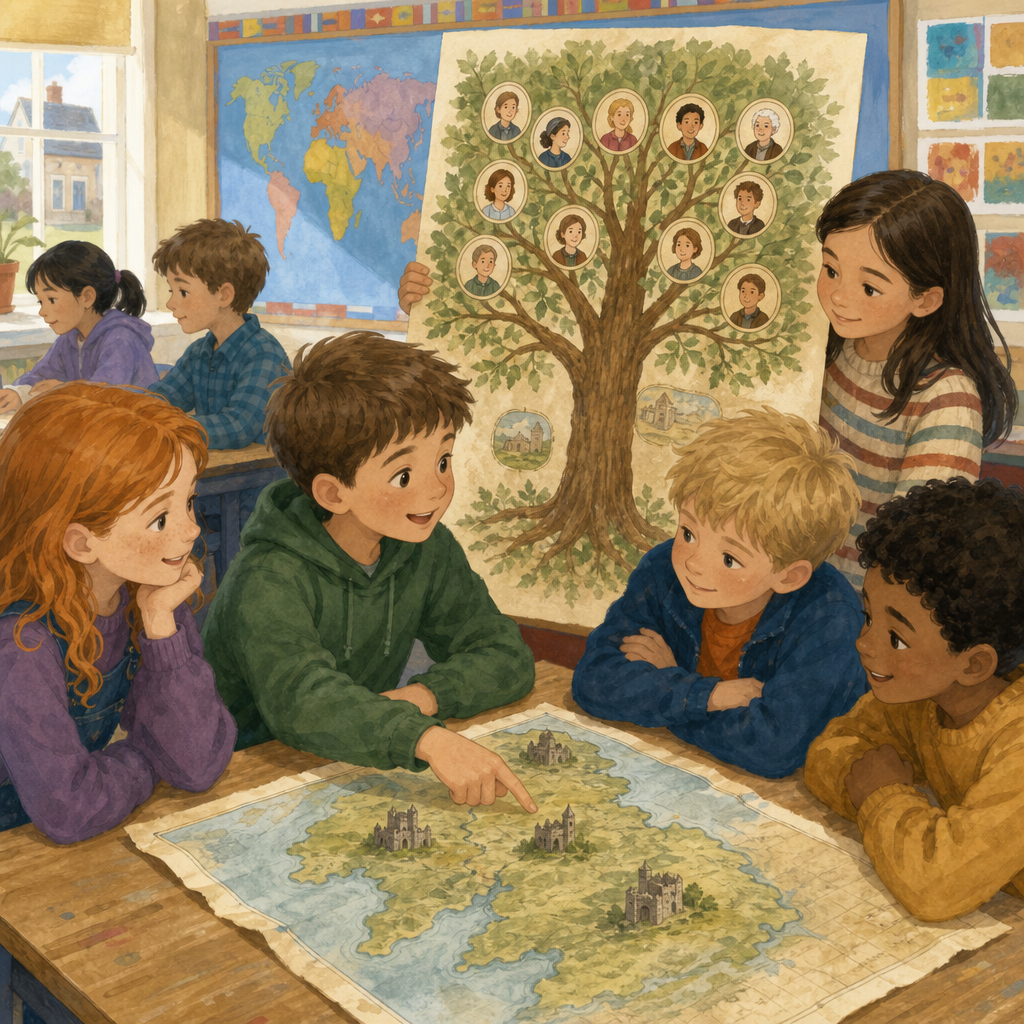
 Some surnames hide a tiny message: child of.
Meet three pieces first:
- mac (MAK) — son of
- Ó (OH) — grandson of
- -son (as in Johnson) — son of
Who can spot Mac, Ó or -son in a surname on the board? Call it out when you see one.
Stretch if you notice extras later: Fitz, -ez, -ski. Same job, other languages.
By the end of this lesson, you will be able to:
- Spot Mac, Ó and -son and say what they mean
- Open a fort name and find the person still inside it
- Think about what your own surname once meant
Names hide secret pieces. A fort is always somebody's fort.
Place names squeeze meaning into short bits the same way surnames do. Each name on the board comes apart into pieces, and one of those pieces is usually a person.
Tap each place, watch the name come apart, and find the person still sitting inside it. After the first reveal, whisper to your partner: person piece or landscape piece?
You are language detectives again, same skill as names, different words.
Worked example first: school / scoil — both grew from the same old idea of a place of learning. True cousins.
Now sort each pair: thumbs up if they are true cousins (shared root, same job), thumbs down if they are false friends — words that look alike but grew from different roots, so the likeness is an accident. Classroom words travel further than you think.
Open your copy. Write these three name-parts carefully, with every mark:
- mac (son of)
- ó (grandson of)
- dún (a fort)
Then write your own surname and what you think it once meant. If nobody knows, write who you would ask.
💬 Discussion time
Many surnames once named a job or a family line. Smith once meant someone who worked metal. Murphy links to an Irish family name. Mac and Ó still mean child or grandson of someone. Fort names still carry a person who held the land.
Pick one of these lines and finish it, so we talk about the idea rather than anyone's private family detail:
- I would keep a job-name like Smith because… / I would change it because…
- Would you rather a name told a job, a place, or whose child someone was?
- Why might people keep a name long after the job or the fort has gone?
Unlock the full learning experience
You're previewing this lesson. Get full access to this lesson and hundreds more — each one ready to teach, with interactive activities, printable resources and pupil progress tracking built in.
This lesson is copyright of Coding Ireland 2017 - 2026. Unauthorised use, copying or distribution is not allowed.