Close your eyes for a moment. What can you still hear? Now wiggle your fingers. What are your hands good at?
Today we find out the special jobs our body parts do.
Keep this light: one curiosity beat only. Cup your ear, then wiggle your fingers. Ask two quick questions and take two or three answers. Do not hand out cards or name every body part yet.
Key question: What is one thing your legs help you do?
Have the body-part and job card packs ready for later, but keep them out of sight for now.
Today's word: job — what a body part is for.
What job do you think your ears do? What about your legs?
Teach the one idea on the board in child language, then use the table yourself. Do not put a second definition block for "match" on the board; children learn matching by doing when you show the ears and hearing cards with your hands.
| Concept | Why it matters | Example |
|---|---|---|
| Job of a body part — what that part is for | Knowing the job helps us look after our bodies and notice when something feels different | Ears help us hear the school bell; legs help us walk to the yard |
Worked model (say aloud before the carousel): Hold up the ears card and the hearing card. Point to your own ears. I wonder what my ears are for. I think their job is hearing. I cup my ears… I can hear the clock. So these two cards go together: ears with hearing. Then model one more with legs and walking (take three steps). Matching is the skill they practise, not a second vocabulary word to memorise.
Misconception to head off: children may say one part only does one thing forever ("hands only hold"). Gently accept the main job for today, and note that some parts help in more than one way (mouth can eat and talk).
Nature of STEM weave: a county GAA player practises so their legs can run and kick; an Irish dancer practises so their feet can point and spring. People train body parts for special jobs, just as we practise using ours.
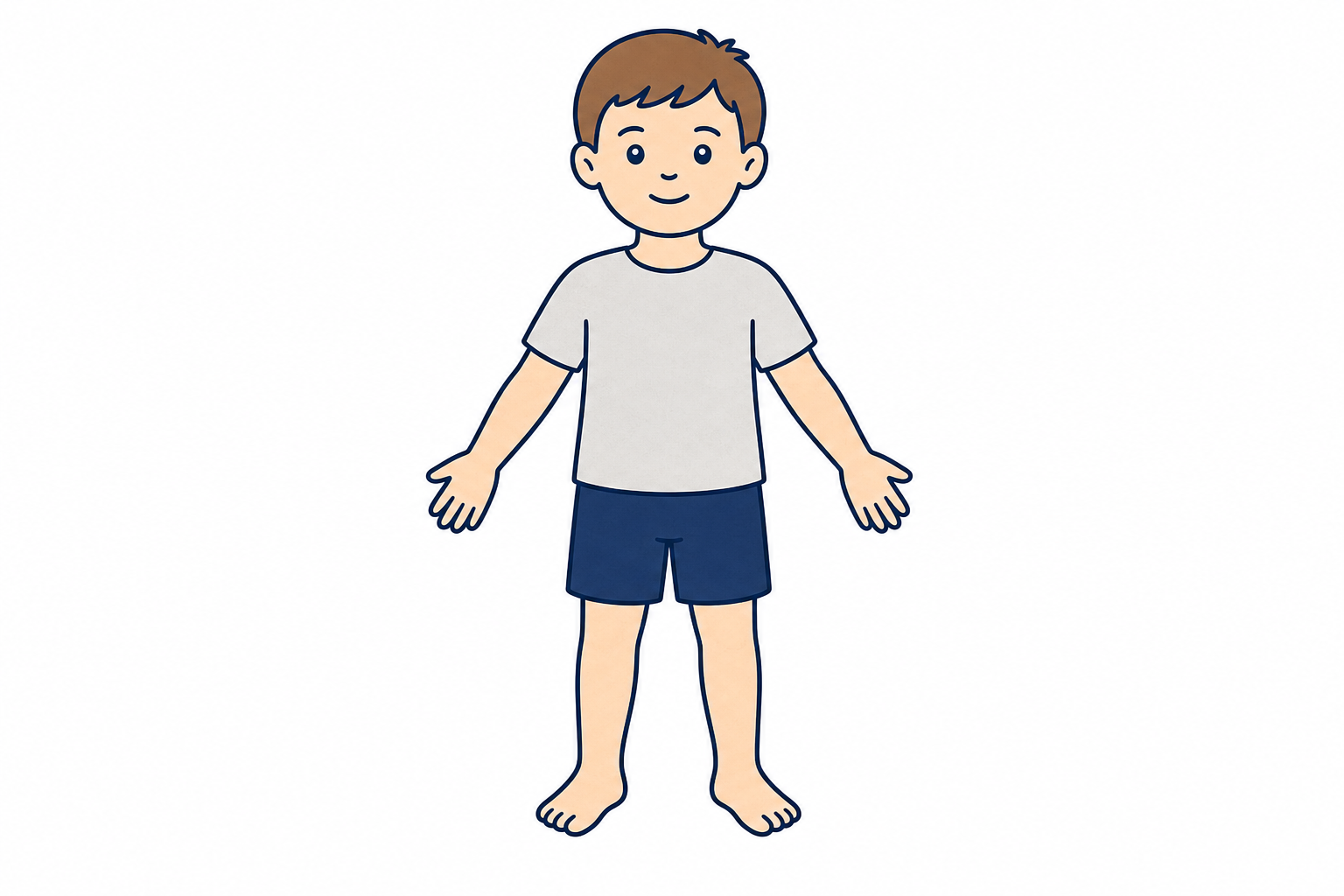
Look at the child figure on the board. Help put the five labels in the right places: head, arms, hands, legs and feet.
Eyes, ears and nose live in our head. When we name a job like hearing or seeing, point to the head on the figure, then point to that part on your own face. For other jobs, point to the part on the figure and on your own body.
Open the interactive activity on the IWB in explore mode. Labels start off the figure. Work as a class: invite children to say or show where each label belongs, and place it together. Once the five labels are on, keep the figure as your shared map while you name jobs and the class points on their own bodies.
Landmark rule (say before any job): Eyes, ears and nose live in our head. When I say hearing or seeing, point to the head on the board, then to that part on your own face. Do not treat "head" as the match for hearing, seeing or smelling; head is only the home of those sense parts.
Arms today: Arms stay on the figure so children can place and point for reach and lift. Say once: Arms help us reach and lift — we practise pointing here. Our picture cards next will focus on ears, eyes, hands, legs and feet. Arms do not appear in the carousel or match set.
Walk-through (keep it brisk once labels are placed):
Ask after each: What job is that part doing? Fold the whole class in: if one child answers, ask the others, Do you agree? Show me on your body.
Bridge to the next step: Next we will meet picture cards for ears, eyes, hands, legs and feet, and show each job with our bodies.
If the interactive is unavailable, draw or point on your own body and have the class mirror you; the later card sort still carries the lesson.
We move around five action spots. At each spot, look at the body-part picture, show its job with your body (like pretending), and say the job out loud. Your teacher will show the first action.
Listen for the signal before you move to the next spot.
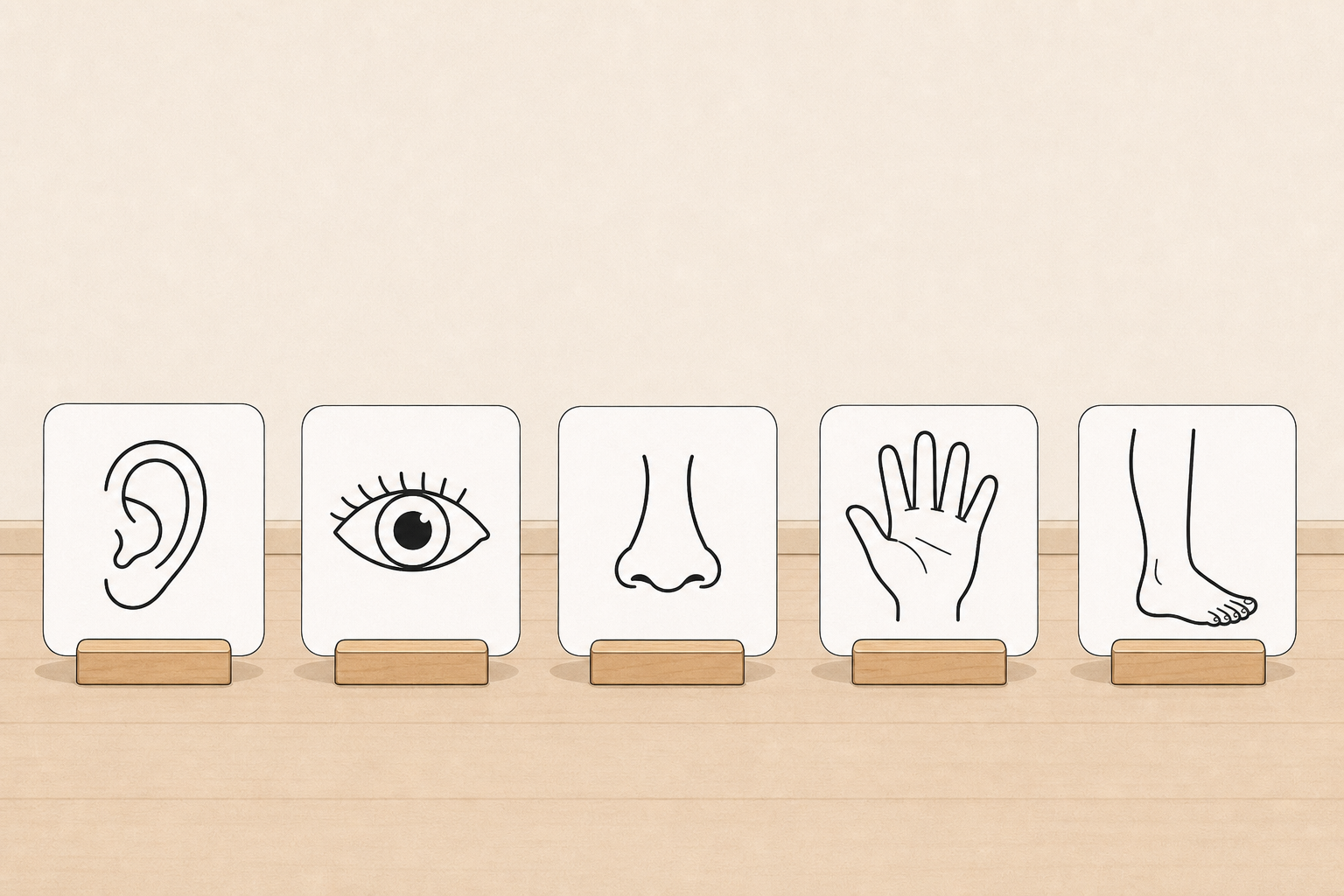
Print the provided carousel body-part picture cards (one shared class set of five). Set five floor spots in a clear space, one card face-up at each. Keep paths clear of bags and chairs.
Card: ears — picture of ears. Job to show: cup hands behind ears and listen.
Card: eyes — picture of eyes. Job to show: peep through finger-circles like binoculars.
Card: hands — picture of hands. Job to show: pretend hold a cup or clap once softly.
Card: legs — picture of legs. Job to show: march on the spot (walking/running).
Card: feet — picture of feet. Job to show: stand tall with feet flat, then tip-toe three steps in place.
These five parts are the ones children will meet again in the match (four core pairs at the tables; feet is the carousel stretch they may draw later).
Model the first spot yourself so every child sees what "show the job with your body" looks like. Split the class into small groups at the five spots. About one minute per spot, then a clap or chime to rotate. You stay central and call the job name if a group is stuck: Ears… hearing!
Pacing lever (use if six minutes will not cover a full circuit): Model one spot, then run only two or three rotations so each group visits two or three cards rather than all five. You can also keep all five cards out but send fewer groups (e.g. three groups sharing nearby spots) so transition time stays short. The goal is every child shows at least two jobs with their body, not that every group hits every card. Prefer fewer solid rotations over a rushed full circuit.
Observation prompts while you circulate: Which part are you using? What is its job? Show me without saying the word.
Safety: gentle actions only; no running between spots; keep hands away from other children's faces.
Differentiation: less confident children copy your action first; confident children can name a second job the same part might help with (legs: walking and running; feet: standing and walking).
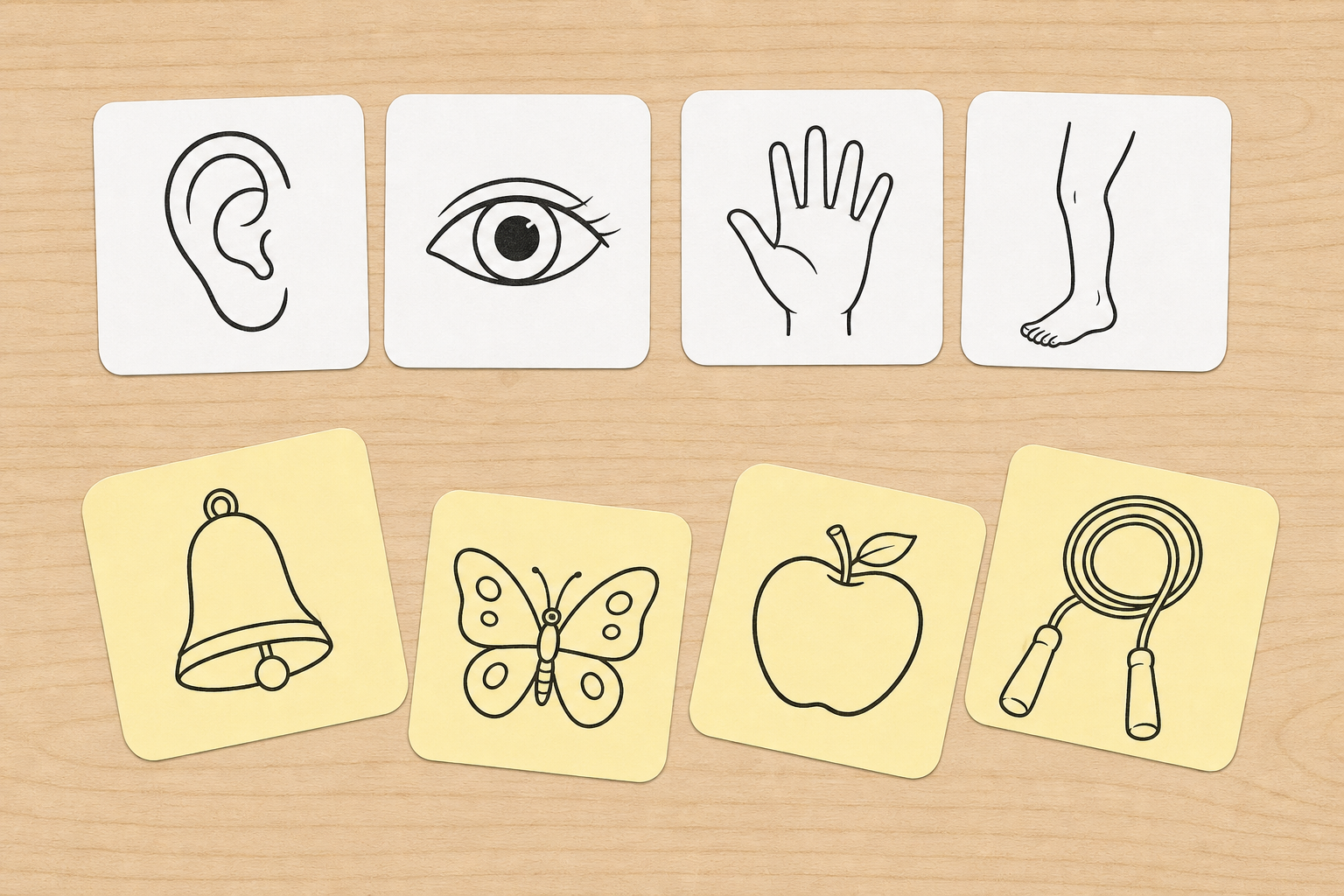
On your table you have four body-part cards and four job cards. Start with one body-part card you know. Find the job card that belongs with it.
When your pair is ready, say the match: Ears are for hearing.
Print the provided match card sets: one mixed set per pair or small group (4 body-part + 4 job cards), plus 1 spare set. Shuffle so parts and jobs are not pre-paired. Lay each set face-up in two loose piles (parts pile and jobs pile) so children are not hunting through one huge mixed heap.
Body-part cards (picture plus short label): ears · eyes · hands · legs
Job cards (picture plus short label): hearing · seeing · holding · walking
Main matches for today's sort: ears — hearing; eyes — seeing; hands — holding; legs — walking.
Accepted thoughtful alternates (do not mark wrong if the child can say why): legs — walking (also running or standing); hands — holding (also touching or clapping). Steer each pair to one clear main match for the spoken sentence.
Model one pair on the IWB or floor first using the ears and hearing cards: Ears are for hearing. Then say: Pick one body-part card. Find its job. Then do the next.
As pairs finish, ask one child from a pair to hold up a match for the class. Ask the watchers: Are they right? How do you know? Fast finishers may draw feet with standing on their journal page (they met feet at the carousel).
On your Investigation Journal page, show one body part matched with its job.
Draw the part and the job. If you like, add a word or label.
Pupils record on the Investigation Journal page. You do not design the page layout; just tell them what to show: one clear match they are sure about (body part and its job).
Sentence stem to say aloud (not write unless ready): My ____ are for ____.
Circulate and scribe an emergent label only if a child asks. Celebrate drawings that show the match, not perfect spelling.
This beat stays in the lesson (about 5 minutes). Do not send the journal page home.
Fast finishers draw a second match on the same page (for example feet and standing from the carousel) or show their match quietly to a partner with their body.
Let's share. Which body part and job did you match? Point to it on your body as you say the job, like My hands are for holding.
Our legs and feet work hard when we run, kick, and dance — who helps us look after bodies that do those jobs?
Display-only oral talk. Keep almost all of the three minutes on two or three pupil matches. Invite children to stand, point to a part, and say its job. Revoice clearly: So Maya's hands are for holding. After each share, ask the class: Do you agree? Show me on your body. How do you know?
Draw out: different parts do different important jobs; saying the match in a full sentence is enough success for today.
One short link after the shares (not a second question thread): Our legs and feet work hard — a county GAA player runs and kicks; an Irish dancer points and springs. Who helps us look after bodies that run, kick, and dance? Accept doctor or physio in one breath, then stop. Do not open a careers discussion.
No typing and no extra written reflection.
Body parts have jobs. We matched parts to jobs and showed one match in our journal.
Cards in the pack, journals closed, gentle feet back to the carpet.
Collect card sets into labelled envelopes for next time. Quick check: every pair returns both body-part and job cards from the match set; collect the five carousel cards separately.
Optional home noticing (oral only): Tonight, notice one job your hands do at home and tell an adult. No worksheet, no journal page, and no screen task.
You're previewing this lesson. Get full access to this lesson and hundreds more — each one ready to teach, with interactive activities, printable resources and pupil progress tracking built in.