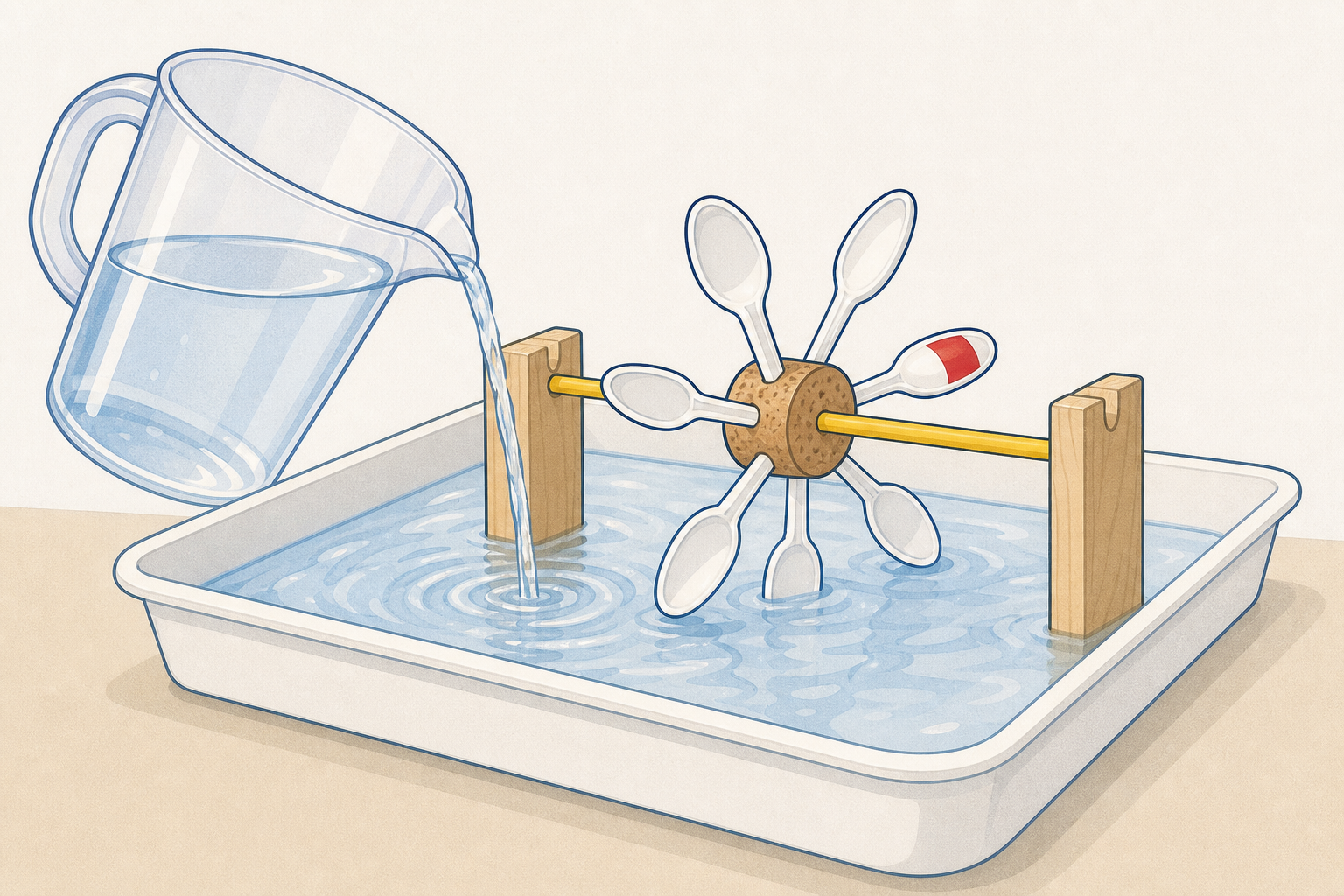
 I’m going to pour this jug of water into the tray. Listen and watch what happens when the water moves.
Hands up: can moving water do a real job, or does it only make a splash? Could moving water turn a wheel?
 You saw moving water push its way across the tray. That push is the force of moving water.
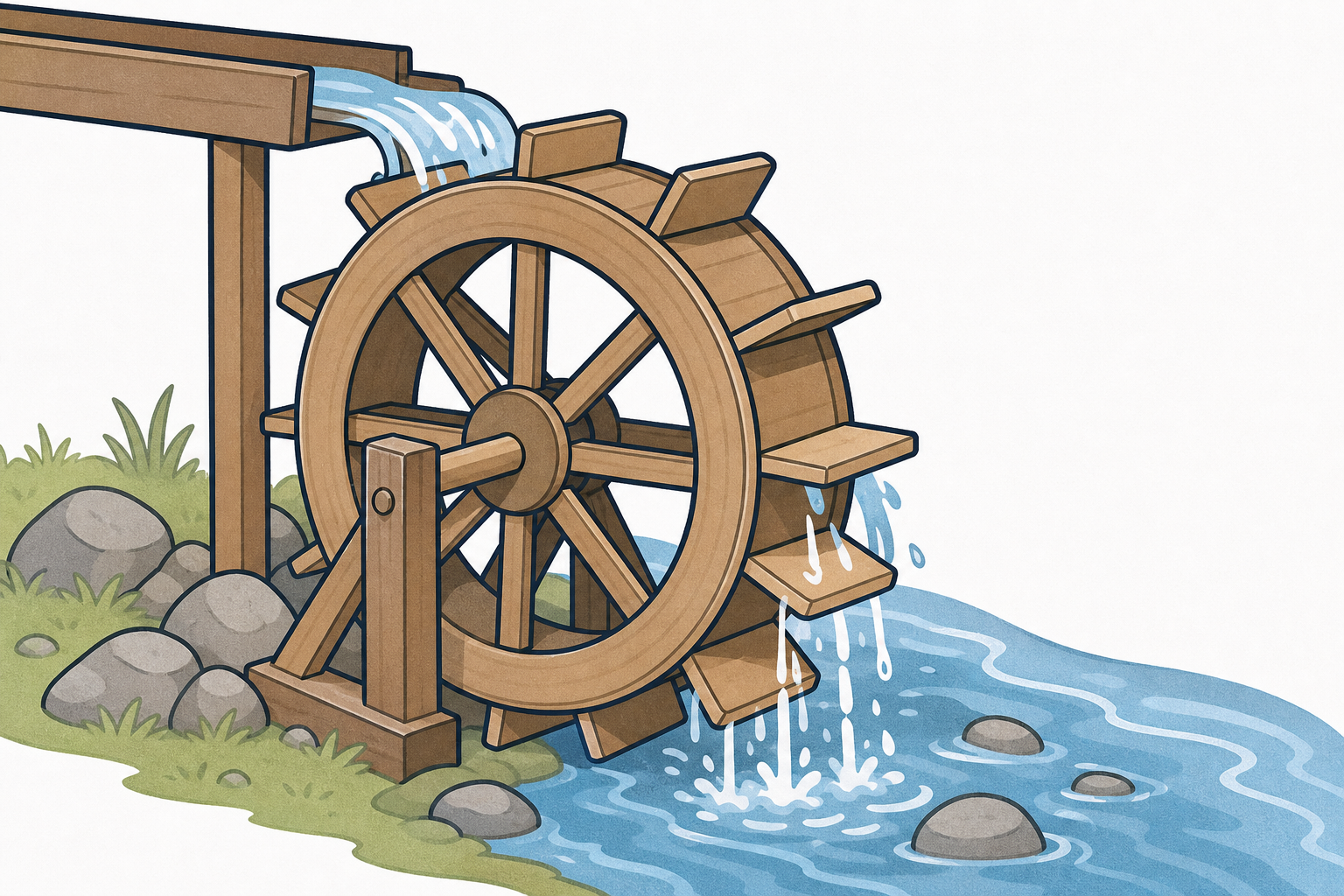
A water wheel is a wheel with paddles that catch that push and turn. The moving water pushes the paddles (a force). That push transfers energy to the wheel so it spins and can do a job.
Later we’ll link the same idea to real power stations in Ireland. If we build a small wheel, what one thing might we change to make it spin faster?
Your group will build a simple water wheel that can spin on a tray.
The hub is the cork or bottle cap at the centre of the wheel, the part the paddles stick out from. The axle is the thin stick or straw the wheel spins on. Build in this order: fix the paddles evenly around the hub, slide the hub onto the axle, rest the axle ends on two supports over the tray, then check it spins with a gentle finger push.
Mark one paddle with a small piece of sticky tape so you can count full turns later.
Success looks like this: when you pour water onto the paddles, the wheel turns. Test with a short pour, then stop and wait for the plan step before you change anything.
 We want to find out what makes our water wheel spin faster. First we sort the six labels on the board together as a class model: call out Change, Measure or Keep the same for each one.
The class model changes pour height and counts the turns in 10 seconds on the class timer.
Then your group chooses for real: pour height or how strong the flow is. On your Investigation Journal page, write your prediction and what you change, measure and keep the same.
What makes the water wheel spin faster?
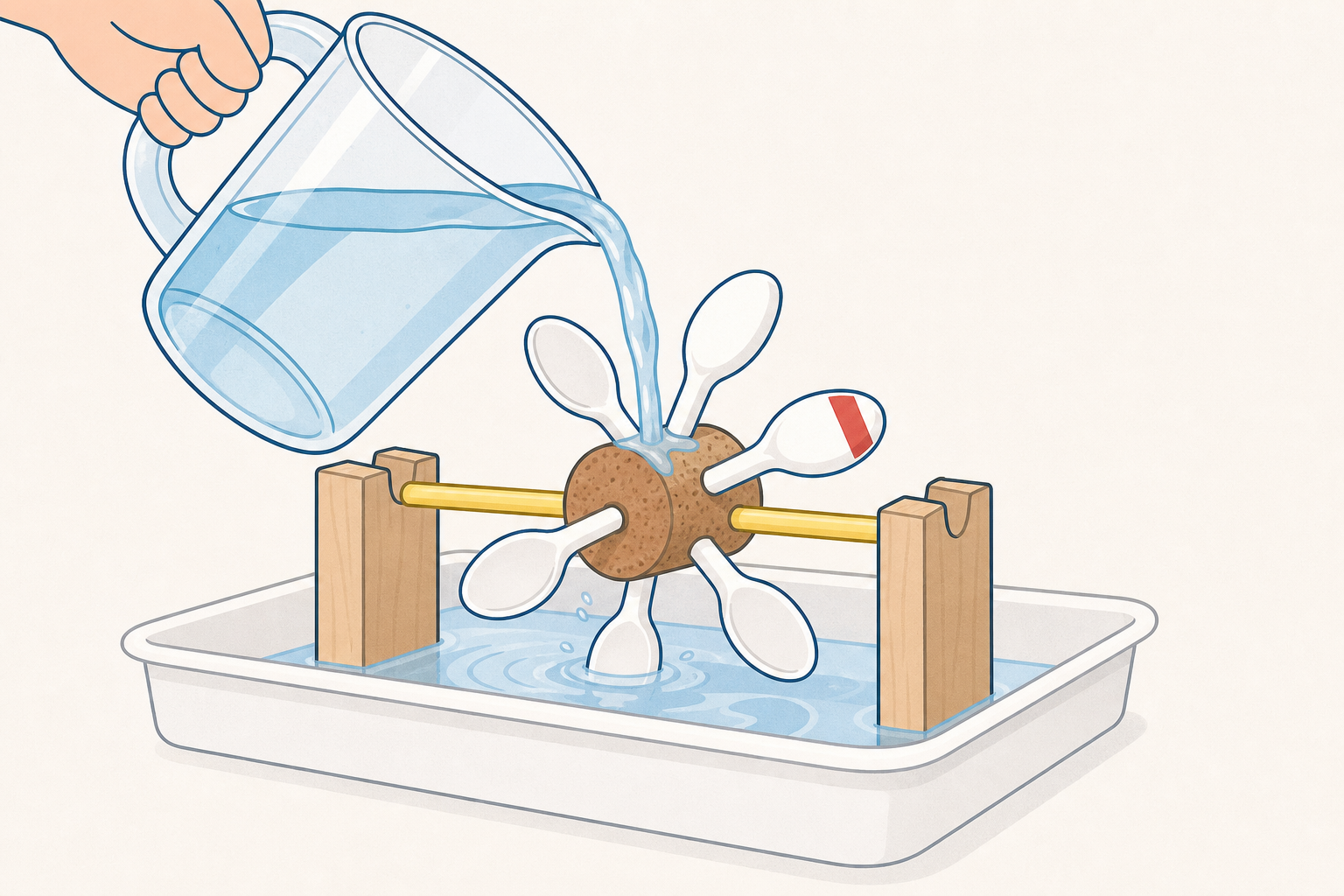 Run the fair test your group planned, changing only the one factor you chose and keeping the wheel, the jug and the counting time the same. Count full turns of your marked paddle, and do each setting twice.
The teacher will run short shared 10-second countdowns on the board. Pour only when your tray is ready for that countdown. If you miss a round, wait for the next one. Cover these jobs in your group: pour, count turns of the marked paddle aloud, watch the shared timer, and record. If your group is not four people, double up or share a job.
While another group is pouring, watch and be ready to say whether their test still looks fair.
Unlock the full learning experience
You're previewing this lesson. Get full access to this lesson and hundreds more — each one ready to teach, with interactive activities, printable resources and pupil progress tracking built in.
This lesson is copyright of Coding Ireland 2017 - 2025. Unauthorised use, copying or distribution is not allowed.